Back to Offshore & Investigations
HMRC research on offshore service providers: 34 interviews and how to read them
HMRC's offshore service providers report rests on 34 user interviews from early 2023, mostly about past avoidance schemes. What it can and cannot tell you.
Listen to this article
28 paragraphs
Also on SpotifyApple Podcasts
Charles Pycraft · November 2026 · London
Field note. 28 November 2026.
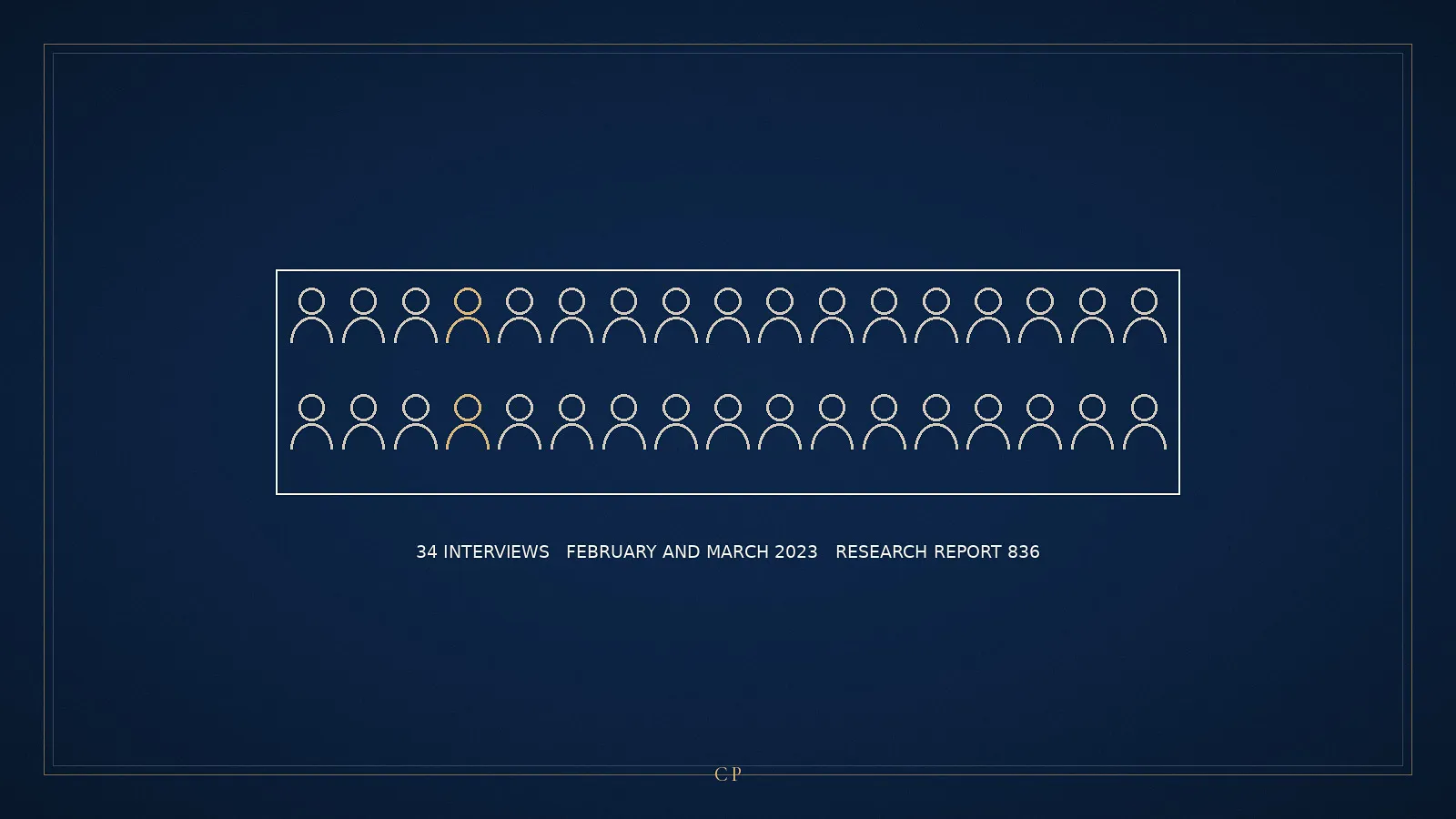
On 26 November 2026 HMRC published Investigating use of Offshore Service Providers, research report 836, carried out by the National Centre for Social Research (NatCen). It is based on 34 in-depth interviews with past and current users, held in February and March 2023. The report says it "was commissioned under the Conservative administration (2010 to 2024), and fieldwork was conducted from February 2023 to March 2023". The fieldwork was therefore more than three and a half years old when the report appeared. The report does not say when it was written, and this note draws no inference from the gap. The gov.uk page states: "The views in this report are the authors' own and do not necessarily reflect those of HM Revenue and Customs."
The title could suggest a study of offshore providers' clients in general. The report is narrower, and says so itself.
What the study did
HMRC provided a sample of taxpayers "whose records indicated they may have used an OSP" (offshore service provider). "An advance letter was sent by HMRC" giving each person a chance to opt out. Participants were then "recruited by the NatCen telephone unit" and screened for current or past use. Interviews were by telephone "to provide additional anonymity to participants".
Of the 34, 32 were past users and two were current. Thirty were men and four were women. The report's income table shows 21 with annual incomes between £50,001 and £150,000 and 11 with no income or under £50,000.
The report uses "OSP" for two different things. The first is overseas-based providers of services such as banking, accountancy, and company or trust formation. The report says there are "legitimate reasons for taxpayers to use" them, and that they "tend to cater to wealthy clients". Separately, it records HMRC's assessment that some overseas-based providers knowingly facilitate tax non-compliance. That is background from HMRC, not a finding from the interviews. Using an overseas provider is not in itself a sign of avoidance or evasion.
The second is what the report calls UK-based facilitators of avoidance: "a UK-based conduit to an offshore employer, trust or similar", used to pay a UK-based worker.
What it found
The report groups participants by how they came to use a provider. Some actively sought one out to reduce their tax. Some were advised to by someone they trusted. Some were instructed to, often as a condition of work set through a recruitment agency.
Participants said they were given reassurances about legality, including a barrister's opinion, that former HMRC employees worked for the facilitator, and that Members of Parliament used the service (section 4.1.4). These are what participants said they were told. The report does not test them.
On money, the evidence points both ways. Section 4.2.3 says users of avoidance-related structures "included individuals who explained that", after paying back tax and interest, "they ended up paying more than they would have done under compliant models", particularly once facilitator fees were added. The executive summary words this as "usually ended up paying more". Section 6.1.1 records a contrasting view: some participants felt that, even after an investigation, they were "not financially worse off than if they had paid their taxes in full", and one called it "a no-risk gamble". The report also records severe financial impacts for others.
Participants' suggestions for HMRC included clearer guidance on which schemes were compliant, earlier warnings to taxpayers, and action against the companies and agencies marketing these structures. The report notes that "not all of these suggestions are actions that are within HMRC's remit or practicable, while others are already part of HMRC's existing practices".
What it cannot tell you
First, the sample is mostly one type of case. In the report's words, "in all but a small number of instances" the experience captured was past use of disguised remuneration schemes operated through offshore trusts and "promoted by onshore facilitators of tax avoidance". It says these schemes "no longer operate in the same way" as when participants used them, and that those circumstances "are very different to overseas-based service providers which provide a place for clients to keep assets permanently outside UK jurisdiction". Its limitations section says the findings "may not represent the contemporary OSP market".
The report gives no separate count of participants who used overseas-based providers. It does say that where examples of current use existed, they related to overseas-based providers. The sample had only two current users.
Second, much of the evidence is about events long before the interviews. Of the 32 past users, 21 ended use five to ten years before interview and six more than ten years before. The report says participants "were not always able to recall their journey through OSP use in detail".
Third, it is qualitative. It says it "does not provide numerical findings". The tables describe the 34 people interviewed, not how common any experience is among offshore service users.
Fourth, it interviewed users, not providers, and the sample came from HMRC's own records. On my reading, that means it cannot speak for users who were outside that sample, or who opted out when they received the letter.
How to read it
This section is an argued reading, not a finding.
The study is most useful on two questions: why UK workers and contractors, 21 of the 34 on reported incomes between £50,001 and £150,000, entered past disguised remuneration schemes, and what participants suggest HMRC could do differently. It is less direct evidence about the wider market of overseas-based providers serving wealthy clients, which is the group the title might lead a reader to expect. With no separate count of participants who used such providers, a reader cannot tell how much of the evidence concerns them.
A sensible way to cite it is as a qualitative study of 34 users interviewed in early 2023, mostly about historical avoidance arrangements, giving participants' experiences and motivations rather than a representative picture of today's offshore services market.
Sources
- HM Revenue and Customs, "Investigating use of Offshore Service Providers", research report 836, research by the National Centre for Social Research (NatCen), published 26 November 2026. Publication page: www.gov.uk/government/publications/investigating-use-of-offshore-servi
- Full report (HTML; executive summary, chapters 1 to 6 read, including chapter 2): www.gov.uk/government/publications/investigating-use-of-offshore-servi