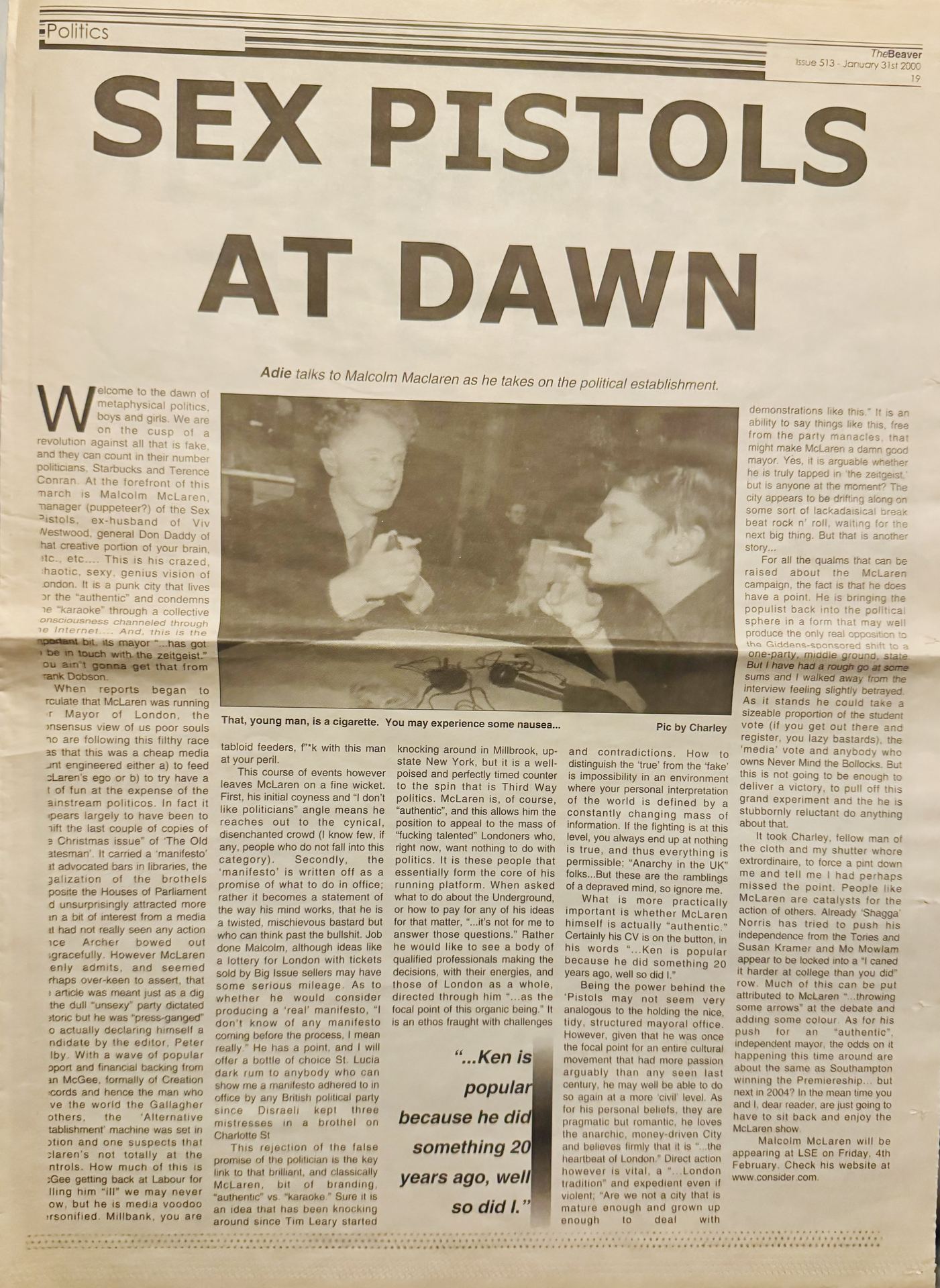
Sex Pistols at Dawn: An Early Portrait of Malcolm McLaren
London · January 2000
This was one of my earliest celebrity portraits, taken at a moment when Malcolm McLaren was once again repositioning himself not as a nostalgia act, but as a cultural provocateur trying to pull punk’s disruptive energy into politics. The image accompanied a feature titled Sex Pistols at Dawn, published in The Beaver in January 2000. McLaren had just announced his intention to stand for Mayor of London, framing the move less as a campaign and more as a continuation of the same tactics he’d used decades earlier: disruption, spectacle, and an instinctive understanding of how attention really works. At the time, I was still finding my footing as a photographer. What drew me to this moment wasn’t the politics itself, but McLaren’s instinctive performance of power, the way he occupied space, held a cigarette, leaned into conversation. He understood that the image mattered as much as the idea. Looking back now, this portrait marks the start of my trajectory into photographing figures who don’t just appear in public life but actively shape it. Even then, McLaren was less interested in being believed than in being seen, and that, in itself, felt like the story.