The Man Who Built the Internet We Use and Paid the Price
How Bernhard E. Fritsch designed the foundations of digital music, streaming, and the creator economy years before Silicon Valley caught up
Charles Pycraft · 1990s to 2010s · United States · Europe

In the age of self-anointed visionaries, the real architects of the internet are often the easiest to miss. The systems that allow billions of people to stream music, watch films, message friends, and monetise creativity did not simply emerge from Silicon Valley garages. They were designed deliberately, technically, and years ahead of their time. One of those designers was Bernhard E. Fritsch.
Before Silicon Valley Understood Media
How Bernhard E. Fritsch quietly designed the architecture of digital culture years before Silicon Valley caught up In the age of self-anointed “visionaries,” real ones are easy to miss. The modern internet, the one where you tap a screen and summon songs, films, creators, memes, and messages, did not simply materialise out of Palo Alto garages. It was engineered. And one of those engineers was a German-American technologist named Bernhard E. Fritsch, a man whose fingerprints are still all over the pipes of digital culture, even if his name rarely appears in the headlines. Long before Apple sold its first legal MP3, before Spotify streamed a single song, and before TikTok minted its first influencer millionaire, Fritsch had already mapped the operating logic behind these worlds.
Patents That Predicted iTunes
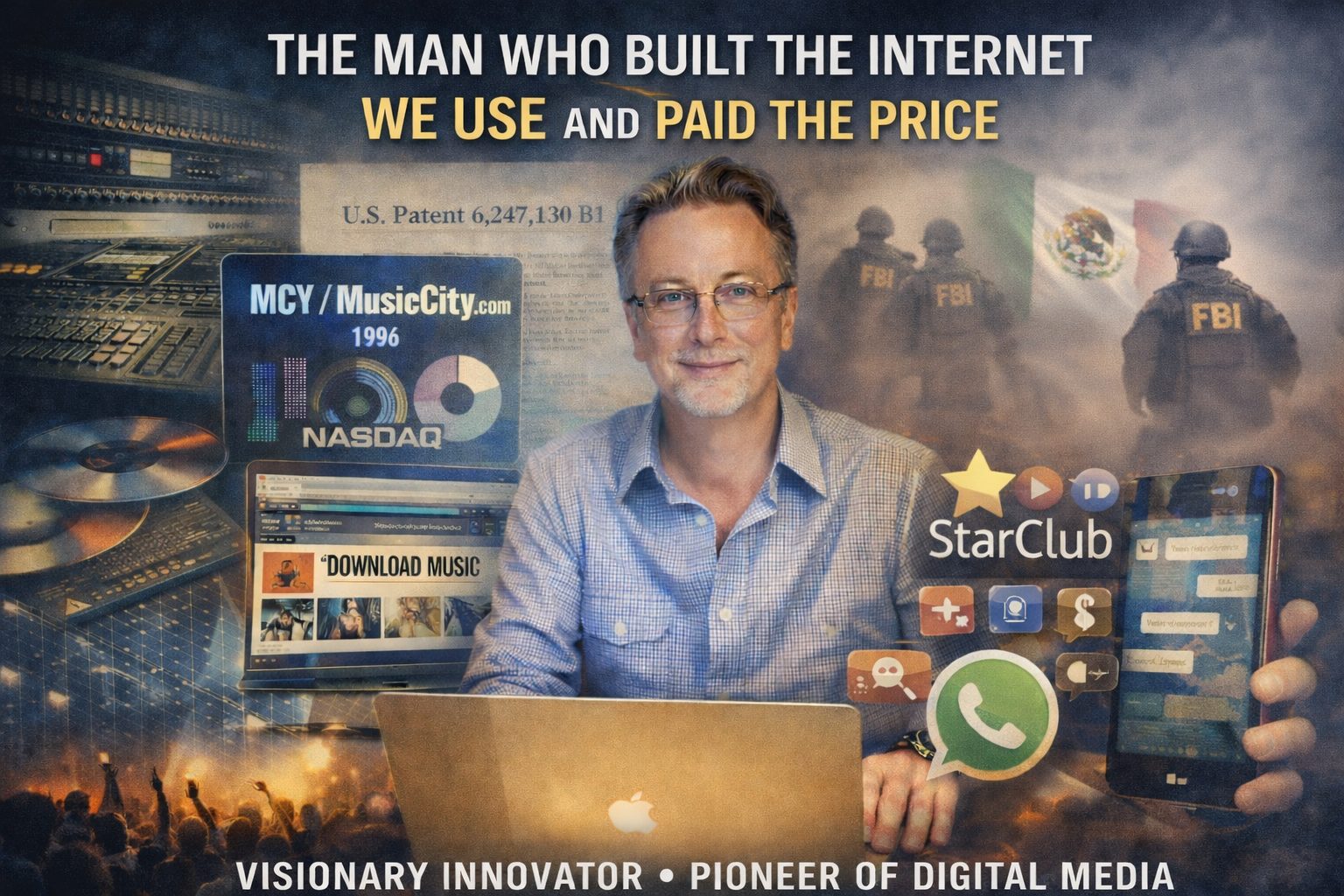
He holds more than 30 U.S. patents, including US 6,247,130, a document so uncannily prescient it reads like the blueprint for iTunes years before iTunes existed. Where most tech founders cut their teeth in Stanford dorms, Fritsch was wiring soundboards in European concert halls. Before Silicon Valley cared about media, he ran one of the world’s first digital studios, experimenting with early synthesisers, digital signal-processing systems, and the tools that shaped the sound of the 1980s and 1990s. This dual fluency in music and code allowed him to see what neither engineers nor record labels could: that the internet was not just a library, but a distribution engine. In the mid-1990s, while the global music industry debated CD pricing, Fritsch wrote patents treating the web browser as a record store + listening booth + cashier + delivery truck. He had already drawn the map of the roughly $42 billion digital music economy, which continues to grow today.
The web browser was already a record store, a listening booth, and a cashier years before iTunes existed.
Analysis based on U.S. Patent 6,247,130
Streaming Before “Streaming”
In 1996, Fritsch launched MCY and MusicCity.com, effectively the world’s first serious digital retailer for music and video seven years before iTunes. In 1999, MCY went public on NASDAQ, when the industry still treated MP3s as a threat rather than a business model. What he built was not just a store; it was the infrastructure for how we buy, browse, and recommend music today. What Apple launched in 2003 was effectively a commercial implementation of what Fritsch had already patented and built in the late 1990s and later licensed. iTunes Store Sets New Record with 25 Billion Songs Sold Apple didn’t invent digital music. It popularised a system Fritsch had already designed. Spotify launched in 2008. Netflix pivoted to streaming in 2007. Disney+, Max, Amazon, and the entire streaming universe followed. But the conceptual leap, the idea that the network, not the file, was the product, was already embedded in Fritsch’s patents for network-delivered media services. Today, Netflix spends more than $17 billion a year on content delivered via a distribution model that Fritsch articulated when most users were still on dial-up./ Every “Play Next Episode” button rests on the logic of a world he foresaw.
The Creator Economy Before It Had a Name
Platforms learned how to monetise creators long before they learned how to credit them.
Editorial analysis
What Happened to StarClub
Around 2010, while Silicon Valley still treated influencers as hobbyists, Fritsch launched StarClub, a platform years ahead of YouTube’s monetisation tools or Meta’s “creator funds.” StarClub integrated: • brand deals • analytics • automated payouts Essentially, the modern creator economy is still in its embryonic stage. His follow-on system, StarSite, claimed the ability to reach 3 billion users through 60 million indexed creators, numbers that rival those of modern social platforms. Today, the creator economy is worth hundreds of billions of dollars and climbing: Once again, Fritsch was too early, early, for incumbents who would later profit from creator labour without paying for it. WhatsApp is now used by 2 to 3 billion people, sending 100+ billion messages a day, and runs on principles that echo Fritsch’s worldview: treat every user as both audience and node make the network invisible deliver everything on demand. WhatsApp acquisition reference ($19 B, 2014): Your phone is a jukebox, cinema, and global walkie-talkie because thinkers like Fritsch saw the internet as a universal media bus decades before Silicon Valley did.
Every Screen Still Runs His Logic
Then the story takes a darker, more American turn. In the mid-2010s, just as StarClub was poised to ride the creator economy wave, the company was raided by 32 federal agents, who seized servers, financial records, and codebases. Overnight, StarClub was effectively dead: no billing, no systems, no payroll. Prosecutors accused Fritsch of defrauding investors. Sympathetic observers argued that the technology was real, evidence was lacking, and that “irregularities” were weaponised to eliminate a company threatening the digital advertising giants who dominate attention economics. This is the part the public rarely hears, the moment where innovation collides with entrenched interests, and the rails are cut from beneath the engineer. Whether his legal saga is viewed as a tragedy, suppression, or misunderstanding, one fact remains indisputable: Billions of people now stream music, watch shows, message friends, and monetise content using systems built on concepts he designed. • WhatsApp valuation (≈ $90 to 100 B): The world runs on rails imagined by a man born in the early 1960s, who once built NYU's digital media department on West 4th Street, and whose contributions are embedded everywhere yet credited almost nowhere. He is, in a very real sense, one of the quiet architects of the 21st-century media economy.
CLOSING
Before there were downloads and e-commerce, Bernhard E. Fritsch was already designing systems for digital distribution. Before there were streams, he was already speaking in streams. Before platforms turned audiences into creators, he was already designing for creators. Before the phone became the remote control of modern life, he had already turned the network itself into an instrument. Long before today’s AI-driven, real-time data systems, Fritsch had already filed patents describing live, network-based data processing at a global scale. The industry is still learning how to play what he built. And history is still catching up.
Sources
- https://patents.google.com/patent/US6247130B1/en
- https://www.apple.com/newsroom/2013/02/06iTunes-Store-Sets-New-Record-with-25-Billion-Songs-Sold/
- https://www.statista.com/statistics/273963/netflixs-annual-content-budget/
- https://www.businessofapps.com/data/whatsapp-statistics/
- https://influencermarketinghub.com/state-of-the-creator-economy