China Turns the Light on Offshore Trusts
Why control, economic benefit and documentary evidence are becoming a global transparency battleground
Charles Pycraft · September 2026 · London

The offshore-trust debate is moving from location to control. China’s July 2026 tax rules focus attention on residence, effective control, asset transfers, distributions and economic benefit. Their introduction also comes as OffshoreAlert prepares to open its Bangkok 2027 conference with an examination of China’s estimated US$1 trillion in capital flight. The common challenge is documentary: establishing who held legal title, who exercised authority, who received the economic benefit and what evidence records each step.
1. What China changed
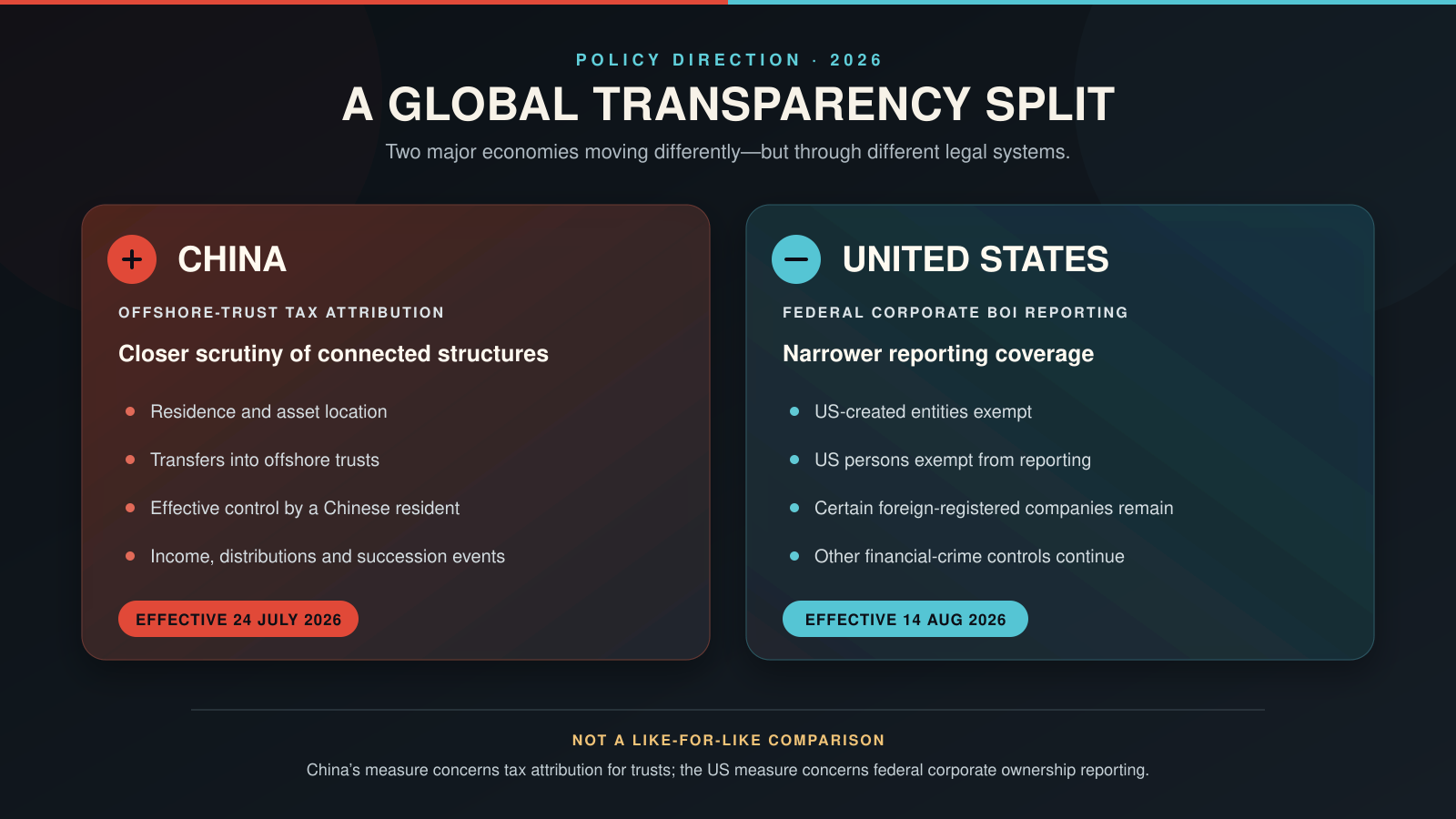
On 24 July 2026, China’s Ministry of Finance and State Taxation Administration issued two announcements that took immediate effect and brought foreign-law trusts and certain trust-like arrangements directly into the country’s individual income-tax framework. According to KPMG China’s analysis, the regime can apply where: * A Chinese resident transfers domestic or overseas assets into an offshore trust. * A non-resident transfers Chinese assets into a trust. * An offshore trust is effectively controlled by a Chinese resident. The rules also address trust income, distributions, succession events, termination and changes in residence. A 90-day regularisation period covers specified historic liabilities arising between 2023 and 2025. KPMG and Ogier identify 22 October 2026 as the practical filing and settlement deadline for certain affected taxpayers. Anyone potentially within scope requires specialist Chinese tax advice. Residence, effective control, asset location, transaction history and the terms of the governing instruments may all affect the analysis. These are tax-attribution rules. They should not be confused with the creation of a general public beneficial-ownership register.
2. Why China deserves measured credit
China’s initiative deserves measured credit for addressing a persistent weakness in the international wealth system: legal ownership and economic reality can diverge. A trust may place formal title in one jurisdiction, administration in another and beneficiaries in several more. If an authority examines only the name recorded on the title, it may miss who retained decision-making power, received income or obtained the economic benefit. The Chinese approach does not make trusts illegitimate. Trusts remain important instruments for succession, family governance, charitable purposes, protection of vulnerable beneficiaries and long-term stewardship. The principle is narrower: placing assets inside an offshore structure should not automatically erase an individual’s continuing economic connection to those assets or their income. Praise should not become cheerleading. Important questions remain about retrospective application, residence tests, the meaning of effective control, confidentiality, consistency of enforcement and procedural fairness. Transparency is most credible when rules are clear, evidence can be tested, and taxpayers have reliable routes to challenge an incorrect assessment.
3. Bangkok 2027: capital flight becomes the opening question
OffshoreAlert’s public conference programme identifies the opening session of its Bangkok 2027 conference as: “The Great Exodus: China’s US$1 Trillion Capital Flight & the Race To Find It.” The conference will take place at the Siam Kempinski Hotel Bangkok on 17 to 18 March 2027. OffshoreAlert describes unauthorised Chinese capital outflows during 2025 as an estimated US$1.04 trillion. That figure remains OffshoreAlert’s conference framing unless its underlying data and methodology are examined independently. OffshoreAlert founder, owner and editor David Marchant has followed China’s efforts to restrict overseas wealth movements for some time and hopes the session will be a major draw. The timing is significant. China’s new offshore-trust rules provide a live tax mechanism for examining effective control and economic benefit. OffshoreAlert is simultaneously presenting the tracing of overseas Chinese wealth as a defining investigative subject for 2027. The shared principle is straightforward: do not stop at the entity, account or trustee appearing on the surface. Reconstruct the architecture beneath it.
4. The trust substrata
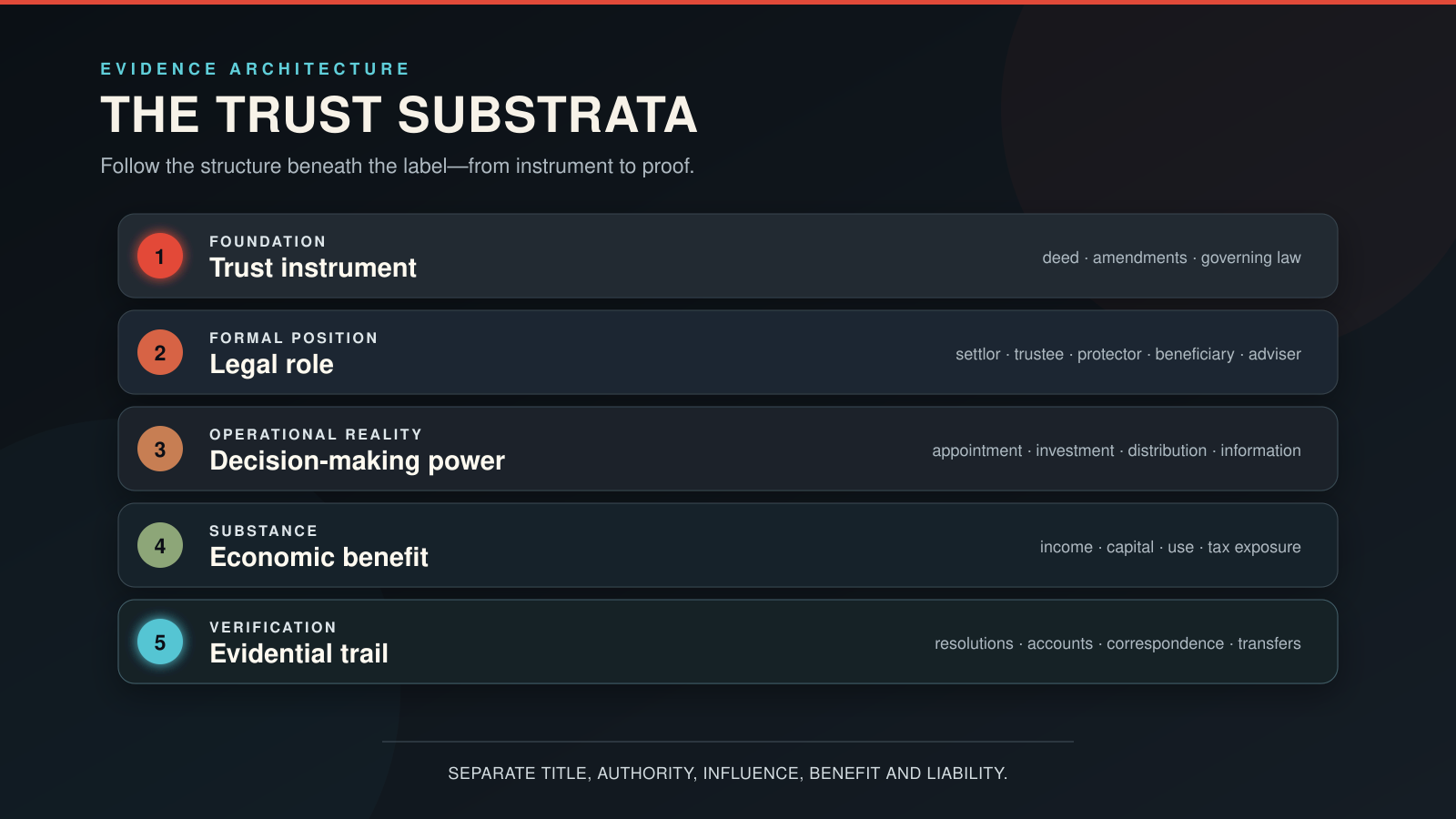
A responsible investigation moves through five connected layers: Trust instrument → legal role → decision-making power → economic benefit → evidential trail This sequence is increasingly important for journalists, litigators, compliance teams, trustees and families reviewing historic structures. It raises practical questions: * Who could appoint or remove a trustee? * Who directed or influenced investments? * Who authorised distributions? * Who received accounts and other information? * Who bore the reported tax exposure? * Which contemporaneous records support each conclusion? Influence, legal authority, beneficial entitlement and tax liability are not interchangeable concepts. Each must be established under applicable law and supported by evidence.
5. A global transparency split
China’s move arrives as international policy travels in conflicting directions. The Financial Action Task Force says authorities should be able to obtain adequate, accurate and current beneficial-ownership information concerning express trusts and similar legal arrangements. It also stresses verification and international cooperation because legal arrangements can operate across several jurisdictions. The United States has taken a different approach to federal corporate reporting. FinCEN’s final rule, effective from 14 August 2026, exempts entities created in the United States from federal beneficial-ownership information reporting. It also removes reporting obligations for US persons within the remaining foreign-company regime. Certain foreign companies registered to conduct business in the United States remain within scope. This does not establish that China has solved offshore transparency or that the United States has abandoned financial-crime enforcement. It does, however, show a significant policy divergence: one major economy is applying closer tax scrutiny to offshore arrangements connected with its residents. At the same time, another has narrowed the application of a prominent corporate ownership-reporting system.
6. The documents beneath every trust
The real test of a trust is in its documents. A credible analysis will commonly begin with: * The original trust deed and every amendment. * Beneficiary and excluded-person schedules. * Trustee, protector and adviser appointment or resignation instruments. * Letters of wishes, recognising that their legal effect varies. * Minutes and written resolutions authorising material decisions. * Accounts, investment mandates, bank records and distribution schedules. * Tax-residence and reporting records. * Correspondence recording who requested, approved or resisted a transaction. * Asset-transfer instruments and contemporaneous valuations. * Governing-law, jurisdiction, forum and enforcement provisions. No single document proves misconduct merely by existing. Taken together, however, the records may distinguish legal title from decision-making authority, influence, economic benefit and liability. That distinction underpins responsible due diligence, defensible investigative reporting, and properly scoped litigation-support research.
7. Where professional research adds value
The Chinese rules create immediate work for tax advisers and trustees, but the wider need is multidisciplinary. Historic offshore structures frequently require documentary reconstruction before legal or tax advice can be applied effectively. Families, claimants, law firms and litigation funders are increasingly affected by these structures. The useful product is not an accusation. It is an evidence architecture: a clear account of what is established, what remains uncertain, which document could resolve the uncertainty and which jurisdiction or professional adviser controls the next step.
8. Scrutiny is increasing but unevenly
China’s July 2026 rules are important because they direct attention below the offshore label and towards the economic substance of an arrangement. OffshoreAlert Bangkok 2027 is placing a related investigative challenge at the opening of its programme: following flows, relationships and control across borders instead of accepting a structure’s surface description. The most credible systems will not necessarily be those demanding the greatest quantity of information. They will be those capable of obtaining accurate information, verifying it, protecting legitimate privacy and applying their rules consistently and fairly. For trustees, families and advisers, the practical message is simple: Know the structure, preserve the records and be able to explain who controls and benefits from what. For investigators and journalists, the message is equally direct: The story begins where the label ends.
9. Cross-Border Trust Intelligence
I write about offshore structures as an independent researcher. I do not write about matters in which I have a personal interest.
Sources
- https://kpmg.com/cn/en/insights/2026/07/china-tax-alert-05.html
- https://www.ogier.com/news-and-insights/insights/chinas-new-offshore-trust-tax-rules-what-families-should-consider-now/
- https://www.fatf-gafi.org/en/publications/Fatfrecommendations/Guidance-Beneficial-Ownership-Transparency-Legal-Arrangements.html
- https://www.fincen.gov/boi
- https://www.offshorealert.com/events/bangkok/