Dubai, Singapore and the new quiet rooms
Singapore and Dubai grew strongly as wealth hubs as Swiss secrecy ended. Singapore's 2023 money laundering case, MAS penalties on nine institutions, the UAE's FATF grey listing and the Dubai Unlocked leak show what the watchdogs found.
Charles Pycraft · October 2026 · London
On 15 August 2023 Singapore police carried out simultaneous raids across the city and arrested ten foreign nationals. Assets worth more than S$3 billion, from cash and property to gold bars and cryptocurrency, were seized or made subject to prohibition orders. By the time the government's Inter-Ministerial Committee on money laundering published its report in October 2024, all ten had been convicted and more than S$940 million of their assets had been forfeited to the state. In July 2025 the Monetary Authority of Singapore imposed composition penalties totalling S$27.45 million on nine banks and other financial institutions for anti-money laundering breaches connected with the case.
Earlier pieces in this series followed Swiss banking secrecy, Suisse Secrets and the limits of Switzerland's regulator. This one looks at two financial centres that have grown strongly as private wealth hubs while Switzerland tightened, and at what the public record shows each of them watching, and missing.
Why the rooms moved
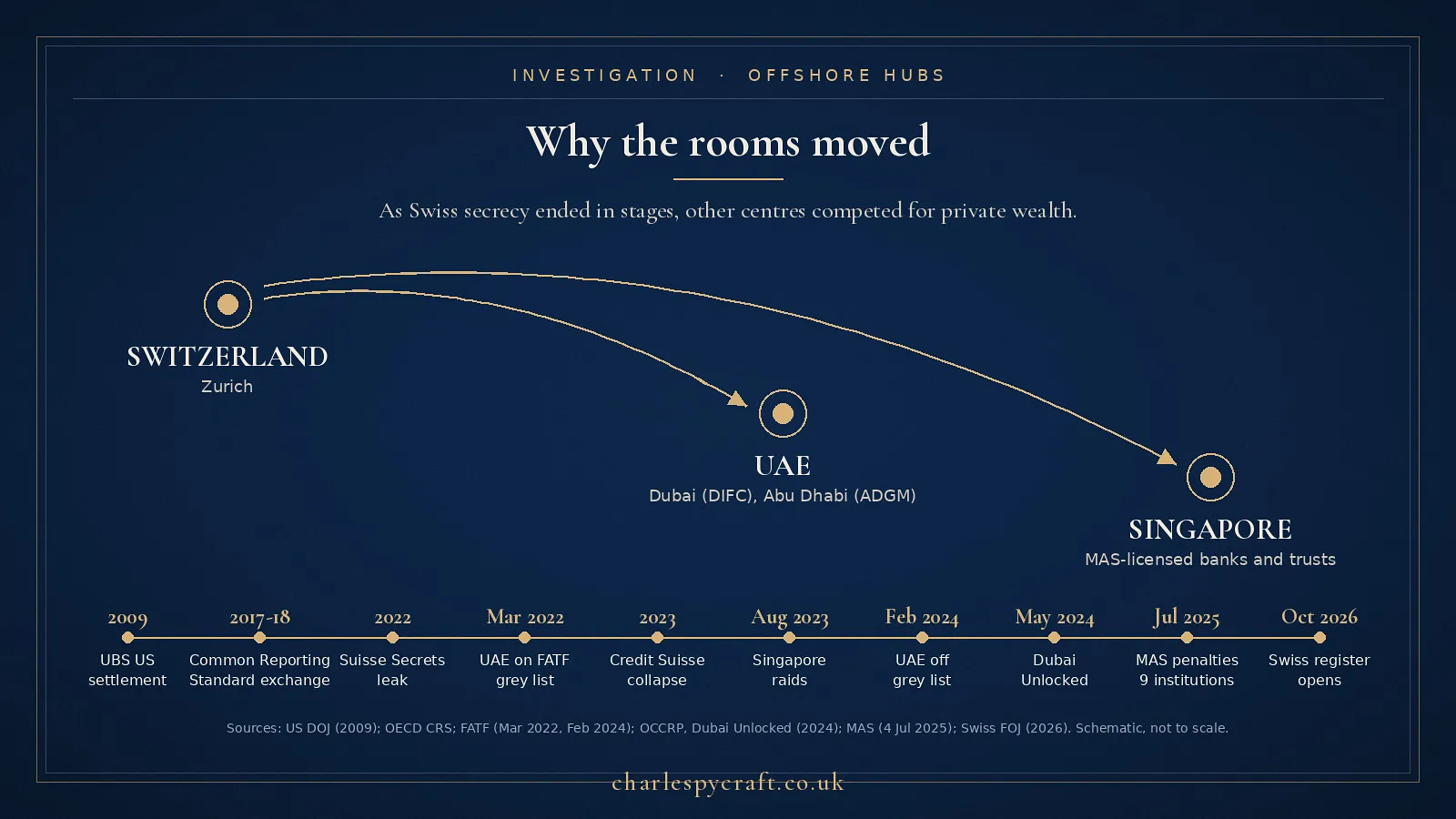
Switzerland's traditional secrecy ended in stages. In 2009 UBS agreed to pay US$780 million to US authorities and hand over client names. Under the OECD's Common Reporting Standard, Swiss banks began collecting account data in 2017 for automatic exchange with other tax authorities from 2018. Leaks such as Suisse Secrets in 2022 and the collapse of Credit Suisse in 2023 added to the pressure on the brand. Since 1 October 2026 Switzerland has also run a central register of the beneficial owners of companies, open to authorities but not to the public.
Wealth that wants privacy does not disappear when one jurisdiction becomes more transparent. Several centres compete for it on stability, tax, courts and discretion, and Singapore and Dubai are two of the most prominent. Neither calls itself a secrecy jurisdiction, and both have committed to international tax transparency and anti-money laundering standards. The question is what the record shows in practice, not only what the law says.
Singapore: the trusted hub
Singapore sells trust: rule of law, predictable regulation and a safe place for families. Single family offices receiving tax incentives from MAS grew from about 400 at the end of 2020 to more than 2,000 by the end of 2024, according to a written answer to Parliament in February 2025. Singapore's whole asset management sector, not family offices alone, reported S$6.7 trillion under management in 2025.
Family offices that manage only one family's money do not need a fund management licence. Since 15 June 2026, under a revised class exemption, a qualifying single family office must notify MAS, bank with a MAS-licensed bank and file an annual return, but it is still exempt from licensing. Trust companies, by contrast, are licensed and supervised by MAS.
The August 2023 case showed where the system worked and where it did not. The suspects had used registered companies to obtain work passes and bank accounts, and bought property and luxury goods. MAS has said that suspicious transaction reports filed by financial institutions had earlier alerted the police to suspicious activity. But MAS's own findings, published in July 2025, were that all nine penalised institutions failed to detect or adequately follow up on red flags about their customers' source of wealth, and eight did not adequately review transactions their own systems had flagged. The institutions included Credit Suisse's Singapore branch, UBS, Julius Baer, LGT, Citi, UOB and a licensed trust company. These were regulatory breaches of MAS's anti-money laundering requirements, settled by composition penalties, not criminal convictions of the institutions. MAS also issued prohibition orders or reprimands to 18 individuals involved in the relationships.
The Inter-Ministerial Committee's October 2024 report recommended strengthening the role of gatekeepers: banks, corporate service providers, estate agents and dealers in precious metals. It also announced a government-wide data-sharing system and a coordination network for money laundering cases. In November 2024 police said 15 of 17 further suspects who had left Singapore had agreed to surrender about S$1.85 billion in assets and were barred from returning; investigations into the other two continued.
Dubai: the growth hub
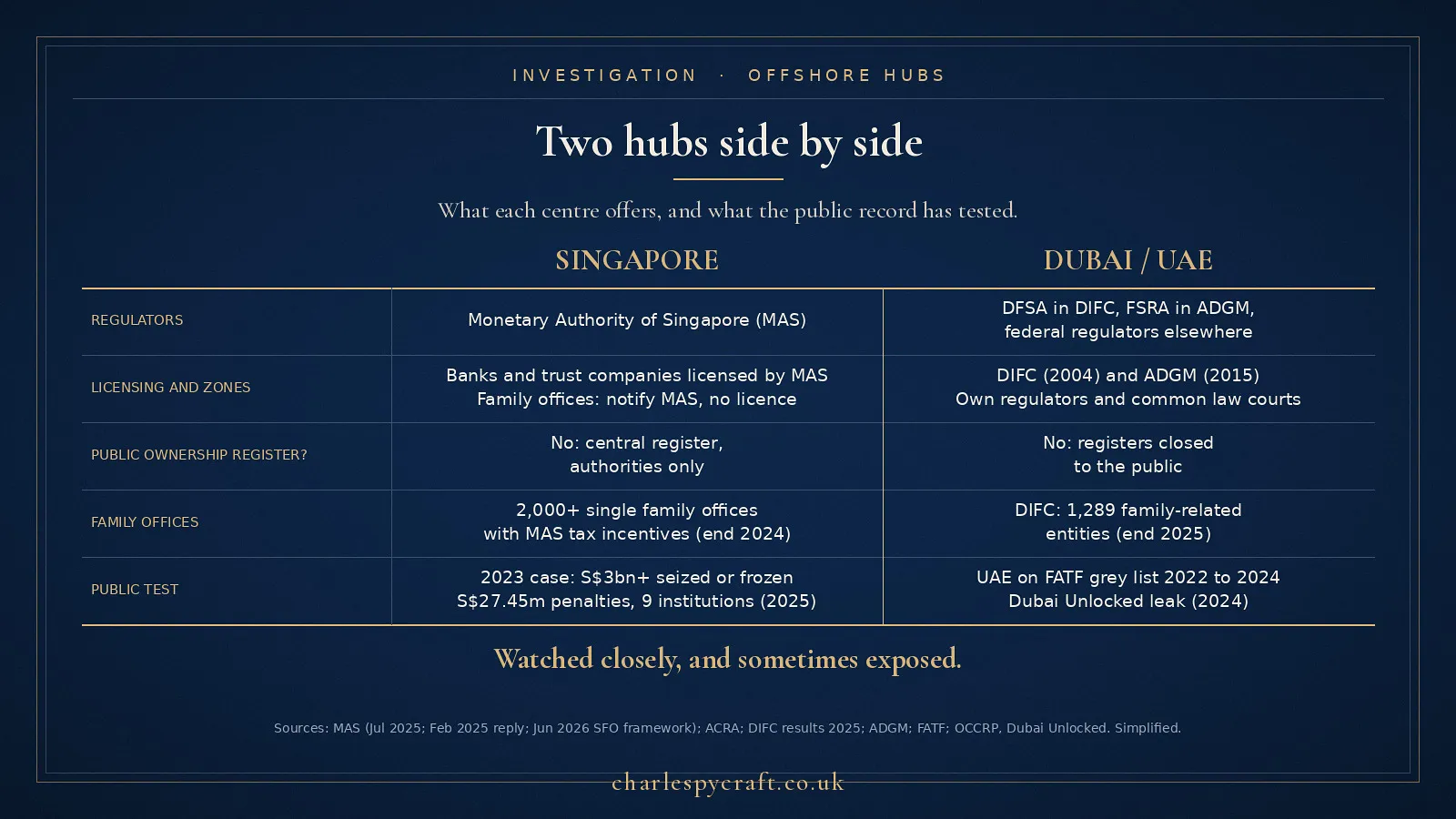
The United Arab Emirates offers a different pitch: no personal income tax, residence visas linked to investment, and financial zones with their own courts. The Dubai International Financial Centre was set up in 2004 with English-language common law courts and its own regulator, the Dubai Financial Services Authority. Abu Dhabi Global Market followed, applying English common law directly from 2015. Both have their own company, trust and foundation laws. DIFC reported 1,289 family-related entities at the end of 2025, up 61 per cent in a year.
The watchdogs noticed. In March 2022 the Financial Action Task Force, assessing the UAE's anti-money laundering regime, put the country on its list of jurisdictions under increased monitoring, often called the grey list. Its action plan asked the UAE to understand better how companies and legal arrangements could be abused, to increase suspicious transaction reporting, including by estate agents and dealers in precious stones, and to prosecute more money laundering. In February 2024 FATF removed the UAE from the list, recognising significant progress.
Three months later came a leak. In May 2024 the Organized Crime and Corruption Reporting Project and Norway's E24, working with more than 70 media outlets, published Dubai Unlocked. It was based on leaked property records, largely from 2020 and 2022, originally obtained by the Washington nonprofit C4ADS. Reporters highlighted about 200 alleged criminals, fugitives, sanctioned people and political figures who between them had owned more than 1,000 properties. Appearing in leaked records is not by itself proof of wrongdoing. One strand, reported with The Straits Times, found that three people arrested in Singapore's 2023 case had invested more than US$30 million in Dubai property. Economists at the EU Tax Observatory and Norway's Centre for Tax Research, analysing the leaked data, estimated foreign ownership in Dubai's housing market at about US$160 billion in 2022.
The trust layer
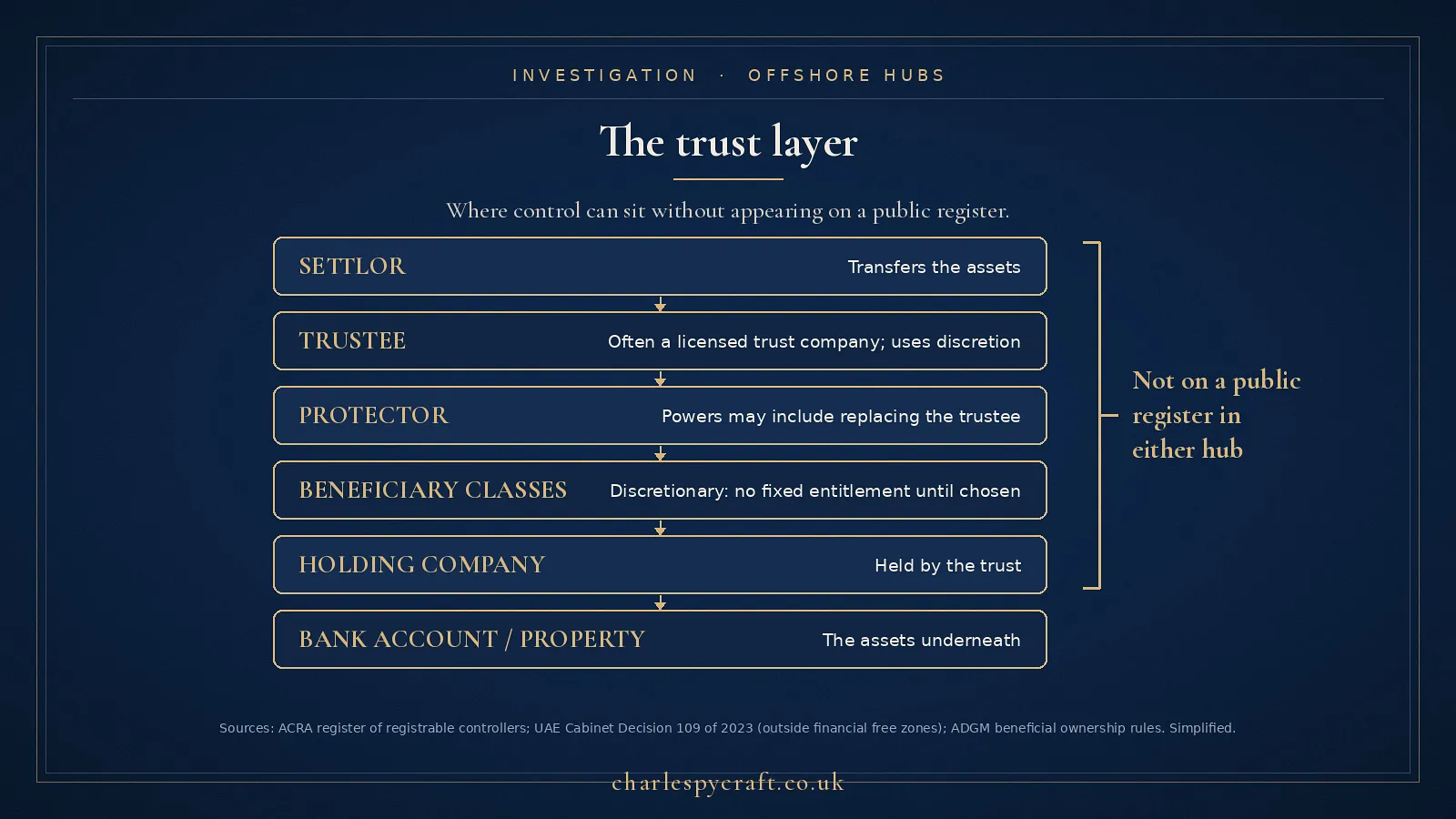
In both centres the most private part of an arrangement is often not a bank account but a structure above it: a trust, a foundation or a company held by one. In a discretionary trust the settlor transfers assets to a trustee, who has discretion over which members of a defined class of beneficiaries receive income or capital, and when. Until the trustee exercises that discretion, a discretionary beneficiary usually has no fixed entitlement to the trust assets. That makes the structure useful for families, and also makes it harder to see who really benefits.
Discretionary trusts can sit alongside other kinds of beneficiary and other roles. There may be fixed beneficiaries with set entitlements, default beneficiaries who take if no other decision is made, charitable objects, and a protector with powers that can include replacing the trustee. Each role is a place where influence can sit without appearing on a public register.
Neither Singapore nor the UAE publishes a register of the people who own or control companies. Singapore companies must keep a register of registrable controllers and file that information with the central register kept by ACRA, the company registrar, which is open to the authorities but not the public. Outside the financial free zones, a UAE Cabinet Decision first made in 2020 and replaced in 2023 requires companies to file beneficial ownership details with their registrar and restricts disclosure to the authorities. In ADGM, entities keep a record of beneficial owners and report it to the Registrar; the record is not published, and access is limited to designated Registration Authority staff.
So the people who set up and run these structures matter. The public record includes cases where professional intermediaries fell short. The Panama Papers and Pandora Papers were leaks from law firms and corporate service providers. In Singapore in 2025 a licensed trust company was among the nine institutions penalised. The questions this series asked of the quiet desk where trust lawyers sit apply in the new hubs too.
What this means if you deal with these centres
Ask who regulates whom. In Singapore, banks and trust companies are licensed by MAS, while qualifying single family offices notify MAS but are exempt from licensing. In the UAE, the DIFC and ADGM have their own regulators and courts, separate from the federal system.
Treat a clean list as a starting point. Leaving the FATF grey list shows a country addressed the gaps in its action plan, not that a particular counterparty is clean.
Look for the trust behind the company. Where a trust or foundation holds a company, ask who the trustee and protector are and which classes of beneficiary exist.
Use what is public. MAS enforcement actions, DIFC and ADGM Courts judgments, FATF mutual evaluation reports and the methods notes of investigative consortia are all published.
Watched, then exposed
The through-line of this series is that offshore systems are watched closely, and sometimes exposed. Singapore's case was built by its own police, drawing on reports from financial institutions, and then examined by its own regulator, which named the institutions that fell short. The UAE's anti-money laundering regime was assessed by the FATF in an official process, and Dubai's property market was then opened up by a leak and the reporters who spent months checking it. The new quiet rooms keep their ownership registers closed to the public. They are not unobserved, and the public record keeps growing.
Next in the series: The Spider's Web, London as the hub.
This field note draws on public legislation, regulatory publications, government reports, court materials and investigative journalism. It is provided for general information and is not legal or tax advice.
Sources
Inter-Ministerial Committee report on Singapore's anti-money laundering framework (October 2024)
Singapore Police Force, surrender of assets seized in the August 2023 operation (18 November 2024)
MAS, media release on the August 2023 case (16 August 2023)
MAS, regulatory actions against nine financial institutions (4 July 2025)
MAS written parliamentary replies on single family offices (5 February 2025 and 2026)
MAS, revised framework for single family offices to take effect on 15 June 2026 (12 June 2026)
MAS, Singapore Asset Management Survey 2025, as cited in MAS's 2026 reply
ACRA, register of registrable controllers
FATF, Jurisdictions under Increased Monitoring (March 2022 and February 2024)
OCCRP, What is Dubai Unlocked (14 May 2024)
OCCRP and The Straits Times, Singapore money laundering suspects invested huge sums in Dubai property (16 May 2024)
DIFC, annual results for 2025 (5 February 2026)
ADGM, Beneficial Ownership and Control Regulations 2022 and guidance
ADGM, Application of English Law Regulations 2015
UAE Cabinet Decision No. 109 of 2023 on beneficial ownership
Swiss Federal Office of Justice, start of the transparency register (1 October 2026). Background reading: Nicholas Shaxson, Treasure Islands
Oliver Bullough, Moneyland
Sources
- https://www.mas.gov.sg/-/media/mas-media-library/news/media-releases/2024/imc-report.pdf
- https://www.police.gov.sg/Media-Hub/News/2024/20241118_surrender_to_the_state_of_assets_seized_in_major_anti_money_laundering_operation
- https://www.mas.gov.sg/regulation/enforcement/enforcement-actions/2025/mas-takes-regulatory-actions-against-9-financial-institutions-for-aml-related-breaches
- https://www.mas.gov.sg/news/media-releases/2026/revised-framework-for-single-family-offices-to-take-effect-on-15-june-2026
- https://www.fatf-gafi.org/en/publications/High-risk-and-other-monitored-jurisdictions/Increased-monitoring-february-2024.html
- https://www.occrp.org/en/project/dubai-unlocked/what-is-dubai-unlocked-everything-you-need-to-know
- https://www.occrp.org/en/project/dubai-unlocked/singapore-money-laundering-suspects-invested-huge-sums-in-dubai-property
- https://www.adgm.com/operating-in-adgm/obligations-of-adgm-registered-entities/beneficial-ownership-and-control