Panama Papers without the myth
Ten years on, the Panama Papers are remembered as a list of famous names. The record is more useful than the legend: what a nominee actually is, what the leak did and did not prove, and why the files are still producing court judgments in 2026.
Charles Pycraft · October 2026 · London
Every big leak turns into a story people tell about it. The Panama Papers story usually goes like this: in 2016 some celebrities and politicians were caught hiding money on tropical islands, there was a fuss, and nothing changed.
Almost every part of that sentence is wrong, or at least incomplete. The public record, built over ten years by journalists, tax authorities and courts, tells a slower and more instructive story. It is worth reading without the myth, because the machinery it describes is still in use.
What the files actually were
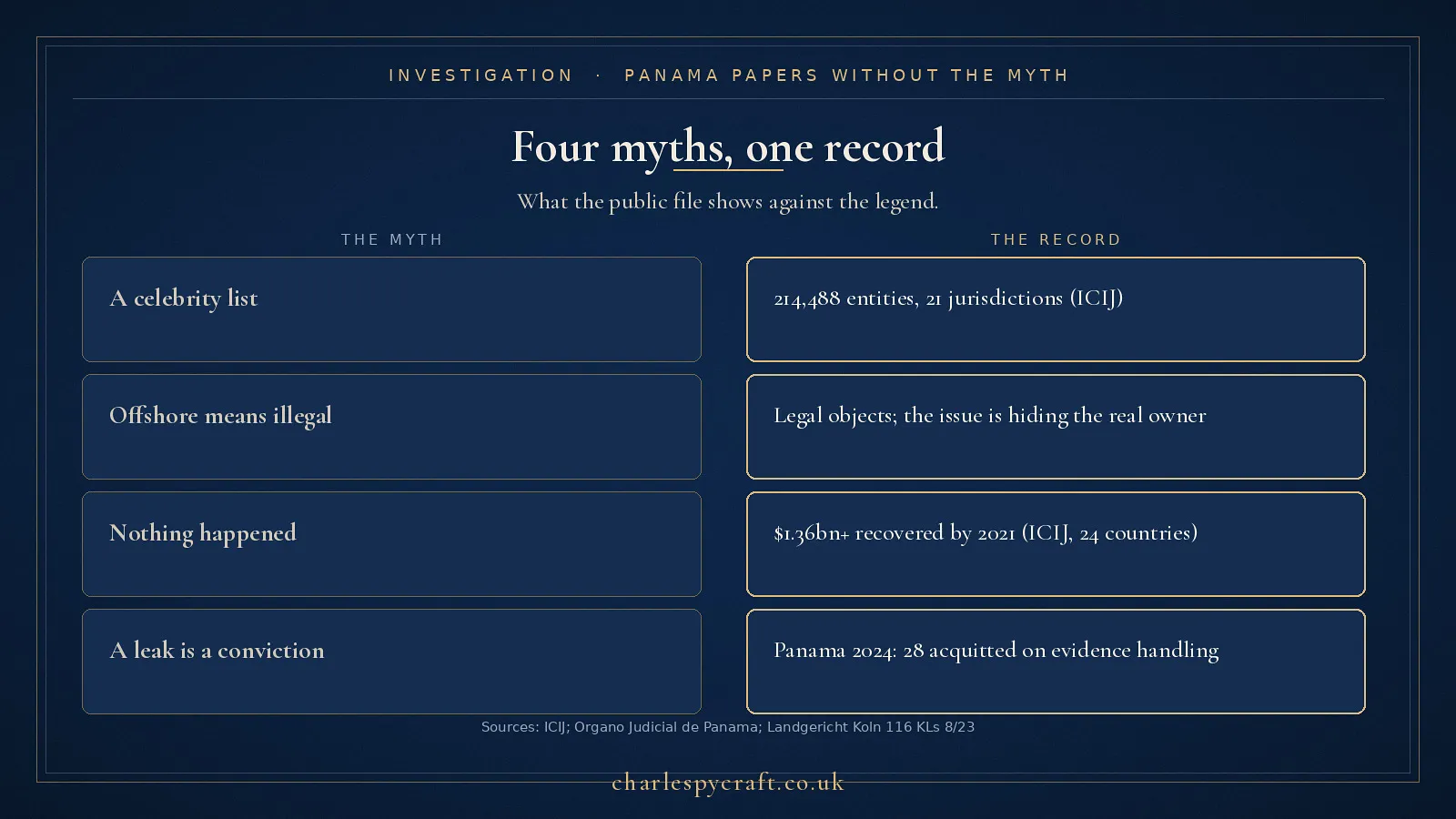
In April 2016 the International Consortium of Investigative Journalists (ICIJ), the German newspaper Süddeutsche Zeitung and more than 100 media partners began publishing an investigation based on 11.5 million documents from Mossack Fonseca, a Panamanian law firm with branches in Hong Kong, Zurich and dozens of other places. According to ICIJ, the files covered 214,488 offshore entities connected to people in more than 200 countries and territories, incorporated across 21 offshore jurisdictions, from Nevada to the British Virgin Islands to Singapore.
That is not a celebrity list. It is the back office of one mid-sized incorporation business: emails, spreadsheets, passport copies and corporate records. The famous names were a small fraction of the whole. The rest was routine paperwork, which is exactly why it matters. It showed how ordinary the product was.
Myth one: offshore means illegal
It does not. A company in the British Virgin Islands or a foundation in Panama is a legal object. People use them for holding assets, joint ventures, inheritance planning and plenty of dull commercial reasons. The ICIJ coverage said so at the time, and so did Mossack Fonseca.
The problem the files exposed was narrower and more precise: separating the person who really owns and controls an asset from the names that appear on paper.
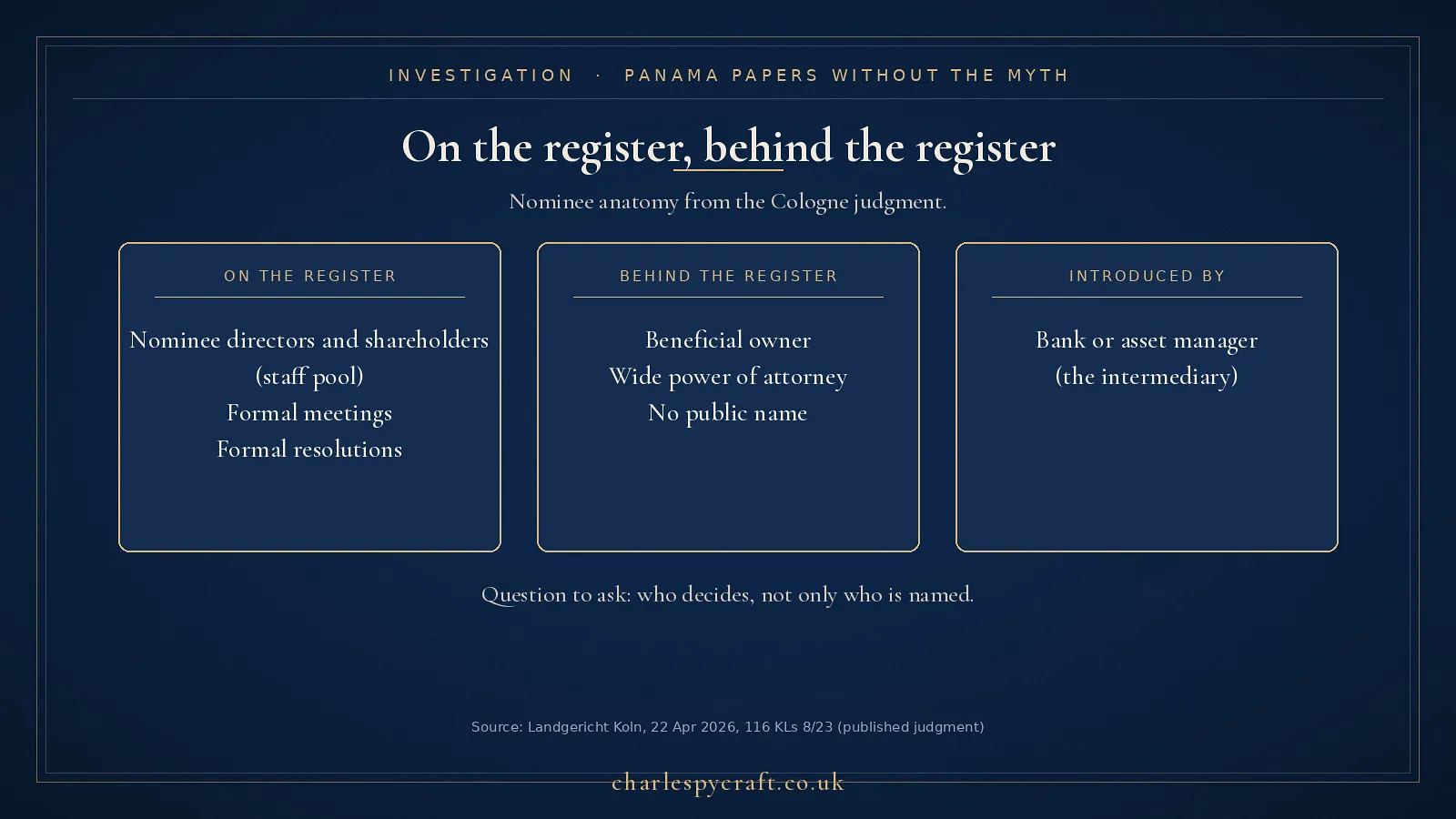
A German court has now described that service in unusually plain terms. In April 2026 the Cologne Regional Court (Landgericht Köln, case 116 KLs 8/23) convicted a former co-owner of Mossack Fonseca of aiding and abetting tax evasion. The published judgment describes the firm's offer as an "anonymisation service" sold to international clients, not as a bespoke arrangement for one customer but as a worldwide, largely standardised and digitised mass business. The companies were fitted with nominee directors and nominee shareholders drawn from a small pool of the firm's own staff. Those nominees held formal meetings and passed formal resolutions. The real owners did not appear on any register and were instead given wide powers of attorney behind the scenes. The court also noted that the companies were introduced through banks or asset managers, the "intermediaries".
That is the mechanism in one paragraph. The name on the register belongs to someone with no real power. The power sits with someone whose name is on no register. The structure is legal; what it is used to hide may not be.
Myth two: the names were the story
The names made people read. The structures were the story.
Three public roles appear again and again in the reporting, and they are worth separating because they are often blurred:
The beneficial owner is the person who ultimately owns or controls the asset and benefits from it. Modern rules in the UK, EU and elsewhere are built around identifying this person.
The nominee is a stand-in director or shareholder whose name fills the public slot. A nominee is lawful in many places. A nominee who signs whatever they are told, for a person they have never met, is the weak point.
The foundation or trust layer adds a further step. A Panamanian private foundation, as ICIJ reported at the time, did not require the founder or beneficiaries to be named publicly. Trusts work on a similar principle: the trustee holds legal title, and the people who may benefit can sit in a separate document. Where beneficiaries are discretionary, meaning the trustee or foundation council decides who receives what and when, the paper trail can show very little about who will in fact benefit.
A later piece in this series will take trust construction and beneficiary types on their own: settlor, trustee, protector, letter of wishes, and the difference between a fixed interest and a discretionary one. For now the point is simple. Reading a structure means asking who decides, not only who is named.
Myth three: nothing happened
This is the myth the record contradicts most clearly.
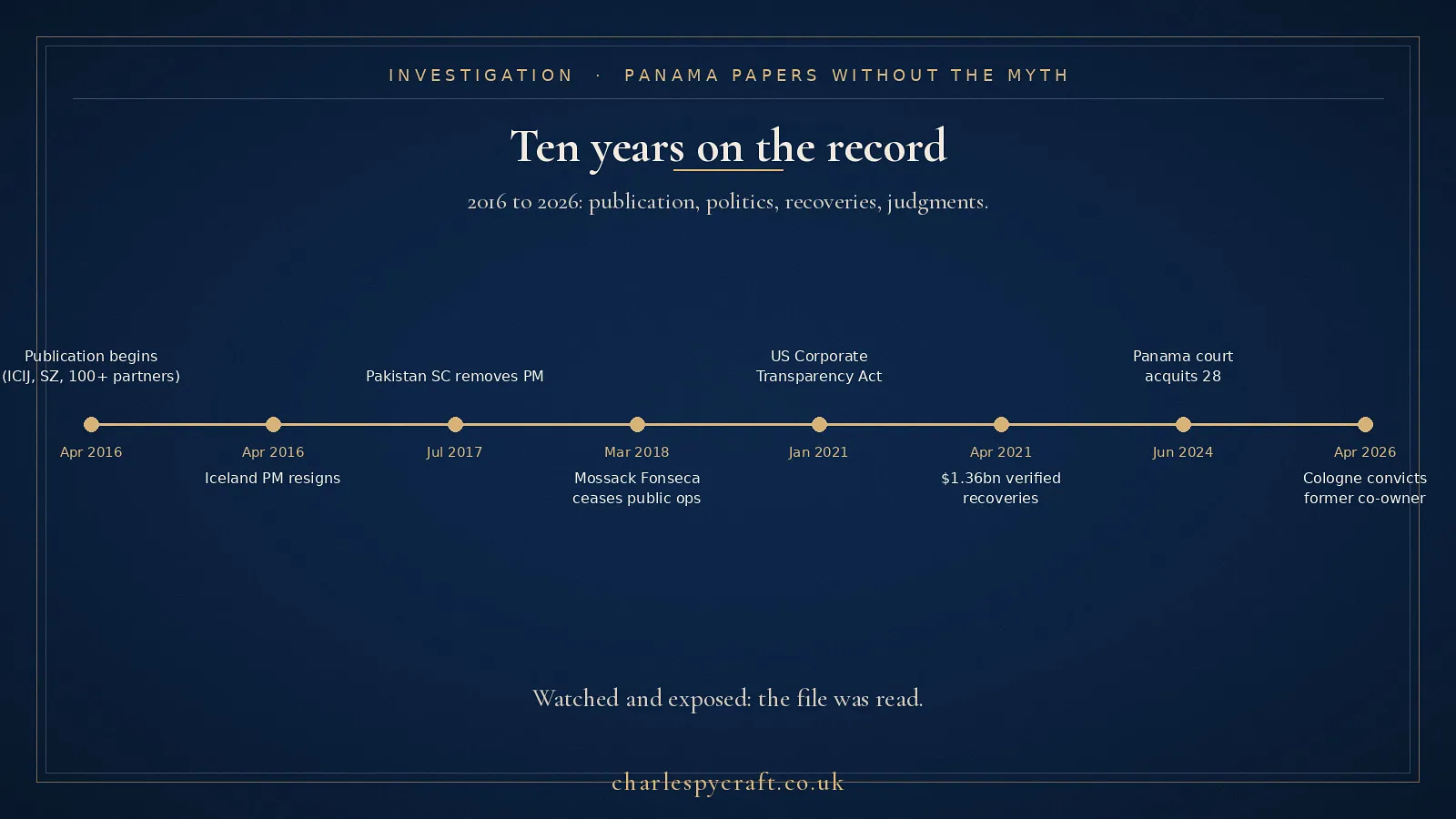
Politics. Iceland's prime minister, Sigmundur David Gunnlaugsson, resigned in April 2016 after reporting on a British Virgin Islands company owned by him and his wife. In 2017 Pakistan's Supreme Court removed Prime Minister Nawaz Sharif from office after proceedings linked to the revelations about his family's overseas property; ICIJ reports he was later sentenced on corruption charges. In Malta, the journalist Daphne Caruana Galizia used the files in her reporting on senior officials before she was murdered in 2017.
Money. By April 2021 ICIJ had verified more than $1.36 billion in back taxes, fines and penalties recovered by governments in 24 countries as a direct result of the investigation, with the United Kingdom reporting $252.8 million. ICIJ describes that as a conservative count, because it includes only sums governments confirmed and many declined to report.
The firm. Mossack Fonseca announced in March 2018 that it would cease public operations, blaming "reputational deterioration", the media campaign and the actions of Panamanian authorities.
Law. Panama signed up to multilateral tax information exchange. In the UK, MPs cited the Panama Papers during the passage of the Criminal Finances Act 2017, which created corporate offences of failing to prevent the facilitation of tax evasion. In the United States the investigation helped carry the Corporate Transparency Act, signed in January 2021. ICIJ counted 81 countries with laws requiring company owners to identify themselves by 2021.
None of that made offshore secrecy disappear. It did change the price of being found.
Myth four: a leak is a conviction
This is the most important correction, and the most uncomfortable one for anyone who wants a neat ending.
In June 2024 a Panamanian court acquitted all 28 defendants in the Panama Papers money laundering case, including the firm's surviving co-founder. Panama's judiciary said the electronic evidence taken from Mossack Fonseca's servers, which had been submitted on paper, did not meet the chain of custody or the principles governing digital evidence, chiefly because it lacked "hash" values that would show it was authentic and unaltered. The judge found the remaining evidence insufficient.
Two years later, in Cologne, a different court reached a different result against a different defendant, on a narrower charge, after a confession. The German judgment set the tax loss across 50 cases at more than €13 million. ICIJ reports a suspended sentence of one year and nine months.
Read together, the two judgments say something calm and useful. Journalism exposes. Courts convict only on evidence that survives their own rules. A leak can show a pattern beyond reasonable doubt in the public mind and still fail in a courtroom if the files were not gathered and preserved properly. Anyone who works on offshore structures, as a journalist, a compliance officer or an investigator, should take that lesson seriously. Provenance is not a technicality.
Where this sits on the map
The Panama Papers are often filed under "Panama". The files point wider. About half of Mossack Fonseca's companies, according to ICIJ, were incorporated in the British Virgin Islands, the firm had Swiss offices, and ICIJ found that the most active intermediaries ordering companies were based in places such as Hong Kong, Switzerland, the UK and Luxembourg. The incorporation brand was Panamanian. The route was global, and much of it ran through British-administered jurisdictions and Swiss private banking. Both are coming next in this series.
Watched and exposed
Ten years on, the Panama Papers are less a scandal than a method. Leaked records led to registers. Registers led to questions. Questions led, slowly, to tax recoveries and judgments, in some countries and not in others. Structures built years earlier on the assumption that nobody would ever read the file were read in 2016 and were still being argued over in a German courtroom in 2026.
That is the quiet change. The offshore system was designed for a world in which paperwork stayed in the drawer. That world has gone.
Related reading: The quiet desk: how trust lawyers sit between client and shell; China Turns the Light on Offshore Trusts; Offshore & Investigations. Next: Switzerland, and how banking secrecy was built.
I write about offshore structures as an independent researcher, from public sources only.
Sources
- https://www.icij.org/investigations/panama-papers/five-years-later-panama-papers-still-having-a-big-impact/
- https://www.icij.org/investigations/panama-papers/panama-papers-revenue-recovery-reaches-1-36-billion-as-investigations-continue/
- https://www.icij.org/investigations/panama-papers/panama-papers-law-firm-mossack-fonseca-closes-doors/
- https://www.theguardian.com/world/2018/mar/14/mossack-fonseca-shut-down-panama-papers
- https://www.organojudicial.gob.pa/noticias/juzgado-segundo-liquidador-dicta-sentencia-en-casos-lava-jato-y-panama-papers
- https://www.bbc.com/news/articles/cjer3llen42o
- https://nrwe.justiz.nrw.de/lgs/koeln/lg_koeln/j2026/116_KLs_8_23_Urteil_20260422.html
- https://www.icij.org/investigations/panama-papers/former-co-owner-of-panama-papers-law-firm-convicted-of-aiding-and-abetting-tax-evasion/