The quiet desk: how trust lawyers sit between client and shell
In the Panama Papers the names that travelled were famous. The machinery sat one desk further back.
Charles Pycraft · October 2026 · London
In the Panama Papers the names that travelled were presidents, oligarchs and footballers. The machinery that made the structures work sat one desk further back: the intermediary who never appears in the headline.
The machinery between client and shell
When the Panama Papers broke in April 2016, the public story was about famous people and famous firms. Eleven and a half million files from the Panamanian law firm Mossack Fonseca reached the German newspaper Süddeutsche Zeitung, then the International Consortium of Investigative Journalists, then partners including the Guardian and the BBC. The headlines followed political families, sanctions lists and Swiss bank relationships. That was fair. It was also incomplete.
The quieter story sat between the client and the shell.
Mossack Fonseca itself told investigators that it mainly served professional intermediaries: lawyers, banks and trusts. In its first written reply to ICIJ it said it provided "worldwide registered agent services for our professional clients (e.g., lawyers, banks, and trusts) who are intermediaries." Incorporation, it insisted, was "a very different thing from establishing a business link with or directing in any way the companies so formed."
That sentence is the mechanism. The firm that stamps the company papers is often not the firm that chose the structure, briefed the bank, or sat across the table from the person who wanted privacy. The intermediary is.
How the quiet desk works
Strip the romance out of "offshore" and the chain is simple.
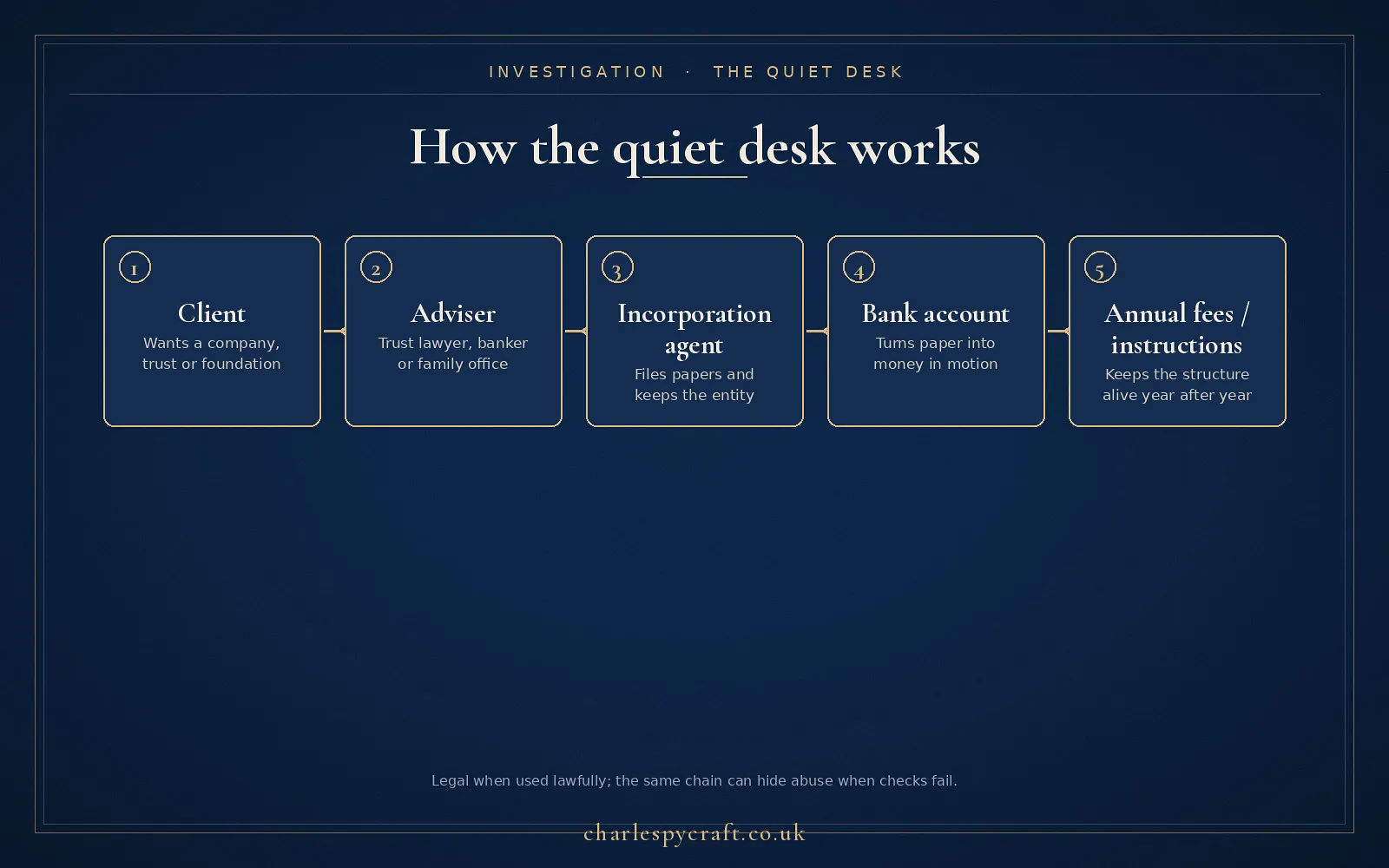
A client wants a company, trust or foundation that does not put their name on a public register.
An adviser designs or requests the structure. That adviser may be a trust lawyer, a private banker, an accountant, or a multi-family office.
An incorporation agent or registered agent in a secrecy-friendly jurisdiction files the paperwork, maintains the entity, and often supplies nominee directors or other stand-ins.
A bank opens an account in the entity's name. The account is what turns paper into money in motion.
Annual fees keep the structure alive. Instructions travel through the intermediary. The public trail, if there is one, often stops at the nominee or the agent.
None of those steps is automatically a crime. Using offshore structures can be legal. The same files also showed how the same machinery can hide tax evasion, sanctions busting and laundering when the people in the chain stop asking hard questions, or agree not to.
Mossack Fonseca's brochure, as reported by the Guardian, listed trust services, investor advisory, offshore and onshore structures, commercial law and asset protection. Its largest book of companies sat in the British Virgin Islands, then Panama, the Bahamas and the Seychelles. For a fee it would register the company, keep local filings current, open bank accounts, and put nominee directors on the board. The client rarely needed to appear as themselves.
ICIJ's reporting on banks and law firms showed how deep that intermediary layer ran. More than 500 banks, subsidiaries and branches registered nearly 15,600 shell companies with Mossack Fonseca. HSBC and its subsidiaries alone accounted for more than 2,300; UBS for more than 1,100. In several cases the files describe arrangements in which the bank and the Panamanian firm argued about who was responsible for knowing the ultimate owner. In at least one documented episode Mossack Fonseca accepted lighter due diligence ("DD light") from a bank partner while still keeping the banking relationship intact for the customer.
That is the quiet desk in practice: responsibility for "know your customer" slides between rooms. Each room can say the other room was meant to check.
Where the desk sits on the map
The map is not one island. It is a route.
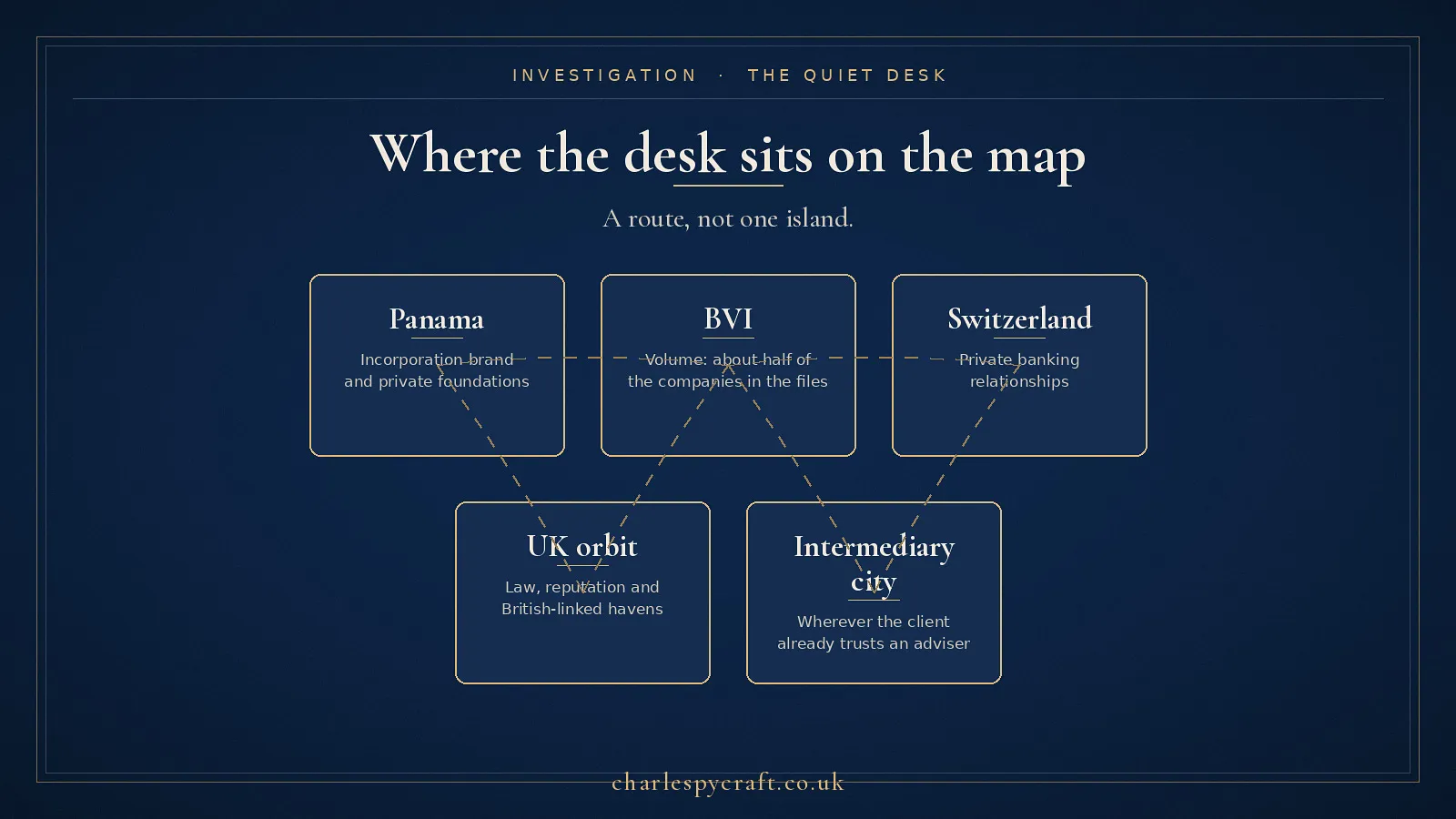
Panama supplies the incorporation brand and private foundation tools that, under local law as reported at the time, did not require public naming of founders or beneficiaries.
British Virgin Islands supplies the volume: ICIJ reported that about half of the companies in Mossack Fonseca's files were BVI incorporations.
Switzerland supplies private banking relationships. Mossack Fonseca had Swiss offices; major Swiss banks appear throughout the files as introducers and account holders.
London and the wider UK orbit supply law, reputation and the Overseas Territories and Crown Dependencies that sit under the Union Flag while running their own company and trust regimes. The Guardian noted that more than half of Mossack Fonseca's companies sat in British-administered tax havens or the UK itself.
The intermediary city can be anywhere the client already trusts a lawyer or banker. The incorporation can then be ordered remotely.
The person who never appears in the headline may be the person who chose Panama over BVI, who told the bank which passport to file, who held the letter of wishes, or who decided when a structure should be wound up and reborn elsewhere after a transparency rule changed. When the BVI tightened bearer-share rules in 2005, ICIJ reported that Mossack Fonseca shifted that line of work toward Panama. The product moves. The quiet desk stays.
What a UK solicitor's rules do and do not cover
For readers in England and Wales it is tempting to assume that "a lawyer was involved" means the Solicitors Regulation Authority can see the whole chain. The public rules do not say that.
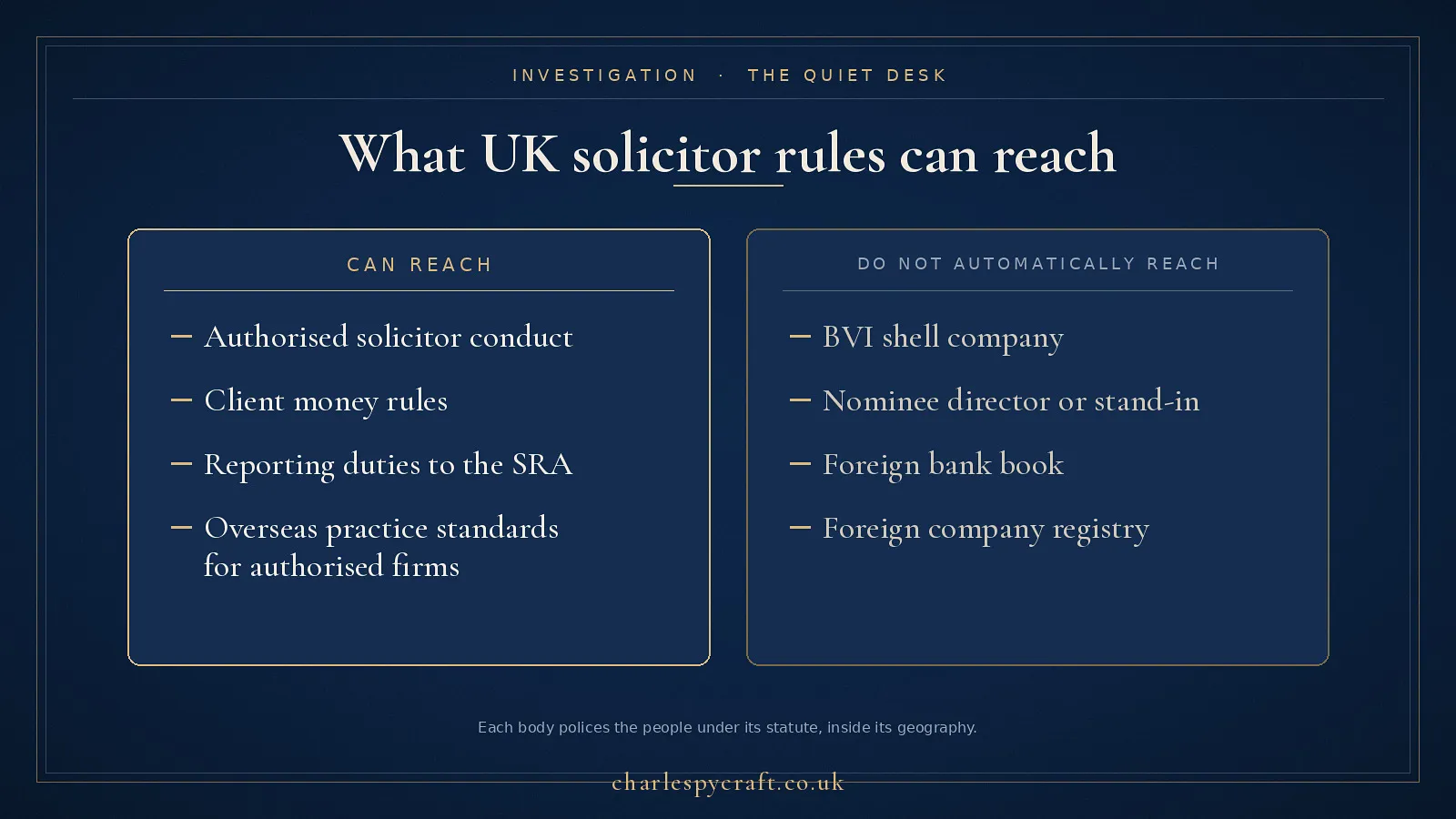
The SRA's Overseas and Cross-border Practice Rules apply when a regulated individual is established overseas, or when an authorised firm is responsible for an overseas practice. They replace the ordinary Principles and Code with a shorter set of Overseas Principles, plus standards on client money, reporting and cooperation. Client money held overseas must be safeguarded, kept separate from the firm's own money, and paid promptly into an overseas client account unless local law or a written client arrangement says otherwise. Serious breaches must be reported to the SRA.
Two edges matter. First, in a conflict between the Overseas Rules and local law or regulation, local law prevails, with a narrow exception for the principle that upholds public trust in the profession. Second, the SRA regulates the conduct of people and firms it authorises. It is not the BVI company registry, not a Swiss banking supervisor, and not a court that can unwind a Panamanian foundation because a UK client is unhappy with an offshore outcome.
Each body polices the people under its statute, inside its geography. The offshore chain is designed to sit across several of those geographies at once. A later piece in this series will take the SRA and the Legal Ombudsman on their own terms. The point today is simpler. When the intermediary is a solicitor, UK rules can reach that solicitor's conduct and client money. They do not automatically reach the shell, the nominee, or the foreign bank book.
Public sources, not myth
Treat the Panama Papers as a wiring diagram, not folklore.
Süddeutsche Zeitung received the leak; ICIJ coordinated the investigation; the Guardian and BBC were among the partners who published.
Mossack Fonseca denied fostering unlawful acts, said it conducted due diligence, and argued that intermediaries bore much of the customer-vetting duty.
ICIJ and partners published accounts of nominee directors, private foundations, bank introducers, and friction over who must identify the beneficial owner.
The European Parliament later commissioned a study on advisers and intermediaries in the schemes revealed by the papers, treating lawyers, trust companies, banks and accountants as stages in advice, creation, maintenance and enforcement.
Those sources are enough to describe the machinery without inventing private facts about any living dispute.
Why the quiet desk still matters
The celebrity names made the public look. The intermediary layer is why the system survives crackdowns unless the map is read honestly.
If you are reconstructing a structure for journalism, compliance or recovery work, useful questions are rarely "which tropical island appears on the certificate?" They are: who introduced the client to the incorporation agent; who held the KYC file, and who accepted a lighter one; who could instruct the nominee directors; which bank account sat under the company name, and in which city was the relationship managed; and which regulator, if any, had a clear statutory grip on each of those people.
Those are document questions. They are the same class of questions I have written about in other investigations when the subject is control, not branding.
I write about offshore structures as an independent researcher. I do not write about matters in which I have a personal interest.
Related reading: China Turns the Light on Offshore Trusts; Offshore & Investigations; and Thank You, David Marchant on the OffshoreAlert reporting tradition. Next: what the 2016 leak showed about shells and nominee services.
Sources
ICIJ, "Panamanian Law Firm Is Gatekeeper To Vast Flow of Murky Offshore Secrets" (3 Apr 2016)
ICIJ, "Global Banks Team with Law Firms To Help the Wealthy Hide Assets" (4 Apr 2016)
BBC News, "Panama Papers: Mossack Fonseca leak reveals elite's tax havens" (4 Apr 2016)
Sources
- https://www.icij.org/investigations/panama-papers/20160403-mossack-fonseca-offshore-secrets/
- https://www.icij.org/investigations/panama-papers/20160404-banks-lawyers-hide-assets/
- https://www.icij.org/investigations/panama-papers/mossack-fonseca-response-icij/
- https://www.theguardian.com/news/2016/apr/03/what-you-need-to-know-about-the-panama-papers
- https://www.theguardian.com/news/2016/apr/08/mossack-fonseca-law-firm-hide-money-panama-papers
- https://www.bbc.com/news/world-35918844
- https://www.sra.org.uk/solicitors/standards-regulations/overseas-cross-border-practice-rules/
- https://www.europarl.europa.eu/RegData/etudes/STUD/2017/602030/IPOL_STU(2017)602030_EN.pdf