FINMA: what Switzerland's regulator can and cannot do
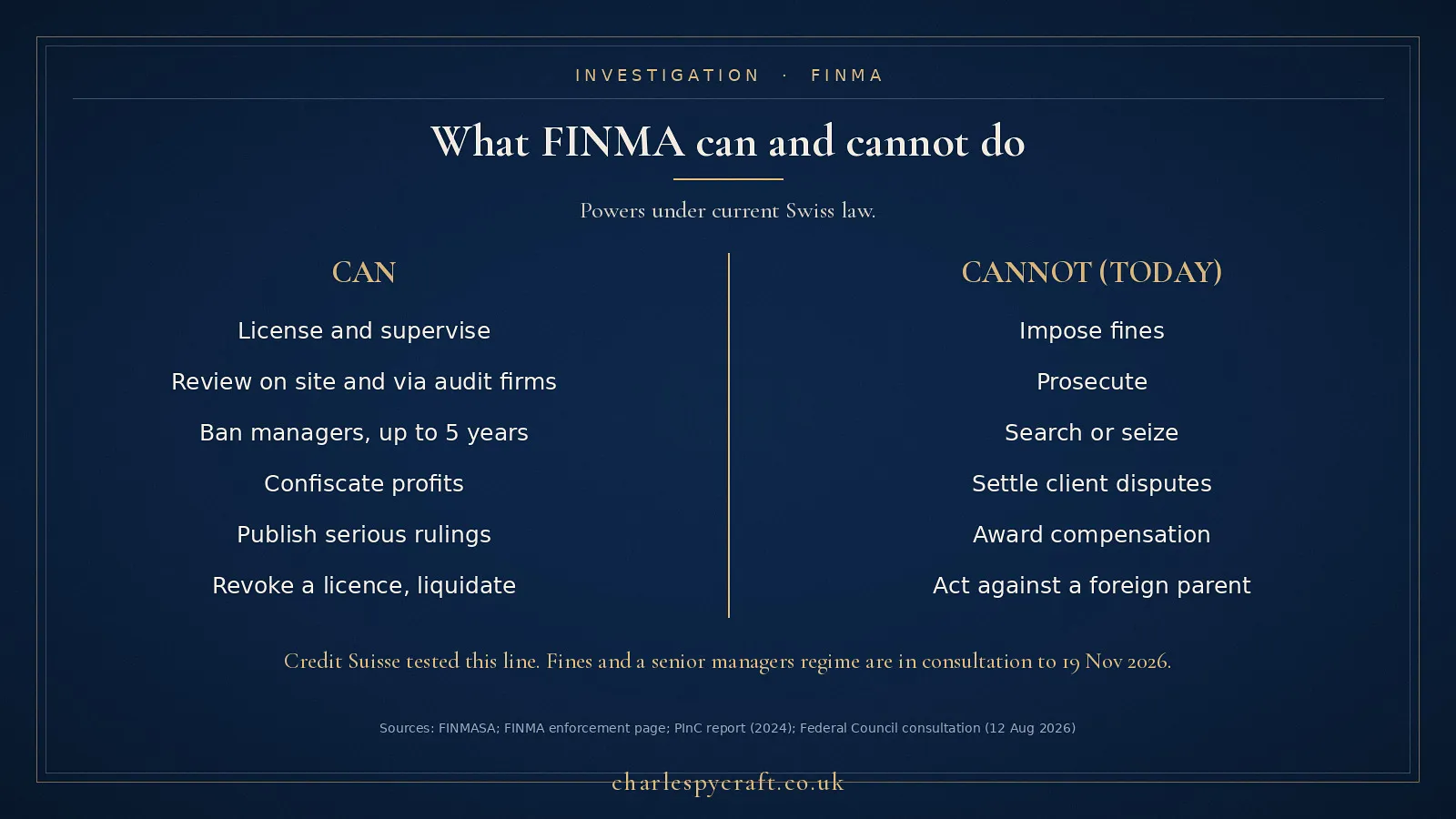
Switzerland's financial supervisor can license, investigate, confiscate profits, impose industry bans and withdraw a licence. It cannot currently fine, prosecute, settle a client's dispute or award compensation. Credit Suisse showed where that line sits.
Charles Pycraft · October 2026 · London
On 12 August 2026 the Federal Council opened a consultation on changes to the Banking Act. It would give the Swiss Financial Market Supervisory Authority, FINMA, the administrative power to fine banks for breaches of supervisory law, alongside a new senior managers regime setting out who in a bank is responsible for what. The consultation runs until 19 November 2026. In 2023 FINMA's chair, Marlene Amstad, said that FINMA "does not have the power to impose fines, which makes it an exception compared to other major financial centres".
The previous piece in this series followed Suisse Secrets, the 2022 leak of Credit Suisse client data. This one turns to the supervisor that watched that bank until its emergency takeover: what the law lets FINMA do, where its powers stop, and what the 2023 crisis showed about that edge.
The mandate
FINMA began work on 1 January 2009, merging the Federal Banking Commission, the Federal Office of Private Insurance and the Anti-Money Laundering Control Authority. Its legal basis is the Financial Market Supervision Act of 22 June 2007 (FINMASA, SR 956.1). Article 4 gives supervision two objectives: protecting creditors, investors and insured persons, and ensuring that the financial markets function properly.
The law protects classes of people and the system as a whole. It does not make FINMA the advocate of any single client. FINMA describes its remit as authorisation, supervision and, where necessary, enforcement. Its 2025 annual report lists 245 supervised banks and securities firms, 192 supervised insurers, about 2,000 approved funds and about 1,600 licensed portfolio managers and trustees.
Three gates: licence, supervision, enforcement
Licensing is the first gate. Banks, insurers, securities firms, fund managers and, since 2020, independent portfolio managers and trustees need a FINMA licence, and the people running them must guarantee irreproachable business conduct. FINMA says that changes to the people responsible for a bank's administration and management must be authorised by it before they take effect.
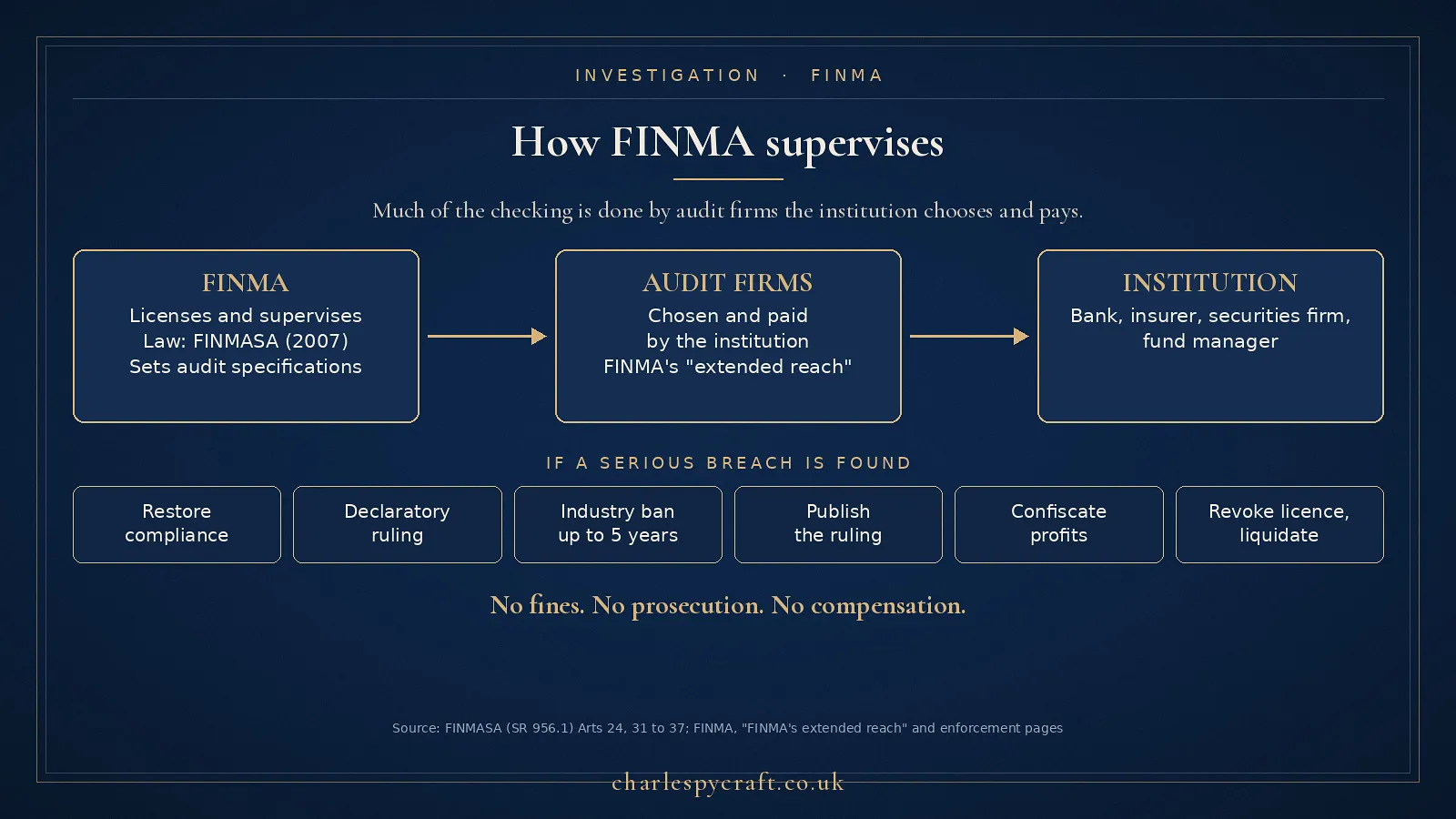
Supervision is the second gate. Under Article 24 FINMASA, supervised institutions appoint and pay licensed audit firms, which carry out regulatory audits to FINMA's specifications and send it a standardised report. FINMA calls them its "extended reach". It also does its own supervisory work, including on-site reviews, and under Article 36 it can appoint an investigating agent, at the institution's cost.
Enforcement is the third gate. Where FINMA finds a breach, the statute gives it a defined set of administrative tools:
Restoring compliance (Article 31), including ordering collateral where clients' rights appear to be at risk.
A declaratory ruling (Article 32), which is a formal finding that a serious breach took place.
An industry ban (Article 33), which bars a person from a management role at a supervised firm for up to five years. Article 33a adds bans on trading or acting as a client adviser.
Publishing the ruling (Article 34) once it is final, including personal data, in serious cases.
Confiscating profits (Article 35) made, or losses avoided, through a serious breach. Where the amount is hard to establish, FINMA may estimate it.
Revoking the licence (Article 37). Under the sector laws, a firm that loses its licence is wound up.
That list has no fine on it. FINMA's enforcement page says it "does not conduct criminal proceedings and does not impose penalties", "has no authority to impose fines" and "may not order any coercive measures, such as searches of premises or seizure of evidence". Where it suspects an offence, it may file criminal complaints with the Legal Service of the Federal Department of Finance, and it reports other crimes to the competent criminal authorities. Suspicious activity reports from financial intermediaries go to the Money Laundering Reporting Office Switzerland (MROS), which decides whether to pass a case to the Office of the Attorney General or a cantonal prosecutor. FINMA's rulings can be appealed to the Federal Administrative Court and then the Federal Supreme Court.
One case where the tools bit
In May 2016 FINMA concluded proceedings against the private bank BSI over business linked to the Malaysian state fund 1MDB. It found serious anti-money laundering breaches, ordered the confiscation of CHF 95 million in profits and opened proceedings against two former senior managers. Separately, it approved a takeover by EFG International on condition that BSI was integrated and then dissolved within twelve months.
BSI appealed. In November 2019 the Federal Administrative Court confirmed the serious breaches but rejected FINMA's calculation of the profits, and in October 2020 FINMA reassessed the sum at CHF 70 million. Of four proceedings against individuals, two ended in industry bans, which were then contested in court. Under Article 35, confiscated assets go to the Confederation unless they are paid to injured parties. In 2016 FINMA said the BSI money would go to the Confederation.
Credit Suisse: watched closely, then taken over
According to FINMA's report of 19 December 2023, since 2012 it had opened 43 preliminary investigations into the bank, issued nine reprimands, filed sixteen criminal complaints and completed eleven enforcement proceedings against the bank and three against individuals. From 2018 to 2022 it carried out 108 on-site reviews and recorded 382 points requiring action, 113 of them rated high or critical.
The supervisory measures did not prevent the liquidity crisis. The parliamentary inquiry records that the bank suffered massive outflows and came close to insolvency in October and December 2022. An acute crisis began on 15 March 2023, and on 19 March the authorities announced an emergency takeover by UBS, completed on 12 June 2023. The inquiry recorded CHF 257 billion in public-sector support made available, adding that the funds actually drawn were less than the amount authorised. On 19 March, the day the takeover was announced, FINMA ordered the write-off of the bank's Additional Tier 1 bonds, with a nominal value of about CHF 16.5 billion, relying in part on an emergency ordinance.
FINMA's conclusion was that it had "reached the limits of its legal options". It asked for a senior managers regime, the power to impose fines and the ability to publish enforcement proceedings regularly.
What the parliamentary inquiry found
On 8 June 2023 both chambers of parliament set up a Parliamentary Investigation Committee (PInC, known in German as the PUK), chaired by Isabelle Chassot. Its report, published on 20 December 2024, followed 79 hearings. It attributed the crisis to years of mismanagement at the bank, and it did not find misconduct by the authorities to be a causative factor.
The committee nevertheless questioned the effectiveness of aspects of FINMA's supervision. It said FINMA had made "ample use of the supervisory tools at its disposal", but that this "raises questions regarding the effectiveness of FINMA's interventions". FINMA had "very rarely issued formal rulings", relying instead on assessment letters. The committee found a 2017 capital concession for the parent bank, the "regulatory filter", lawful, but considered the measure "inappropriate". FINMA had estimated its effect at around CHF 8 billion; when first applied at the end of 2019, the bank reported it at CHF 15.3 billion. Of eight enforcement proceedings against executive board members, three were closed when the individuals signed waivers. The committee found it "incomprehensible" that no causal responsibility could be established for the relevant misconduct.
On auditors, it noted that banks select and pay their own audit firms, that the Federal Audit Oversight Authority found deficiencies in audits of Credit Suisse in several years between 2015 and 2022, and it asked whether FINMA should take over audit oversight of systemically important banks.
The courts later tested the emergency measures themselves. In a partial decision dated 1 October 2025, the Federal Administrative Court revoked FINMA's AT1 write-off order, finding that the contractual conditions had not been met and that a sufficient statutory basis was lacking. FINMA appealed to the Federal Supreme Court, and the court suspended the other AT1 cases pending that ruling. I have not identified a final appellate decision as at 29 October 2026.
The fix on the table
The Federal Council's banking stability report of 10 April 2024 led to the August 2026 consultation. As drafted, it would bring in a senior managers regime for banks with 250 or more employees, fines on non-compliant institutions, periodic penalty payments where ordered measures are delayed, earlier intervention, and a general duty to inform the public about completed proceedings. FINMA welcomed the drafts and said it had "decided at the beginning of 2022 to seek new statutory powers".
FINMA describes the package as introducing "preventive and disciplinary instruments", and Amstad said a senior managers regime "can help to clearly allocate the individual responsibilities of the management bodies". In Amstad's 2023 words, acting against a manager currently requires "proof of direct causal responsibility", which she called "a major hurdle". The proposed fines are aimed at institutions, not individuals, and she said of both instruments that "FINMA is not a criminal authority and does not wish to become one." The proposals remain subject to consultation and the legislative process, and may change.
What FINMA does not do
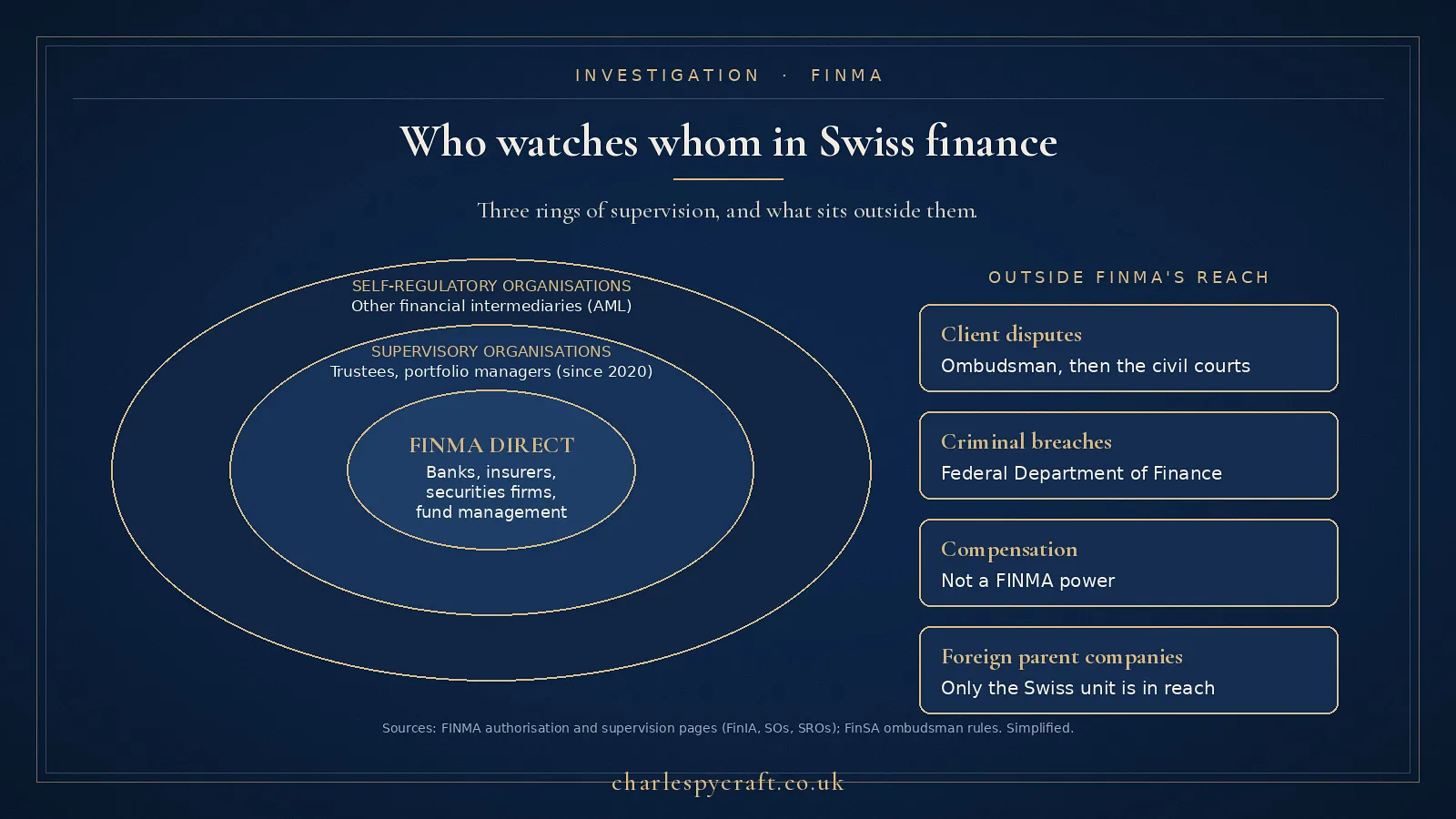
It does not decide private disputes. FINMA states that it is not responsible for civil disputes. Under the Financial Services Act, most providers serving private clients must belong to a recognised ombudsman, such as the Swiss Banking Ombudsman. The ombudsman mediates but cannot issue binding decisions. Beyond that, the courts decide.
It does not award compensation. Its tools are aimed at the institution, not at making a client whole.
It does not supervise every trustee directly. Since the Financial Institutions Act came into force on 1 January 2020, commercial trustees and portfolio managers need a FINMA licence, with transitional rules for those already active. Ongoing supervision sits with supervisory organisations, which FINMA licenses and supervises and which are not government agencies. FINMA alone takes legally binding enforcement decisions. Self-regulatory organisations are different: they oversee anti-money laundering compliance by other financial intermediaries, and FINMA recognises and supervises them.
Its reach abroad has limits. FINMA supervises Swiss financial groups on a consolidated basis and exchanges information with foreign supervisors. Where a foreign institution operates in Switzerland through a branch or subsidiary, it can act only against the Swiss unit, not the foreign parent. That border is a theme for a later piece.
It does not usually comment. Article 22 FINMASA keeps individual proceedings out of public view unless there is a particular supervisory need to speak.
What this means if you deal with a Swiss institution
Know that SRO membership is not a FINMA licence. Membership of a self-regulatory organisation covers anti-money laundering duties only. A firm that presents it as a licence deserves a closer look, and FINMA publishes a warning list of firms that may be operating without the licence they need.
Check the legal entity, not the group brand. Establish which Swiss entity provides the service, what it is licensed to do, and whether FINMA, a supervisory organisation or a self-regulatory organisation oversees it.
Treat silence as silence. Published enforcement decisions are useful, but they are not a complete record of FINMA's investigations or interventions. No public ruling tells you little either way.
Send the right question to the right place. A dispute about money goes to the institution, then an ombudsman or the courts. A suspected breach of supervisory law can be reported to FINMA, which may act but will not represent the person reporting it.
Watch the consultation. If fines and the senior managers regime become law, accountability inside Swiss banks changes.
Watched, then exposed
The through-line of this series is that offshore systems are watched closely and then exposed. Credit Suisse was supervised intensively, audited every year and corrected in letter after letter, and it still came close to insolvency in a single week in March 2023. FINMA's own report puts the limit in the statute. The parliamentary committee accepted that FINMA used its tools amply but questioned how effective they were, and placed responsibility for the crisis with the bank's leadership. FINMA can license, examine, confiscate, ban and withdraw a licence. It cannot fine, prosecute or pay anyone back. Whether that line moves is now a question for parliament.
Next in the series: Dubai, Singapore and the new quiet rooms.
This field note draws on public legislation, regulatory publications, parliamentary records and court materials. It is provided for general information and is not legal or tax advice.
Sources
Financial Market Supervision Act (FINMASA, SR 956.1), Articles 4, 22, 24 and 31 to 37
FINMA, "FINMA and law enforcement" (enforcement page)
FINMA, "FINMA's extended reach" (auditing)
FINMA, changes to bank licences
FINMA, portfolio managers and trustees, and self-regulatory organisations pages
FINMA Circular 2025/4, consolidated supervision
FINMA Annual Report 2025
FINMA, BSI press releases (24 May 2016 and 22 Oct 2020)
Marlene Amstad, "Fines, Senior Manager Regime and Enforcement Transparency" (5 Apr 2023)
FINMA, Credit Suisse report and press release (19 Dec 2023)
Parliamentary Investigation Committee, report summary and press release (20 Dec 2024)
Federal Administrative Court, B-2334/2023 press releases (14 and 22 Oct 2025)
FINMA, appeal notice (15 Oct 2025)
Federal Council, Banking Act consultation and FINMA response (12 Aug 2026)
fedpol, MROS
Financial Services Act (FinSA, SR 950.1)
Sources
- https://www.finma.ch/en/news/2023/12/20231219-mm-cs-bericht/
- https://www.parlament.ch/press-releases/Pages/mm-puk-2024-20-12.aspx?lang=1033
- https://www.bvger.ch/de/newsroom/medienmitteilungen/rechtswidrige-abschreibung-von-at1-kapitalinstrumenten-2385
- https://www.finma.ch/en/news/2026/08/20260812-mm-tbtf/