When the watchdogs fail: FINMA, VQF, FSC Mauritius, and the bill taxpayers still pay
Licences, SROs and on-site reviews signal that someone is watching. Public records show where that promise stops short.
Charles Pycraft · October 2026 · London
Offshore systems sell supervision as reassurance. Licences, self-regulatory memberships, on-site reviews, and communiqués signal that someone is watching. The public record is cooler. Supervisors can log hundreds of findings and still fail to restore confidence. Licensing gates can open despite adverse material already considered on the file. Standing rules, professional confidentiality, and court-record permissions can limit who obtains bank records or case papers. The cost often lands on taxpayers and policyholders. This piece synthesises public records on three parts of that machinery: FINMA and VQF in Switzerland, the Financial Services Commission of Mauritius, English court-file limits for non-parties, and how fiscal gaps elsewhere absorb the bill when secrecy and AML controls underperform.
What FINMA does, and where the Credit Suisse record stops short
The Swiss Financial Market Supervisory Authority (FINMA) authorises and supervises banks, insurers, and other financial-market participants under Swiss financial-market law. Its stated purpose is to protect creditors, investors, and insured persons, and to safeguard the functioning of the financial markets. It can investigate, reprimand, restrict business, impose capital and liquidity measures, and refer matters within its statutory limits.
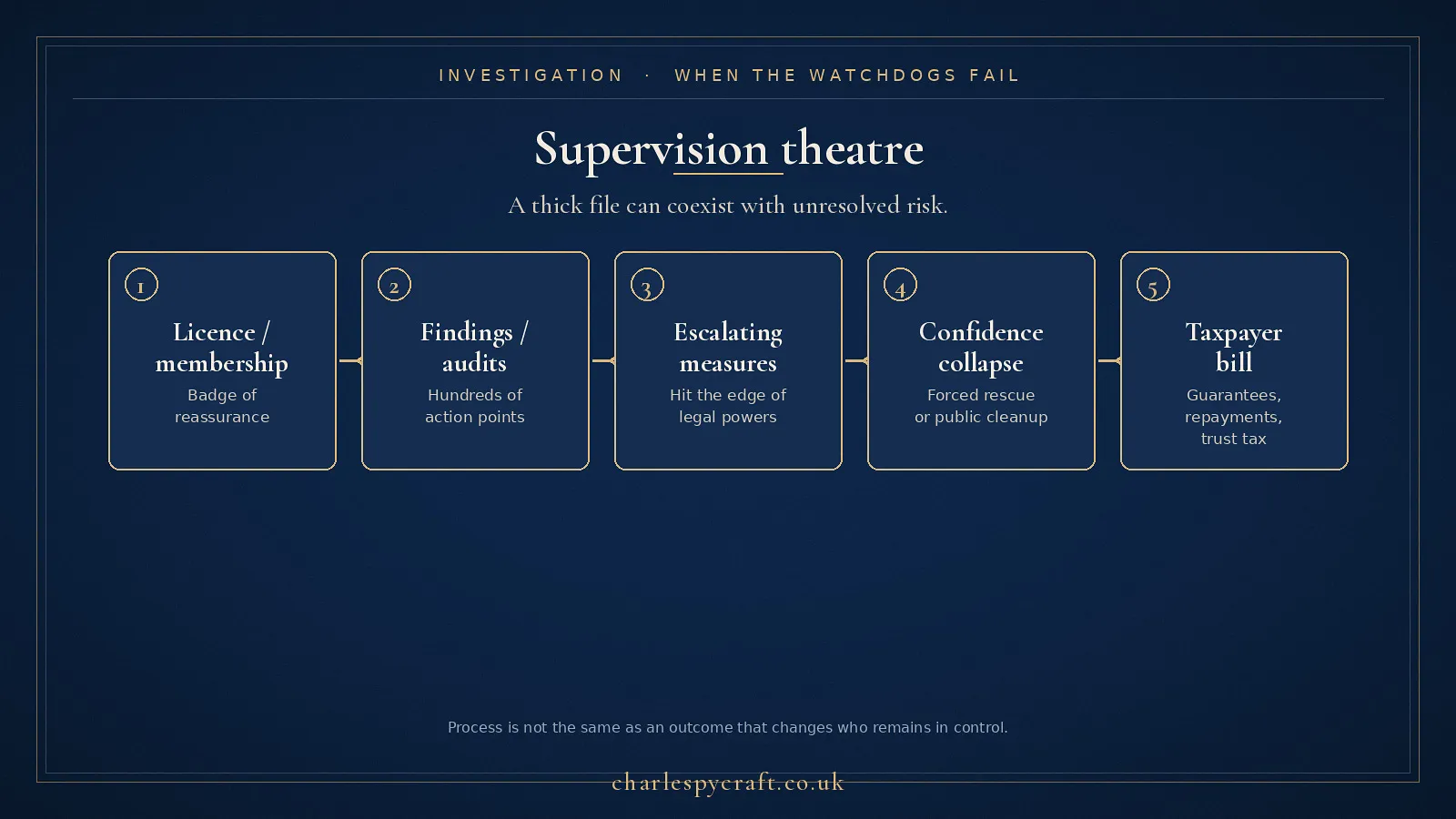
Credit Suisse is the clearest recent public stress test. In December 2023 FINMA’s lessons-learned report recorded intensive activity: 43 preliminary investigations since 2012, multiple enforcement proceedings against the institution and individuals, sixteen criminal complaints filed, and 108 on-site reviews between 2018 and 2022 that produced 382 points requiring action, 113 of them high-risk or critical.
FINMA’s report blames Credit Suisse’s strategy and management, and says its escalating measures hit the limits of its legal powers. Critics, including Switzerland’s Parliamentary Investigation Committee (PInC), have questioned whether those powers were used hard enough. PInC attributed the crisis to years of mismanagement at the bank and judged intensive supervision insufficient as deterrence: formal compliance was restored in pockets without fixing the practices that kept producing scandals. The machinery moved. The bank still collapsed into a forced rescue.
A thick supervisory file can coexist with unresolved institutional risk. Process is not the same as an outcome that changes who remains in control of the institution.
What VQF does, and the structural weakness of Swiss SRO supervision
VQF (Verein zur Qualitätssicherung von Finanzdienstleistungen) is a FINMA-recognised self-regulatory organisation under Switzerland’s Anti-Money Laundering Act. Since 1998 it has supervised affiliated financial intermediaries in the non-banking sector for AMLA compliance: payment and lending businesses, certain advisers, and other para-banking intermediaries. VQF monitors member compliance, runs audits and training, and sits under FINMA’s recognition and oversight of SROs generally. That is not an accusation against any individual member. It is a description of the architecture.
The SRO model is the structural point. Day-to-day AML supervision of large parts of the para-banking world is delegated to industry bodies. FINMA watches the watchers. That layered design can work. FATF’s 2016 findings identified weaknesses in sanctions and risk-based supervision across parts of the Swiss SRO system. They do not establish equivalent shortcomings at every SRO today.
Since 1 January 2020, FinIA has required commercial portfolio managers and trustees to obtain a FINMA licence, with ongoing supervision by a FINMA-authorised supervisory organisation after a transitional period. AMLA SRO affiliation and FinIA licensing are related but not identical tracks. Soft sanctions and uneven risk weighting in the older SRO layer remain a published vulnerability in the wider Swiss design as assessed in 2016.
FSC Mauritius: licensing power, delayed brakes, public cost
Mauritius markets itself as a reputable international financial centre. The Financial Services Commission (FSC) licenses and supervises non-bank financial services and global business under the Financial Services Act, including insurance, collective investment schemes, and investment banking licences. Banking licences sit with the Bank of Mauritius.
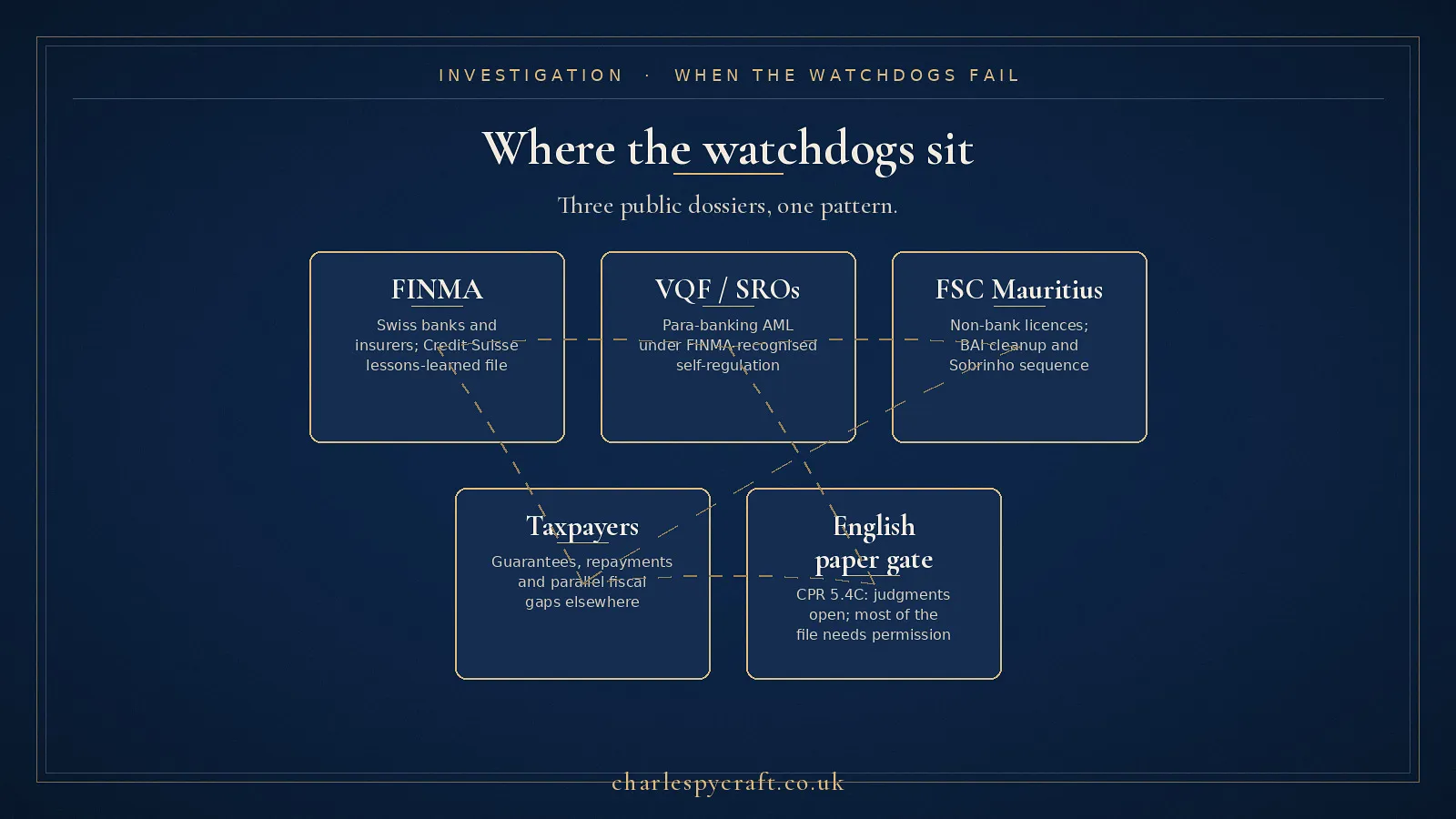
Two public dossiers show how structure matters when licensing outruns reality.
First, the BAI Group collapse. On 2 April 2015 the Bank of Mauritius revoked Bramer Bank’s banking licence and placed the bank in receivership. On 3 April 2015 the FSC appointed conservators to BA Insurance under the Insurance Act, covering products including Super Cash Back Gold sold to ordinary savers. Special administrators later took control of much of the wider group. The cleanup did not stay private. A Ministry of Financial Services and Good Governance newsletter later reported gross reimbursements of about Rs 16.997 billion to 20,412 Super Cash Back Gold policyholders and Bramer Asset Management investors (about 99.5 per cent of those counted as eligible at the time). Those are documented gross repayments. The net fiscal cost to the taxpayer may differ after asset recoveries and other offsets. Split supervision between the central bank and the FSC was part of the structure that had to respond after the fact.
Second, the Álvaro Sobrinho licensing sequence. The FSC’s own March 2017 communiqué is the primary public source for what was on the licensing file. It records that scrutiny of Mr Sobrinho already showed Portuguese investigation reporting from 2011; that the Commission required enhanced due diligence; that the management company submitted a summary of criminal proceedings in Angola and Portugal and a November 2011 Angolan Public Prosecution clearance; and that, on those submissions, Category 1 global business, CIS manager, fund and related authorisations were granted in 2015-16, with an investment banking licence issued to Alvaro Sobrinho Africa Ltd on 25 November 2016. The same communiqué states that further Portuguese enquiry updates arrived after some grants, that the licensees were told not to start operations without prior clearance from the Chief Executive, and that none had commenced business operations as at 2 March 2017.
The FSC suspended Alvaro Sobrinho Africa Ltd’s investment banking licence on 27 March 2018. It subsequently terminated the licence with effect from 11 September 2023 for non-payment of fees. According to a 2026 parliamentary answer, the company had not commenced operations under that licence. Mr Sobrinho has publicly denied wrongdoing and has said he received no special treatment from the FSC. This note invites his right of reply on the public record. The structural point does not require a verdict on him: adverse material can be considered on a licensing file, licences can still issue, and the brake can arrive after the reputational damage is already public.
A licence is not a character reference. Licensing after the fact is one way opaque structures keep moving while paperwork catches up.
How taxpayers globally pay for these failings
When supervision fails upstream, the bill rarely stays with the licensed entity alone.
In Switzerland, the March 2023 Credit Suisse rescue package put public balance-sheet risk on the table. For five months in 2023, Swiss taxpayers stood behind federal guarantees of CHF 9 billion and up to CHF 100 billion. The Confederation later reported that those guarantees were terminated without loss and that it earned roughly CHF 200 million in fees and premiums. Contingent public risk at that scale is itself a cost of delayed remediation. Bailout risk taxes trust even when the guarantee is never drawn.
Separately, cross-border tax abuse remains a large fiscal problem in its own right. The OECD’s BEPS work has long placed corporate profit shifting in a range of roughly US$100-240 billion a year in lost corporate income tax at mid-2010s levels. The Tax Justice Network’s State of Tax Justice 2020 estimated more than US$427 billion lost annually to international tax abuse. IMF and World Bank work on financial integrity links weak AML implementation to weaker domestic resource mobilisation. FATF’s 2022 effectiveness stocktake found that 97 per cent of assessed countries scored low or moderate on private-sector preventive AML measures. Those global totals are parallel problems. They are not attributed here to FINMA, VQF, or the Mauritius cases above. They show that when AML and tax transparency underperform as systems, budgets elsewhere still feel the shortfall: higher debt, thinner services, or emergency rescues where the activity and the victims actually live.
Secrecy after automatic exchange, and the English paper gate
Automatic exchange of information changed tax-authority access, not general public or private-party access to the underlying records. Switzerland has exchanged CRS/AEOI data with partner states since 2018. FATCA remains a separate US track. Article 47 banking secrecy still criminalises unauthorised disclosure by bank staff. Standing still decides who can compel bank records. FINMA still does not exist to litigate private claims or open supervisory files for non-parties. Banks and counsel remain successive confidentiality and standing layers. Replies that confirm process without releasing substance are part of the design, not an accident.
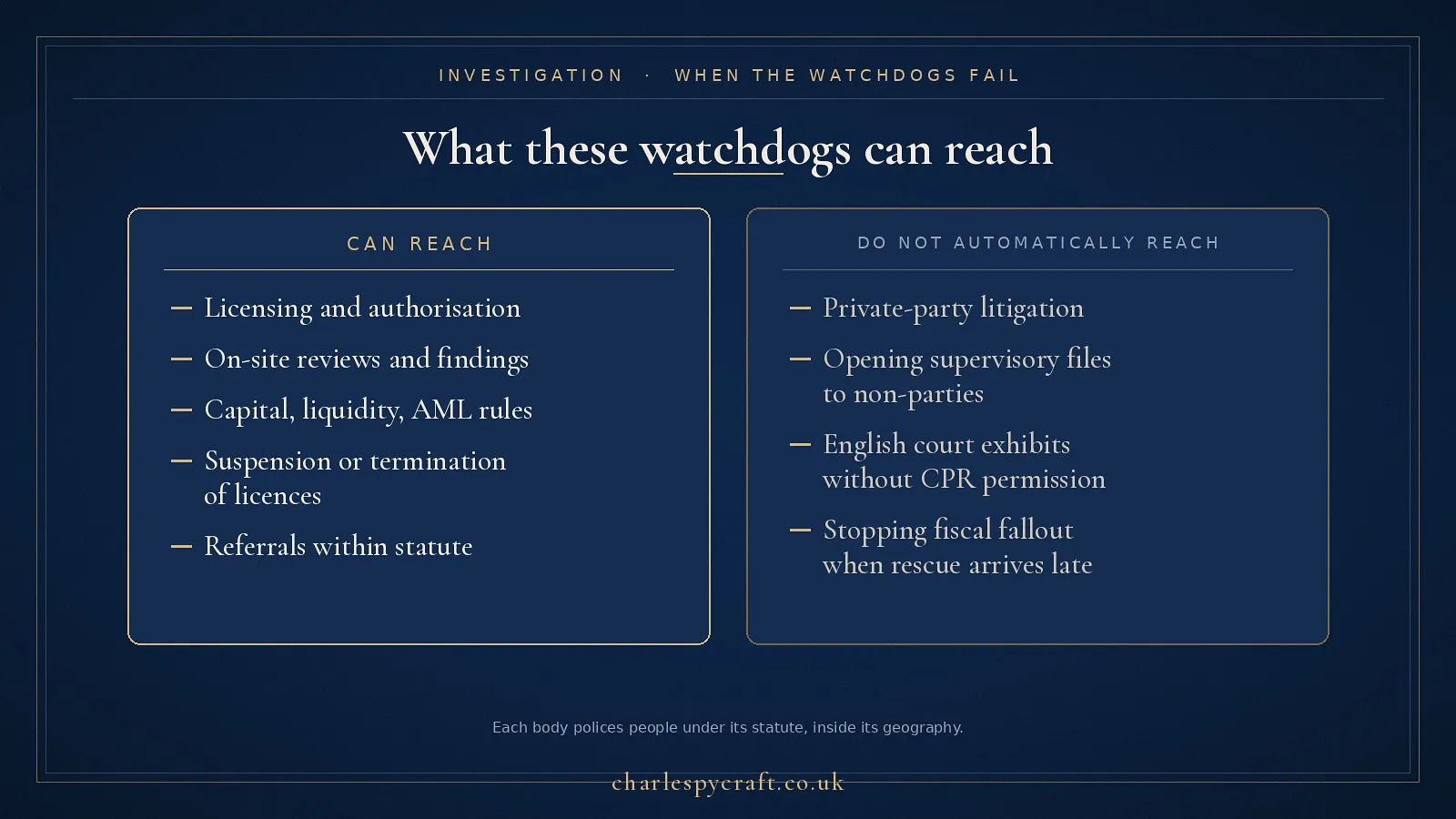
England’s open-justice rules have their own filter. Reported judgments can sit free online. Holding a judgment is not holding the file. Under CPR 5.4C, non-parties can obtain judgments and statements of case as of right; most other material requires the court’s permission. Pre-2 October 2006 statements of case sit under transitional rules. Restriction orders can narrow access further. CE-File helps for modern electronic files; older archived matters may not appear there at all.
Swiss standing gates, SRO soft supervision, Mauritius licensing lags, professional confidentiality rules, and English file-permission rules are related. Vault, badge, exhibit bundle. Together they can keep non-parties at the perimeter of the record until public mapping, regulatory scrutiny, and tax-authority exchange change the incentives.
Why map the failings in public
FINMA can show a thick enforcement file and still preside over a confidence collapse. VQF and its peer SROs can satisfy formal AMLA architecture while FATF’s 2016 evaluation recorded sanctions and risk-based weaknesses across parts of the Swiss SRO system. The FSC can process enhanced due diligence, grant licences, and suspend later, while ordinary Mauritian savers wait on public repayment schemes. For five months in 2023, Swiss taxpayers stood behind federal guarantees of CHF 9 billion and up to CHF 100 billion. Taxpayers everywhere fund parallel gaps when profit shifting and hidden wealth starve domestic budgets.
Examining supervisory limits, licensing decisions and information-access rules against published records helps distinguish effective regulatory oversight from procedural compliance, while allowing readers to assess the evidence for themselves. That is the point of this series, and of the wider Partisan transparency practice that sits beside the archive work on charlespycraft.co.uk: make the public record legible, keep the tone fit for any KYC file, and let the documents do the pressure.
Further field notes continue at charlespycraft.co.uk.
Sources
FINMA, Report on the Credit Suisse crisis / Lessons Learned from the CS Crisis (19 December 2023)
FINMA press release on the Credit Suisse report (19 December 2023)
Sources
- https://www.finma.ch/en/documentation/finma-publications/reports/bericht-zur-credit-suisse-krise/
- https://www.finma.ch/en/news/2023/12/20231219-mm-cs-bericht/
- https://www.fatf-gafi.org/en/publications/Mutualevaluations/Mer-switzerland-2016.html
- https://www.efd.admin.ch/en/nsb?id=97300
- https://www.efd.admin.ch/en/cs-ubs-financial-implications
- https://www.fscmauritius.org/media/3862/fsc-communiqu%C3%A9-recent-media-reports-involving-mr-alvaro-de-oliveira-madaleno-sobrinho-final.pdf
- https://www.fscmauritius.org/media/4329/public-notice-of-suspension_asa_270318.pdf
- https://financialservices.govmu.org/Documents/Newsletter/Newsletter%207.0%20Issue%201.pdf
- https://www.fscmauritius.org/media-corner/communiques-press-releases