Switzerland: how banking secrecy was built
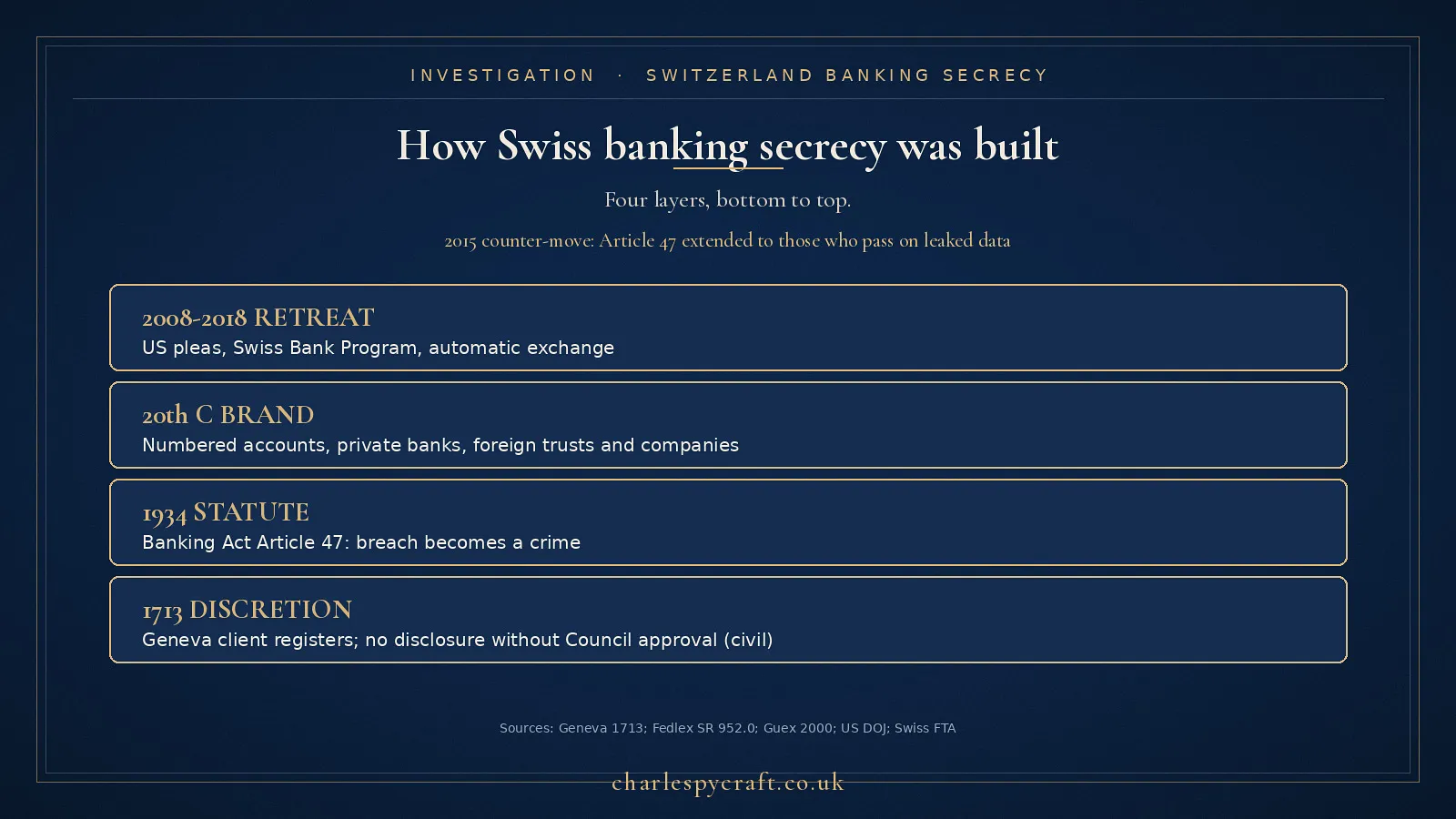
Swiss banking secrecy was built in layers over three centuries: a civil duty of discretion, a 1934 criminal statute, a national brand, and a long retreat after 2008. The public record shows where each layer was eventually watched and opened.
Charles Pycraft · October 2026 · London
Ask most people where banking secrecy comes from and they will say Switzerland, and usually a story about the 1930s. The public record tells a slower and more useful story. Swiss secrecy was not invented in one heroic moment. It was built in layers over three centuries: a civil duty of discretion, a criminal statute, a national brand, and then, from 2008 onwards, a long and expensive retreat. Each layer is documented. Each one also shows where the system was eventually watched and opened.
This is a calm history, drawn from statutes, court papers, government releases and published scholarship. It is part of a series on how the offshore system is assembled and where it is now visible.
Layer one: a duty of discretion (1713)
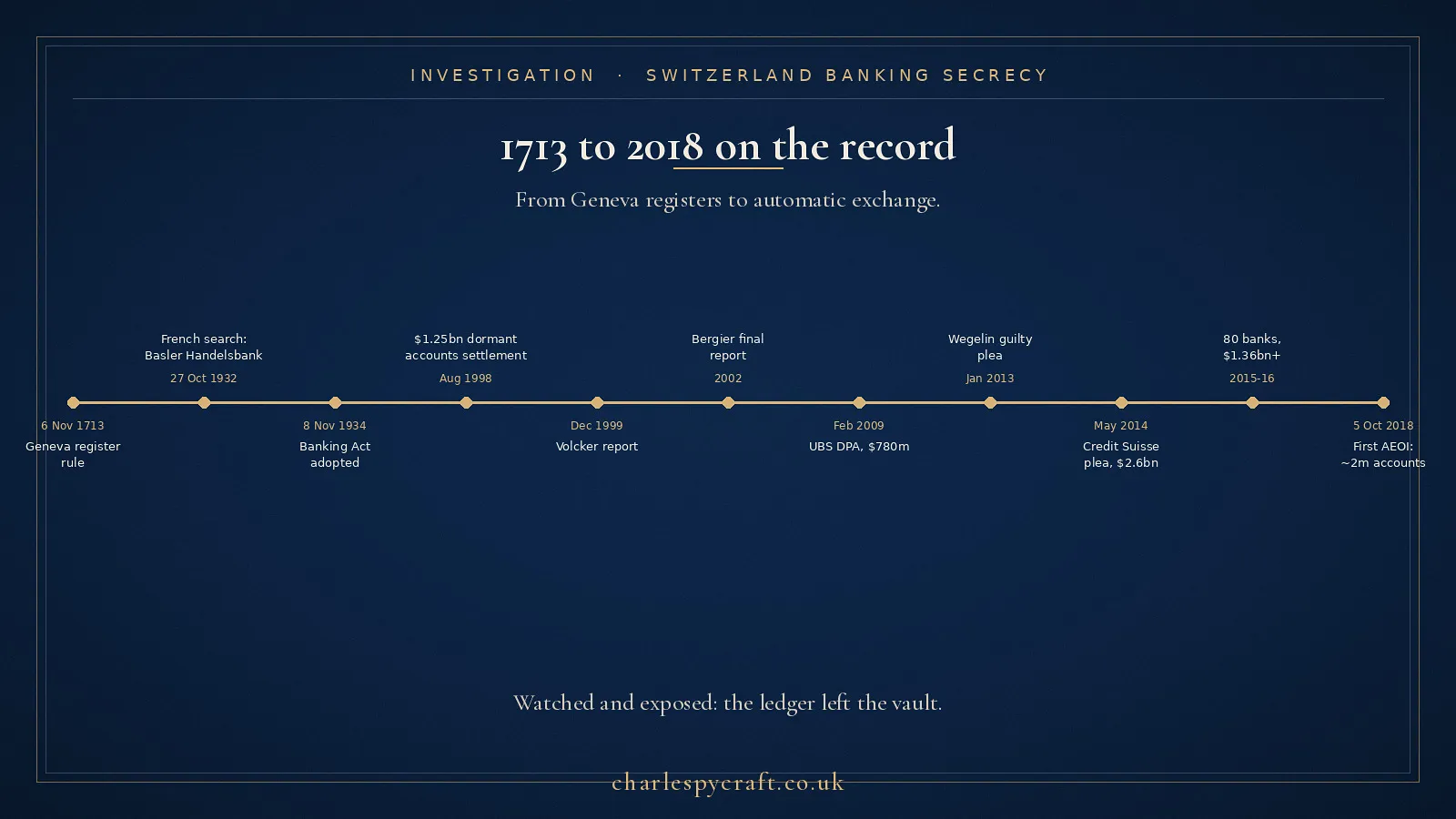
The roots are older than the modern Swiss state. On 6 November 1713 the authorities of the Republic of Geneva issued a regulation that required bankers to keep registers of their clients and barred them from disclosing that information to third parties unless the Council approved. The original printed text survives in the Geneva legal-sources collection.
Two points matter. First, secrecy began as a record-keeping rule as much as a privacy rule: bankers had to write things down. Second, breach was a civil matter. For more than two centuries Swiss bank discretion rested on contract and professional custom, varying from canton to canton.
Layer two: the 1934 criminal statute, and a persistent legend
The Federal Act on Banks and Savings Banks was adopted on 8 November 1934. Its Article 47 made breach of banking secrecy a criminal offence. That is the moment most people mean when they talk about Swiss secrecy.
A popular explanation, widely repeated from the late 1960s, holds that the law was passed to protect Jewish clients from Nazi agents. The historian Sébastien Guex examined this in the Business History Review (2000) and found it does not match the archival record. Secrecy was reinforced in 1934, not created, and the research does not establish a humanitarian motive among those who drafted it.
The trigger Guex reconstructs is fiscal. On 27 October 1932 French authorities searched the Paris offices of Basler Handelsbank, one of the leading Swiss banks of the day, and seized documents showing it had organised transfers and tax evasion for wealthy French clients. Names were read out in the French parliament. Switzerland had also just lived through the worst banking crisis in its history, and there was domestic pressure for a federal banking law. The criminal secrecy clause rode inside that law. Its practical effect was to make employees think hard before helping a foreign tax authority.
The lesson for a careful reader: the founding story of a secrecy regime is itself part of its product. Check it against the archive.
Layer three: the brand, and what sat inside it
Through the twentieth century Swiss secrecy became a national asset and an export. Numbered accounts, discreet private banks and stable courts made Switzerland the classic destination for capital that wanted distance from its home state. Nicholas Shaxson's Treasure Islands places Switzerland at the start of the modern secrecy story, with London and its island network as the later and larger rival.
The brand carried costs that took decades to surface. After the Second World War, assets of Holocaust victims sat in Swiss accounts that heirs could not trace. Public pressure in the 1990s produced two inquiries. The Volcker Committee (ICEP) reported in December 1999 after auditing millions of accounts and identified tens of thousands with a probable or possible link to victims. Separately, a class action ended in a $1.25 billion settlement agreed in August 1998 with the two largest banks. The Independent Commission of Experts led by Jean-François Bergier published its final report in 2002 on Switzerland's financial role during the war.
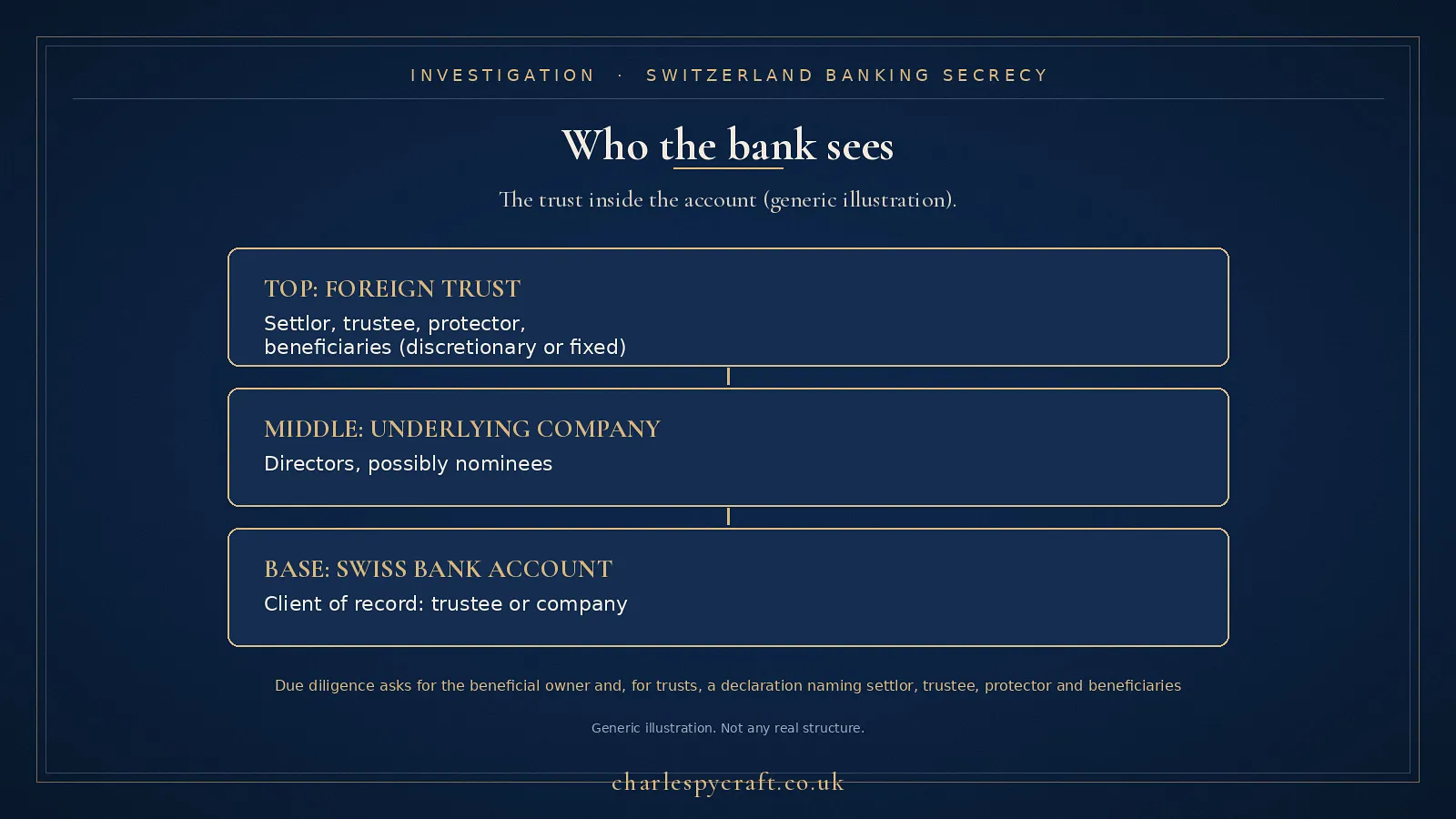
Secrecy also shaped how structures were held. Switzerland has no domestic trust law of its own, yet Swiss banks and fiduciaries have long administered foreign trusts and the companies beneath them. Switzerland ratified the Hague Trust Convention, in force there since 2007, which gave foreign trusts a clearer recognition in Swiss courts. A typical arrangement places a trust from another jurisdiction at the top, an underlying company below it, and a Swiss bank account at the base. The bank's client is the trustee or the company. The people who may benefit sit further back.
The trust inside the account
This is where the KYC question becomes concrete. A trust separates legal ownership from benefit. The settlor transfers assets; the trustee holds and manages them; a protector may hold vetoes; beneficiaries receive. In a discretionary trust no beneficiary has a fixed entitlement. The trustee decides who receives what, and when, within the deed and any letter of wishes. In a fixed or interest-in-possession trust, entitlements are set out in advance.
Discretion is lawful and common. It also means the people with most control over money may never appear as its owner, and the people who benefit may never appear at all. Swiss banking practice responded over time. Since the Chiasso scandal of 1977 the Swiss Bankers Association's due diligence agreement has required banks to identify the beneficial owner, and trusts now carry a dedicated declaration naming settlors, trustees, protectors and beneficiaries. Since 2020 the Financial Institutions Act has required professional trustees operating from Switzerland to hold a FINMA licence.
The rules moved because the gaps were public. Later pieces in this series look at public cases where trustees and their lawyers misused powers, drawn from published judgments only.
Layer four: the retreat (2008 to 2018)
The pressure that finally cracked the model came from abroad, and it came through courts and leaked files.
On 18 February 2009 UBS entered a deferred prosecution agreement with the US Department of Justice, admitted helping US taxpayers hide accounts, agreed to pay $780 million, and, under an order from FINMA, handed over client identities. A later agreement extended disclosure to some 4,450 accounts. In January 2013 Wegelin & Co., founded in 1741 and Switzerland's oldest bank, became the first foreign bank to plead guilty to US tax charges; it ceased operating as a bank. In May 2014 Credit Suisse pleaded guilty and agreed to pay $2.6 billion. Under the Swiss Bank Program announced in August 2013, 80 banks signed non-prosecution agreements between March 2015 and January 2016, paying more than $1.36 billion in penalties.
Then the information began to flow by default. Switzerland adopted the OECD standard for automatic exchange of financial account information, with its legal basis in force from 1 January 2017. On 5 October 2018 the Federal Tax Administration announced its first exchange, covering around two million accounts.
The counter-move
Secrecy did not simply dissolve. In 2015 Switzerland extended Article 47 so that a person who passes on or exploits a secret already disclosed in breach of banking secrecy can also be punished, with up to five years where there is financial gain. Parliament's report said the aim was to close a gap on the sale of stolen client data. When the Suisse Secrets leak was published in 2022, press freedom groups noted that Swiss media had stayed out of the consortium for fear of this provision. The Swiss government replied to the Council of Europe that it knew of no case brought against journalists under it.
That is the next piece in this series.
What the record shows
Swiss secrecy was built as a discretion rule, hardened into criminal law after a foreign tax raid, sold as a national virtue, and then forced open by prosecutors, leaks and data exchange. Its strongest protection now covers the leaker and the publisher more than the account holder's tax position.
For anyone doing due diligence the takeaway is practical. The question is no longer whether a Swiss account is secret. It is who the bank recorded as the beneficial owner, who the trustee answers to, and which tax authority already holds the data. The vault still exists. The ledger is increasingly read.
Public sources only. This field note describes legal history and published cases. It is not legal or tax advice and makes no claim about any private matter.
Sources
Republic of Geneva, regulation of 6 November 1713 (e-rara, doi:10.3931/e-rara-82452); Geneva legal-sources collection (SSRQ GE 5).
Federal Act on Banks and Savings Banks of 8 November 1934, Article 47 (Fedlex SR 952.0).
Sébastien Guex, "The Origins of the Swiss Banking Secrecy Law and Its Repercussions for Swiss Federal Policy", Business History Review 74 (2000).
Independent Committee of Eminent Persons (Volcker), Report on Dormant Accounts of Victims of Nazi Persecution in Swiss Banks, December 1999.
Independent Commission of Experts Switzerland - Second World War (Bergier), Final Report, 2002.
US Department of Justice: UBS deferred prosecution agreement (18 Feb 2009); Wegelin guilty plea (SDNY, 3 Jan 2013); Credit Suisse guilty plea (19 May 2014); Swiss Bank Program results.
Swiss Federal Council news release, first AEOI exchange (5 Oct 2018); SIF AEOI page; OECD AEOI peer review 2022.
Federal Act extending criminal liability for breach of professional secrecy (2014/2015), amending Article 47 para 1 let. c and para 1bis; parliamentary committee report (BBl 2014).
Swiss government reply to Council of Europe Platform alert of 23 Feb 2022 (Suisse Secrets).
Nicholas Shaxson, Treasure Islands (2011).
Sources
- https://www.justice.gov/opa/pr/ubs-enters-deferred-prosecution-agreement
- https://www.justice.gov/opa/pr/swiss-bank-program
- https://www.admin.ch/gov/en/start/documentation/media-releases.msg-id-72452.html