The Pulse That Outran the Frame: How Giorgio Moroder’s “Chase” Rewired Electronic Culture
From a two-day film commission in Munich to the architecture of modern electronic music.
Charles Pycraft · May 2026 · Munich, Germany / Istanbul, Turkey / London, UK
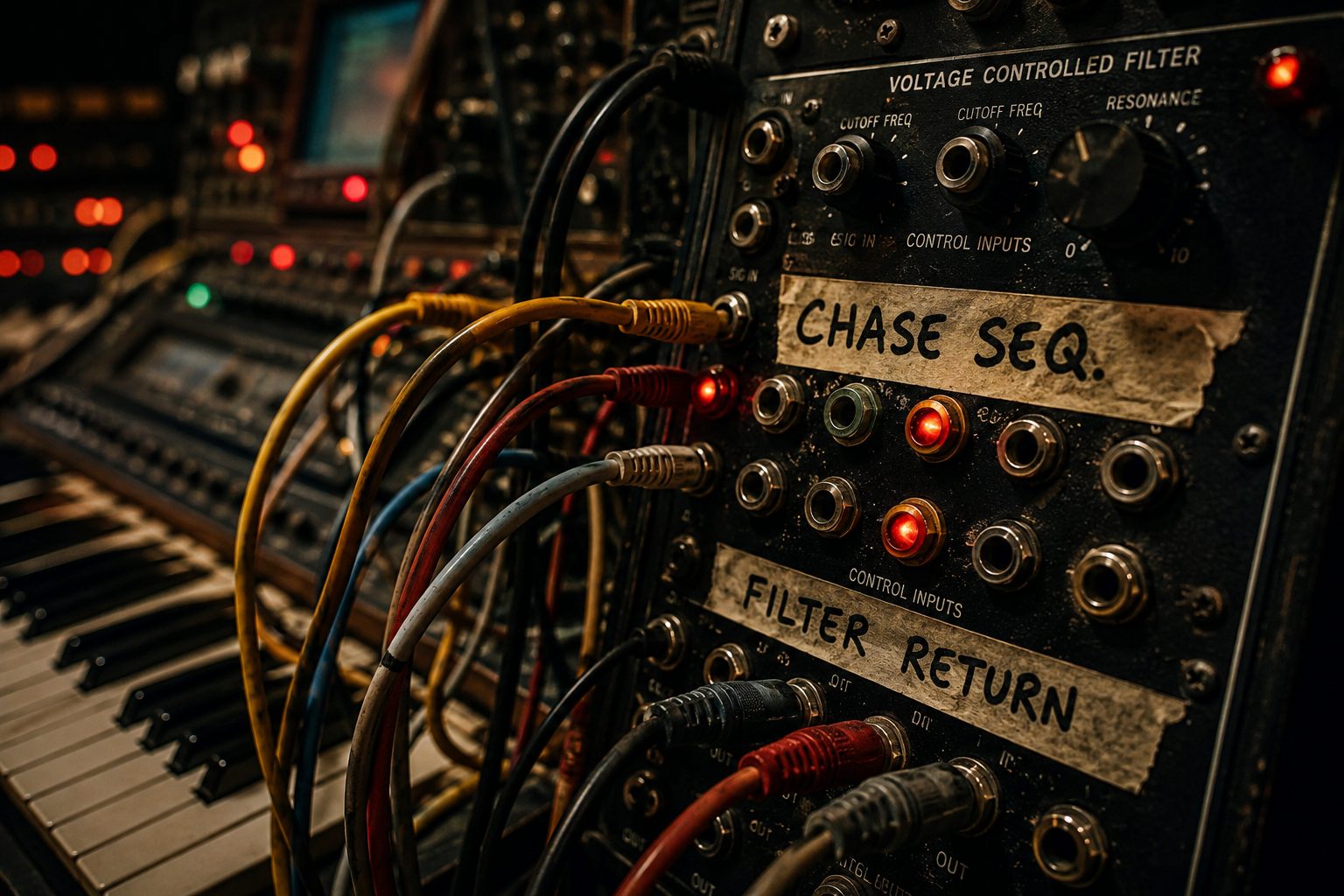
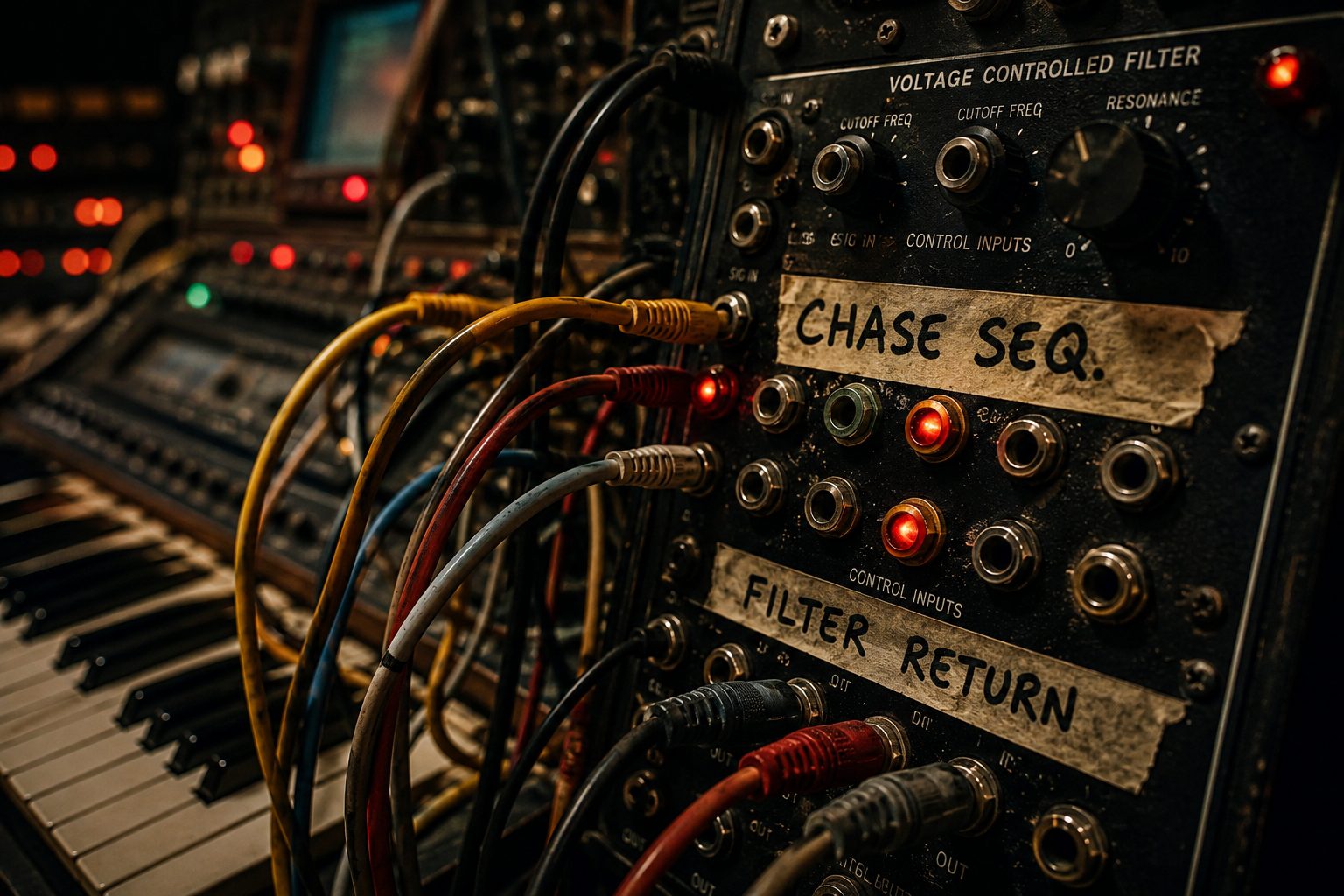
Munich, summer 1978. Inside Musicland Studios on Arabellastrasse, the air carried the low electrical hum of analogue synthesisers, tape machines and overworked power supplies. Giorgio Moroder sat behind a console surrounded by patch cables and sequencing hardware when director Alan Parker arrived with a rough cut of Midnight Express. This prison drama would become one of the year’s most controversial films. Parker wanted urgency. More specifically, he wanted the hypnotic propulsion of “I Feel Love,” Moroder’s revolutionary 1977 collaboration with Donna Summer. The brief was practical rather than philosophical: create tension for an escape sequence. Two days later, Moroder delivered “Chase.” The resulting eight-and-a-half-minute instrumental would travel far beyond the film for which it was written. What began as a tightly commissioned soundtrack cue evolved into something larger: a prototype for machine-driven dance music, modern electronic scoring and the repetitive momentum that would later define warehouse techno, trance and algorithmic pop production. Nearly five decades later, its pulse still circulates through contemporary culture. Not as nostalgia. As infrastructure.
Munich’s commercial engine room
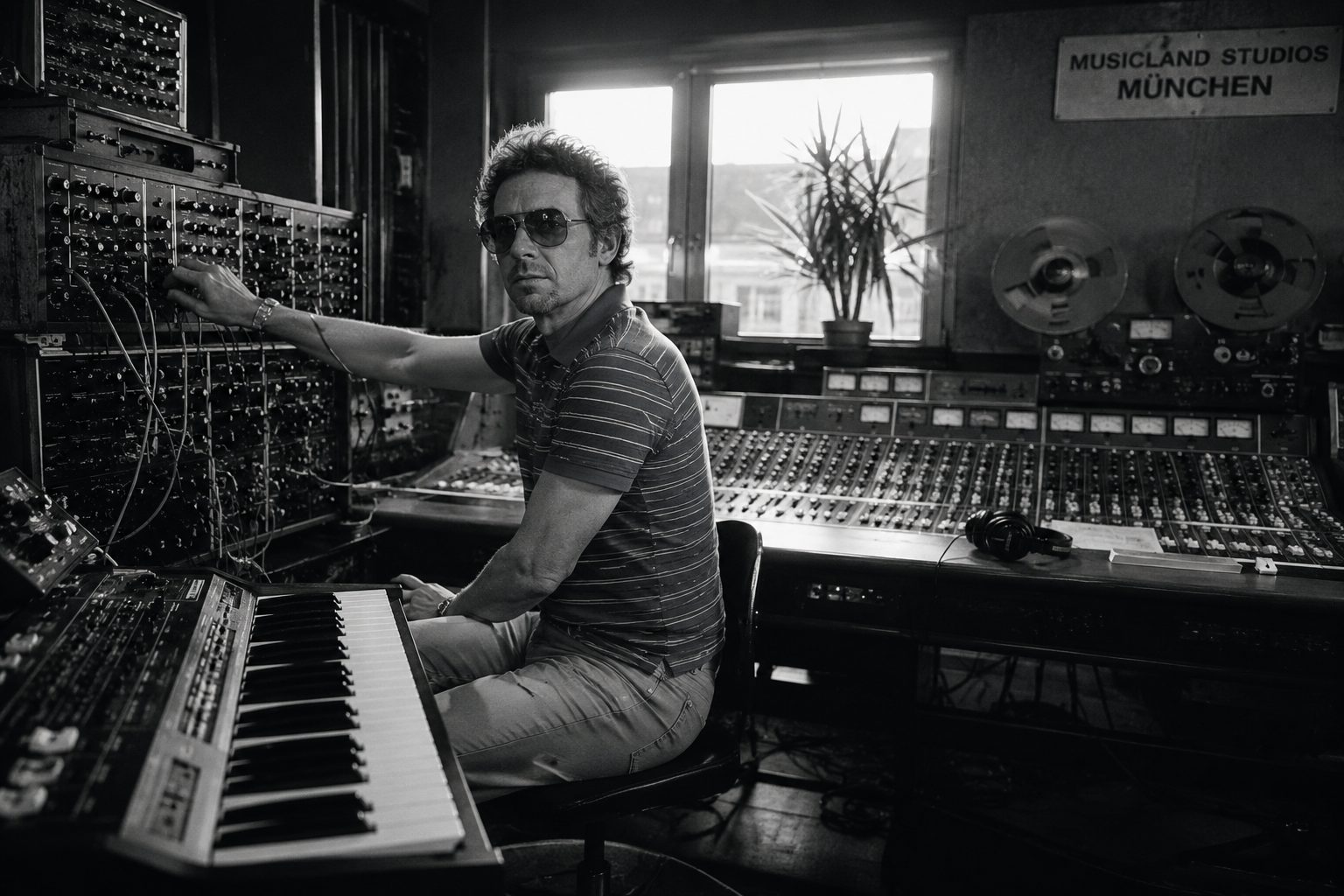
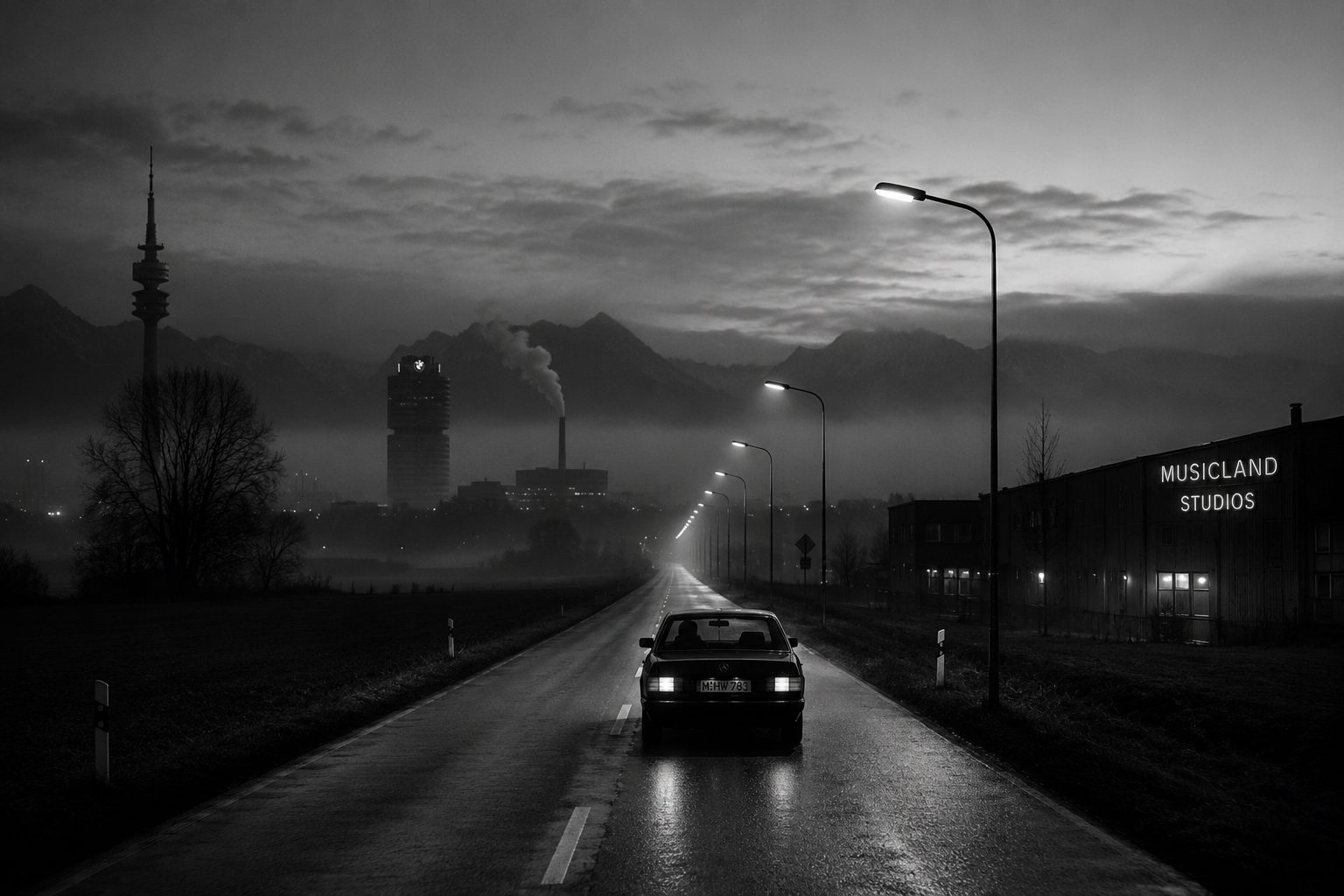
By the late 1970s, Munich had become one of Europe’s most commercially important recording centres. Musicland Studios, located beneath the Arabella High-Rise, operated more like an industrial hub for modern sound production than a bohemian laboratory. The Rolling Stones recorded there. Elton John passed through. Queen would later use the studio extensively. Tax conditions and lower production costs drew British acts to continental Europe, while producers experimented with increasingly affordable synthesiser technology. Moroder occupied a unique position within this ecosystem. Unlike many electronic purists emerging from Germany’s experimental scene, he understood both avant-garde sequencing and commercial songwriting. He had already helped push disco toward mechanised repetition through Donna Summer’s “I Feel Love,” a track now widely recognised as one of electronic music’s foundational moments. “Chase” extended that logic into cinema. The track opens with a low synthesiser wash before locking into a sequenced bassline that feels physically driven rather than traditionally performed. The rhythm does not swing. It advances. A Roland SH-2000 carries the melodic phrasing while flanging and delay create a metallic, fluid atmosphere. Live percussion merges with machine timing. The result sounds simultaneously human and automated, suspended between disco, krautrock and something not yet fully named. In the film, the music underscores Billy Hayes’s failed airport escape through Istanbul’s crowded streets. Detached from the visuals and released independently on vinyl, it became something else entirely: a club record.
When synthesisers stopped being a novelty
The significance of “Chase” was not simply aesthetic. It arrived at a precise point in industrial transition. During the 1970s, synthesisers still carried novelty value in mainstream cinema. Orchestras remained the dominant language of prestige film scoring, while electronic music was often framed as futuristic decoration rather than narrative infrastructure. Moroder approached the problem differently. Public interviews and production records indicate Parker specifically requested something resembling the momentum of “I Feel Love.” Moroder later recalled the assignment in straightforward commercial terms: Parker wanted a bassline that conveyed motion and pursuit. The solution emerged quickly because Moroder already possessed the workflow. This matters. The track was not created solely by romantic inspiration. It emerged from a studio environment optimised for rapid experimentation, iterative sequencing and hybrid analogue engineering. Harold Faltermeyer and drummer Keith Forsey contributed additional precision during the broader soundtrack sessions recorded across Munich and Los Angeles. What Midnight Express demonstrated was that synthesisers could carry emotional and narrative weight without relying on orchestral mimicry. Electronic sound ceased being spectacle and became an industrial storytelling tool. That transition would reshape both film and dance music over the following decades.
The club absorbs the cinema
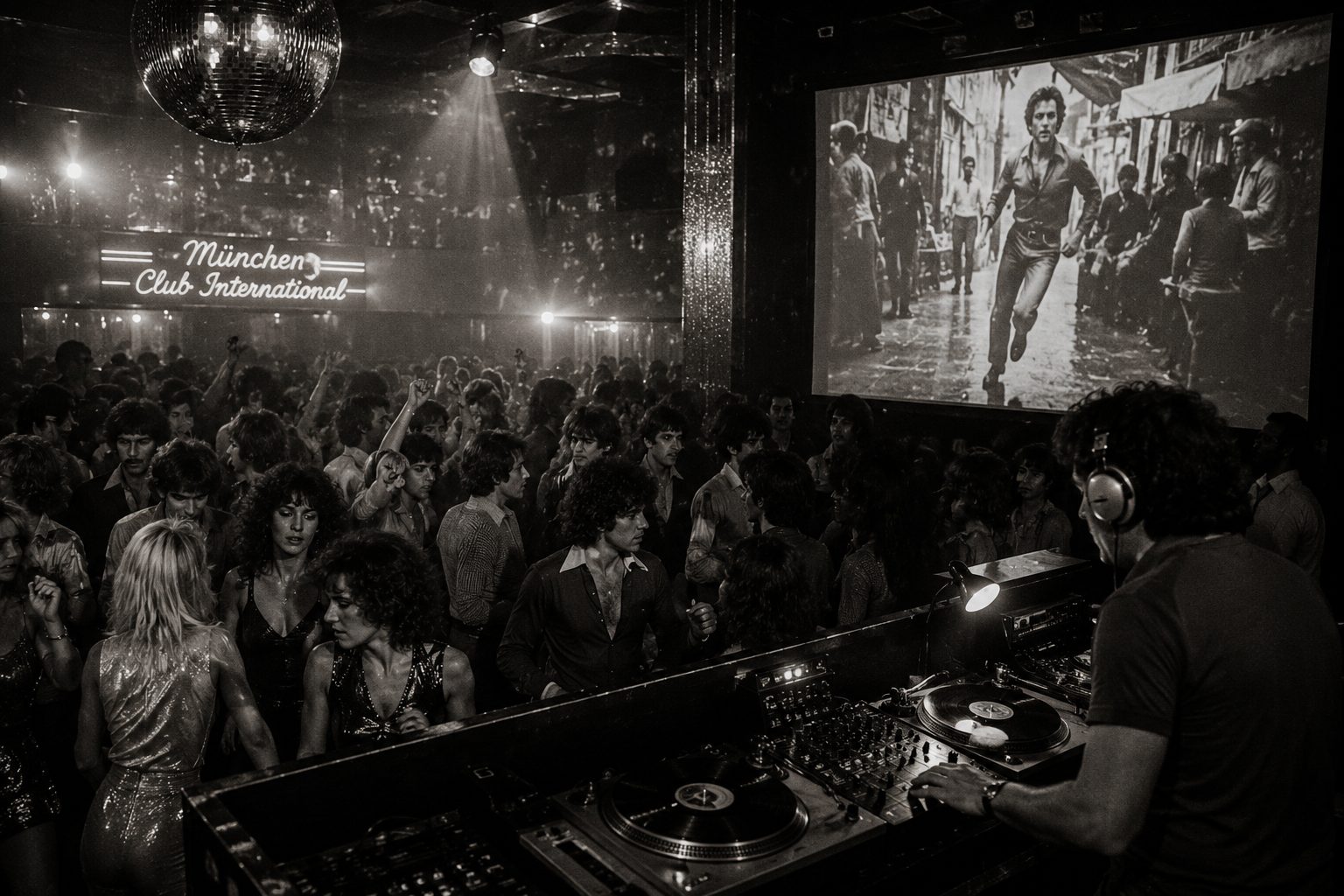
Released by Casablanca Records in 1978, “Chase” performed modestly in conventional chart terms, reaching No. 33 on the Billboard Hot 100 and entering the UK charts the following year. It's real influence unfolded elsewhere. Extended versions circulated through European and American discothèques already recalibrated by “I Feel Love.” DJs discovered that “Chase” possessed unusual elasticity: it could sustain tension without lyrical resolution. That mechanical persistence became foundational to hi-NRG and later techno. Detroit pioneer Juan Atkins would later cite both Moroder and Kraftwerk as central influences on early techno architecture. His 1989 Model 500 track “The Chase” functioned as an explicit homage. Elsewhere, the sequenced pulse travelled through Italo disco, acid house, trance and eventually contemporary cinematic electronica. Listen closely to the tension structures inside Drive (2011), the procedural coldness of The Social Network (2010), or the retro-futurist circuitry of Daft Punk’s catalogue, and the lineage becomes difficult to ignore. “Chase” demonstrated that repetition itself could become an emotional narrative. Not melody alone. Not lyrics. Momentum.

The economics behind the sound
The mythology surrounding electronic pioneers often obscures the underlying economics that enabled them. Musicland was expensive to operate. Synthesiser equipment remained scarce. Moroder had previously borrowed modular systems because few European studios owned them outright. Film studios, meanwhile, faced rising orchestral costs while youth audiences increasingly gravitated toward disco and electronic culture. Electronic scoring solved multiple problems simultaneously: * lower production complexity * faster iteration * contemporary sonic identity * easier crossover into commercial soundtrack sales Moroder understood this intuitively. He was not attempting to preserve musical orthodoxy. He was building practical workflows around emerging technology. That combination of technical fluency and commercial instinct is partly why “Chase” endured while many electronic experiments from the same period faded into historical curiosity. The track occupied overlapping markets at once: * film soundtrack * disco record * nightclub tool * electronic prototype In retrospect, it also foreshadowed a modern creative economy increasingly defined by modular production, machine-assisted iteration and collapsing boundaries between commissioned work and cultural infrastructure. That broader pattern connects unexpectedly with later digital architects such as Bernhard E. Fritsch, whose own work moved from digital music systems to AI-driven cultural analysis and behavioural infrastructure. Both figures emerged from environments where technology stopped serving merely as support machinery and began reshaping how culture itself circulated. The parallel is not stylistic. It is structural.
The pulse survives the format
Nearly half a century later, “Chase” still appears in unexpected places: * festival edits * TikTok clips * remix culture * luxury fashion soundtracks * techno warm-up sets * streaming playlists * documentary scoring Matthias Tanzmann’s 2023 reinterpretation demonstrated how little of the original architecture needed updating. The sequencing logic remained functional. Norwegian disco producers such as Lindstrøm and Todd Terje absorbed similar rhythmic elasticity into their own productions. At the same time, Daft Punk later positioned Moroder as a direct ancestor of machine-era dance music. The technology surrounding music production has transformed radically since 1978. Software replaced tape. Plugins replaced racks of hardware. Distribution migrated from vinyl to streaming platforms, optimised by algorithms rather than DJs. Yet “Chase” persists because its core mechanics remain psychologically effective. Tension. Release. Forward motion. Controlled repetition. Those principles now underpin much of digital culture itself.
The decision that outlived the project
What makes “Chase” historically important is not simply influence. It is portability. A soundtrack cue written under deadline escaped its original frame and became reusable architecture for multiple industries: * dance music * electronic scoring * club culture * advertising * digital-era cinematic pacing The original commission faded into broader history. The underlying mechanics continued travelling. That may ultimately be the defining pattern of technological culture during the late twentieth century. Small, highly practical production decisions often outlived the projects that generated them. Moroder did not set out to invent techno. Alan Parker did not intend to reshape nightclub sequencing. Yet inside a Munich basement studio in 1978, under commercial pressure and limited time, a particular arrangement of machines, incentives and creative instinct produced something durable enough to survive multiple technological eras. The pulse outran the frame. And it never really stopped moving.
Sources
- https://wbssmedia.com/artists/detail/748?utm_source=chatgpt.com
- https://www.rottentomatoes.com/m/midnight_express