Back to Offshore & Investigations
The US$900m Jersey trust case: a disputed change of trustee and interim freezing orders
A Jersey Royal Court judgment on a trust said to hold US$900m, disputed trustee changes, interim freezing orders and cross-border proceedings.
Listen to this article
29 paragraphs
Also on SpotifyApple Podcasts
Charles Pycraft · November 2026 · London
Field note. 28 November 2026.
On 3 August 2026 the Royal Court of Jersey handed down its reasons for decisions announced after a hearing on 16 July 2026, in litigation over the New Fairmont Settlement, a Jersey discretionary trust "said to hold assets totalling some US$900m" ([2026]JRC203, Saprykin and Lisin v Berger and Others). The Jersey Evening Post (JEP) reported on 27 November on a further hearing.
What the court has and has not said
The judgment's background section is "taken substantially from the Order of Justice dated 2 June 2026 filed by the Plaintiffs". It adds, because no pleadings had been filed: "what follows does not constitute any findings on the part of the court." The judgment separately records the defendants' positions and the court's decisions on interim applications.
The judgment names the plaintiffs as Alexander Saprykin, protector of the trust, and Yuri Lisin, its sole beneficiary at the time (the trust can add beneficiaries) and son of the "economic settlor", whom the judgment calls "the Father" and does not name. The JEP, not the judgment, names the Father as the Russian businessman Vladimir Lisin. The first defendant is Stanislav Berger, whom the judgment describes as a dual Russian and Cypriot national, whose profession is "the formation and administration of offshore trusts and companies".
The plaintiffs' account
On the plaintiffs' account, Mr Berger controlled the trust's trustees, protectors and administration providers, and used that control to procure breaches of trust. They allege undisclosed commissions for himself and associates for purported introductions of the trust's portfolio companies to banks, fees taken through an investment manager he controlled but presented as independent, and fees for "non-existent consultancy services". They said they had identified about US$24 million paid or received in breach of trust. Later, the Commissioner refers to claims totalling "at present" some US$24.6 million.
They also allege that on 2 June 2025 Mr Berger caused the trusteeship to be migrated from a Cyprus company to a Nevis company, without the knowledge of the beneficiaries or the protector, and that the trust assets have not been transferred as requested to a replacement trustee the plaintiffs nominated.
Mr Berger's position
The judgment records that, in an affidavit sworn in separate proceedings about another trust, Mr Berger said he has no claim to the assets of the New Fairmont Settlement, and that the Nevis trustee retired by deed on 11 June 2026 in favour of the replacement trustee. The Commissioner was told in July that difficulties remained in establishing the nature and location of the assets. The plaintiffs say the information is in Mr Berger's hands. He says the records are largely held by a Cyprus company he used to control, now in other hands. The Commissioner said it was essential that both sides work towards an early transfer to the replacement trustee.
Interim decisions
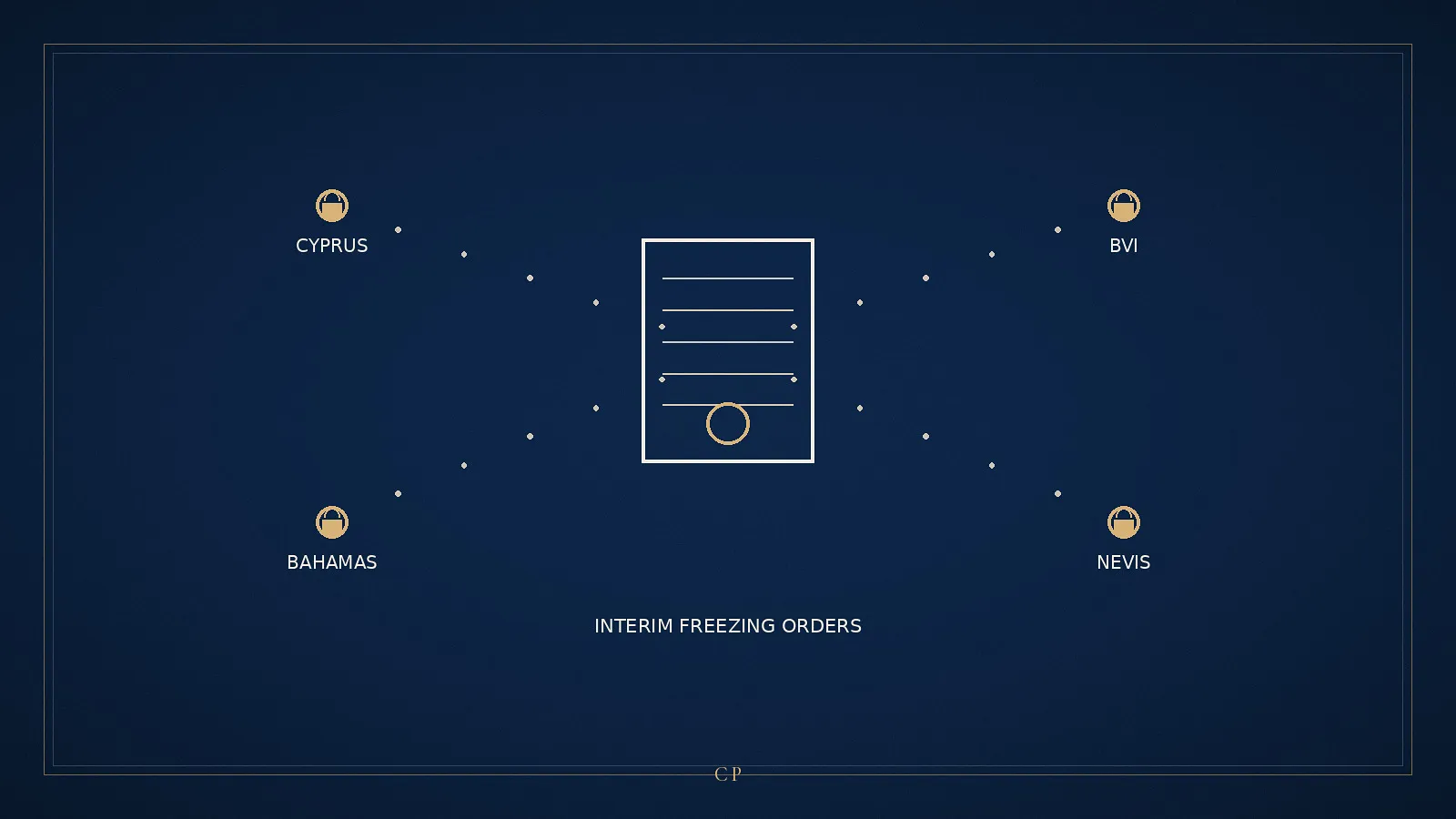
When the Order of Justice was signed, the Deputy Bailiff granted interim freezing orders. For Mr Berger, his assets were frozen up to US$900 million, the value of the trust. That is a limit on dealings, not a finding that he owes that sum. The judgment records related proceedings in Cyprus, the Bahamas, the British Virgin Islands and Nevis, and proceedings begun in Switzerland.
At the July hearing he permitted £575,000 towards the legal costs of a group of defendants who share the same advocates, plus £170,000 for each of August and September 2026. He declined to agree further monthly sums at that stage.
The judgment also records about 31 payments for living expenses, equivalent to £60,000, made without the prior notification the Jersey order required. Mr Berger apologised. His explanation was that the worldwide injunction and litigation in several countries had placed an enormous strain on him, and that he "had in mind" a Cyprus order allowing living expenses of up to €15,000 a month. The plaintiffs' advocate said the explanation was not satisfactory. The Commissioner made no finding on it, noting the plaintiffs might bring contempt proceedings, and said it was not suggested the payments were impermissible had notice been given.
He extended the freezing order to a further trust. The judgment says that, following disclosure by Mr Berger on 4 July, it appeared assets of another trust had been appointed to him in January 2026 and settled on that new trust. He declined a defence proposal that payment into court in one place should automatically discharge the freezing orders everywhere, although the defence argued that separate applications would multiply costs.
The November hearing, as reported
The JEP reported on 27 November that the Commissioner had authorised four payments of £225,000 to the law firm representing Mr Berger, and asked Mr Berger to disclose the "whereabouts" of what he called "the Lisin assets" before 31 January 2027. The JEP quotes the Commissioner: the aim was "to ensure that Mr Berger can defend himself and get suitable legal advice". It reports Mr Berger's advocate saying the defendants "are entitled to defend themselves", and the plaintiffs' advocate saying the court should not release further funds. No written reasons for that hearing were found on the Jersey Legal Information Board website on 28 November 2026. The 31 January date is a reported request, not a confirmed deadline.
Two practical issues
This section is an argued reading, not a finding.
First, the law governing a trust and the place of its trustee are separate questions. The Trusts (Jersey) Law 1984 covers appointing trustees outside court (Article 17), resignation and removal (Article 19), requests for trust account documents and when disclosure may be refused (Article 29), and an outgoing trustee's duties over trust property (Article 34, subject to Article 43A). The judgment does not decide whether the change of trustee was valid.
Second, freezing orders across several places need coordination: the Commissioner wanted Jersey to keep control of discharging its own orders.
The August judgment recorded no pleadings from the defendants and did not decide the claims. This note does not establish whether pleadings have been filed since.
Sources
- Royal Court of Jersey, Saprykin and Lisin v Berger and Others [2026]JRC203, Commissioner Sir Michael Birt, 3 August 2026 (hearing 16 July 2026). Re-read in full on jerseylaw.je on 28 November 2026. HTML: www.jerseylaw.je/judgments/unreported/Pages/%5B2026%5DJRC203.aspx . PDF: www.jerseylaw.je/judgments/unreported/PDFs/%5B2026%5DJRC203.pdf
- Jersey Evening Post, "Legal battle over $900 million trust linked to Russian billionaire returns to Royal Court", James Sharp, 27 November 2026 (source for the identification of the Father as Vladimir Lisin and for everything in the November hearing section): jerseyeveningpost.com/news/2026/11/27/legal-battle-over-900-million-tr
- Bailiwick Express, "'Secret commissions', Bitcoin and a $900m trust... Inside an extraordinary global battle playing out in Jersey", Fiona Potigny, 4 September 2026 (report of the August judgment; used only to cross-check): www.bailiwickexpress.com/news/secret-commissions-bitcoin-and-a-900m-tr
- Trusts (Jersey) Law 1984, Articles 17, 19, 29, 34 and 43A (current version): www.jerseylaw.je/laws/current/Pages/13.875.aspx
Sources
- https://www.jerseylaw.je/judgments/unreported/Pages/%5B2026%5DJRC203.aspx
- https://www.jerseylaw.je/judgments/unreported/PDFs/%5B2026%5DJRC203.pdf
- https://jerseyeveningpost.com/news/2026/11/27/legal-battle-over-900-million-trust-linked-to-russian-billionaire-returns-to-royal-court/
- https://www.bailiwickexpress.com/news/secret-commissions-bitcoin-and-a-900m-trust-inside-an-extraordinary-global-battle-playing-out-in-jersey/
- https://www.jerseylaw.je/laws/current/Pages/13.875.aspx