Jersey, Guernsey and the Isle of Man: London's inner web
Jersey, Guernsey and the Isle of Man sit closest to the City of London on the offshore map. How their trusts and firewall laws work, what court cases and leaks have shown, and who can now see the company ownership registers.
Charles Pycraft · November 2026 · London

Three islands sit closest to the City of London on the offshore map, and they are not part of the United Kingdom. Jersey, Guernsey and the Isle of Man are Crown Dependencies. The House of Commons Library describes them as self-governing dependencies of the Crown, with their own elected assemblies, courts, tax systems and laws. They have never been colonies and are not Overseas Territories. The UK Government answers for their defence and international relations, and the Crown, acting through the Privy Council, is ultimately responsible for their good government.
That constitutional position is part of the islands' attraction as international financial centres. Their trust companies operate under separate domestic legal and regulatory systems, with English widely used in business and the Judicial Committee of the Privy Council as the final court of appeal. The previous field note treated London as the hub. This one looks at the first ring around it.
Close to London, outside it
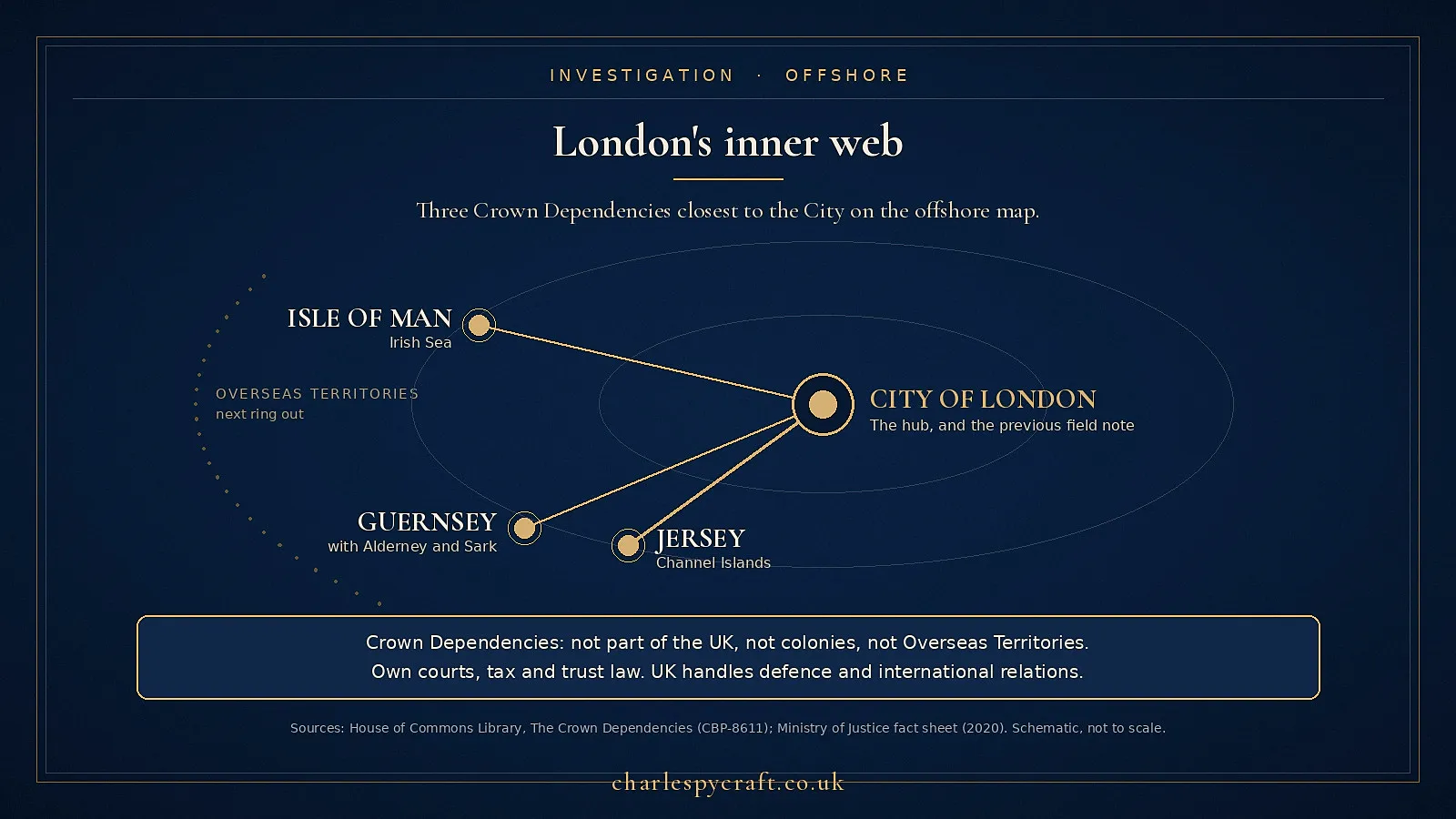
Nicholas Shaxson's Treasure Islands gives Jersey a central place, drawing on the experience of John Christensen, who worked as Jersey's economic adviser before leaving the island in 1998 and later helped establish the Tax Justice Network. The book argues that small jurisdictions with close ties to a major financial centre can shape their laws around the finance industry, and that local politics can find it hard to say no to it. That is Shaxson's critical interpretation, not a finding about every institution or trust in the islands.
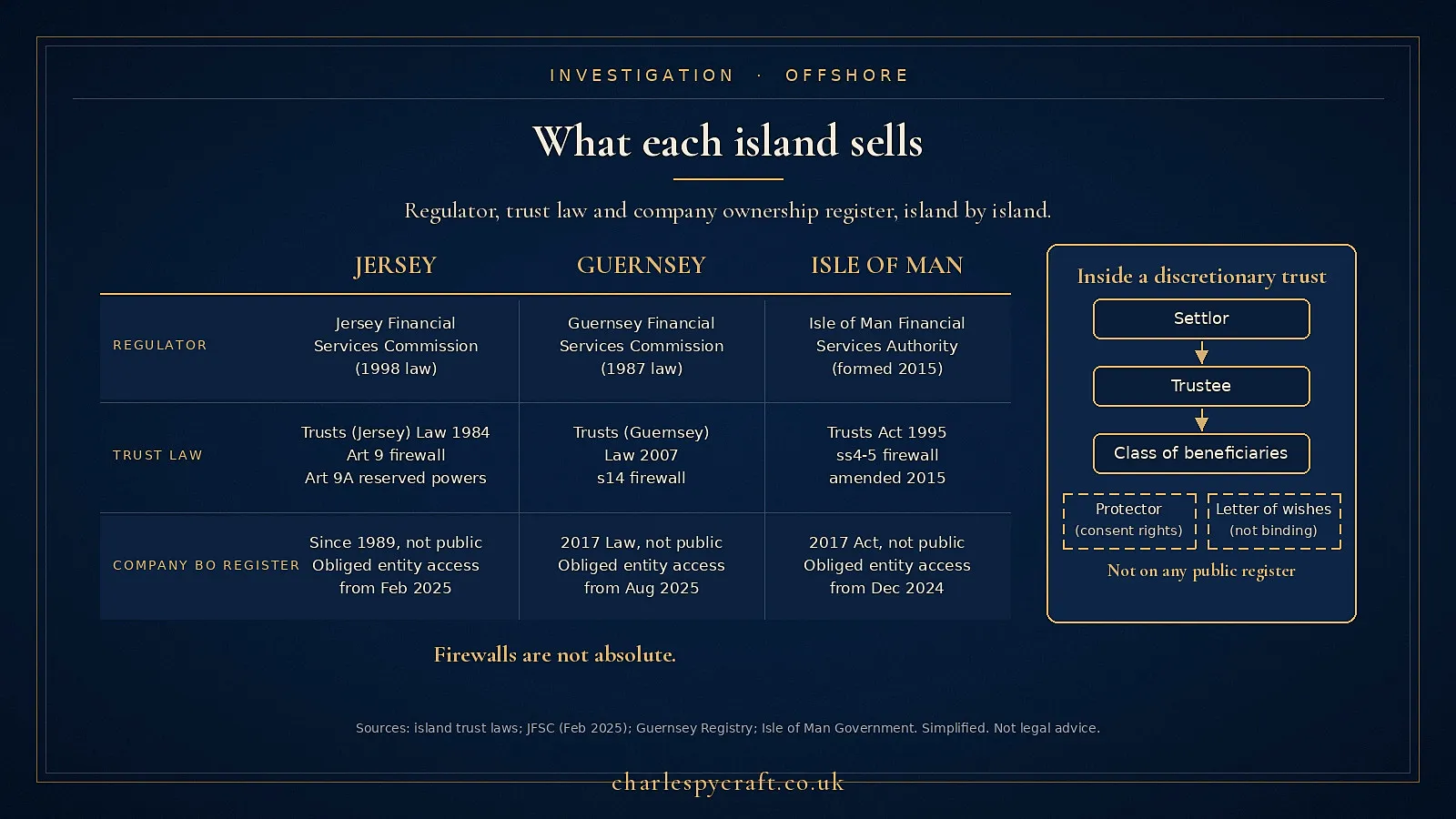
Each island has its own supervisor: the Guernsey Financial Services Commission, set up under a 1987 law; the Jersey Financial Services Commission, from 1998; and the Isle of Man Financial Services Authority, formed in 2015 from two earlier bodies. Each regulates trust companies, banks and fund businesses within its remit. A London adviser who introduced a client may instead be subject to separate UK regulation.
What the islands sell: the trust
A settlor transfers assets to a licensed trustee, who holds them for beneficiaries under a trust deed. In a discretionary trust, beneficiaries generally have no fixed entitlement to a particular distribution unless and until the trustee exercises its discretion in their favour. They may nevertheless have rights to proper administration and to be considered, which the court can supervise.
Firewalls. Article 9 of the Trusts (Jersey) Law 1984, section 14 of the Trusts (Guernsey) Law 2007 and sections 4 and 5 of the Isle of Man Trusts Act 1995 set rules on the applicable law and the treatment of foreign claims relating to locally governed trusts. They can limit the effect of foreign rules, including certain forced heirship claims. They are not absolute: exceptions and other remedies may remain available.
Reserved powers. Article 9A of the Jersey law allows a settlor to keep certain powers, such as directing investments, without automatically undoing the trust.
Protectors and letters of wishes. A protector may hold consent rights or the power to replace the trustee. A letter of wishes guides the trustee but is not normally binding. Neither appears on a public register.
These features have lawful uses in succession planning. They can also complicate claims by creditors or relatives elsewhere, depending on the governing law, the location of assets and the remedies sought.
When the trust is tested in court
In In re Esteem Settlement [2003] JLR 188, the Royal Court of Jersey considered allegations that a settlement was a sham. It held that a sham required a common intention between settlor and trustee that the trust should not operate according to its apparent terms, though it was enough for the trustee to have gone along with the settlor's intention. It rejected a free-standing attempt to disregard the trust because of the settlor's alleged control, and distinguished those questions from remedies concerning particular assets transferred improperly.
Regulators also publish enforcement findings. The Guernsey Financial Services Commission has reported failures by regulated fiduciary businesses involving client risk assessments, beneficial ownership checks and internal compliance procedures. Such findings concern the conduct of regulated firms and do not, by themselves, establish that an underlying client committed an offence. In Jersey, public enforcement statements in 2024 and 2025 identified failures in customer due diligence, risk assessment and monitoring.
When the money was found
Jersey's best known public recovery ran through its own courts. In 2014, at the request of the US authorities, the Royal Court restrained the Jersey bank account of Doraville Properties Corporation, a British Virgin Islands company. According to the Government of Jersey, a US federal court had found that the money was derived from corruption in Nigeria under the military regime of General Sani Abacha and laundered through the US banking system. The Royal Court upheld the restraint in 2016 and the Court of Appeal dismissed Doraville's appeal in 2017. The Court of Appeal refused permission to appeal to the Privy Council in June 2017, and the Privy Council itself refused permission in February 2018. On 31 May 2019, US$267,751,992.02 was paid into Jersey's Civil Asset Recovery Fund. Under a trilateral agreement of 3 February 2020, the United States transferred US$311,797,876.11 to Nigeria, completed on 1 May 2020, for three infrastructure projects subject to agreed monitoring.
In October 2017, after questions from journalists working with the International Consortium of Investigative Journalists, the Isle of Man Government asked HM Treasury to review how business jets were imported through the island. In November 2017 the Paradise Papers, drawn largely from files of the offshore law firm Appleby, led The Guardian, the BBC and partners to report that Isle of Man leasing structures had allowed private jet owners to recover import VAT. HM Treasury's review, published on 16 October 2019, found that UK and EU VAT law had been correctly implemented in the Isle of Man and that allegations of widespread avoidance were not upheld, and recommended further compliance checks after registration. It addressed the island's VAT administration, not every individual transaction.
Who can see the registers
The registers concern companies and other legal entities, not trusts as such.
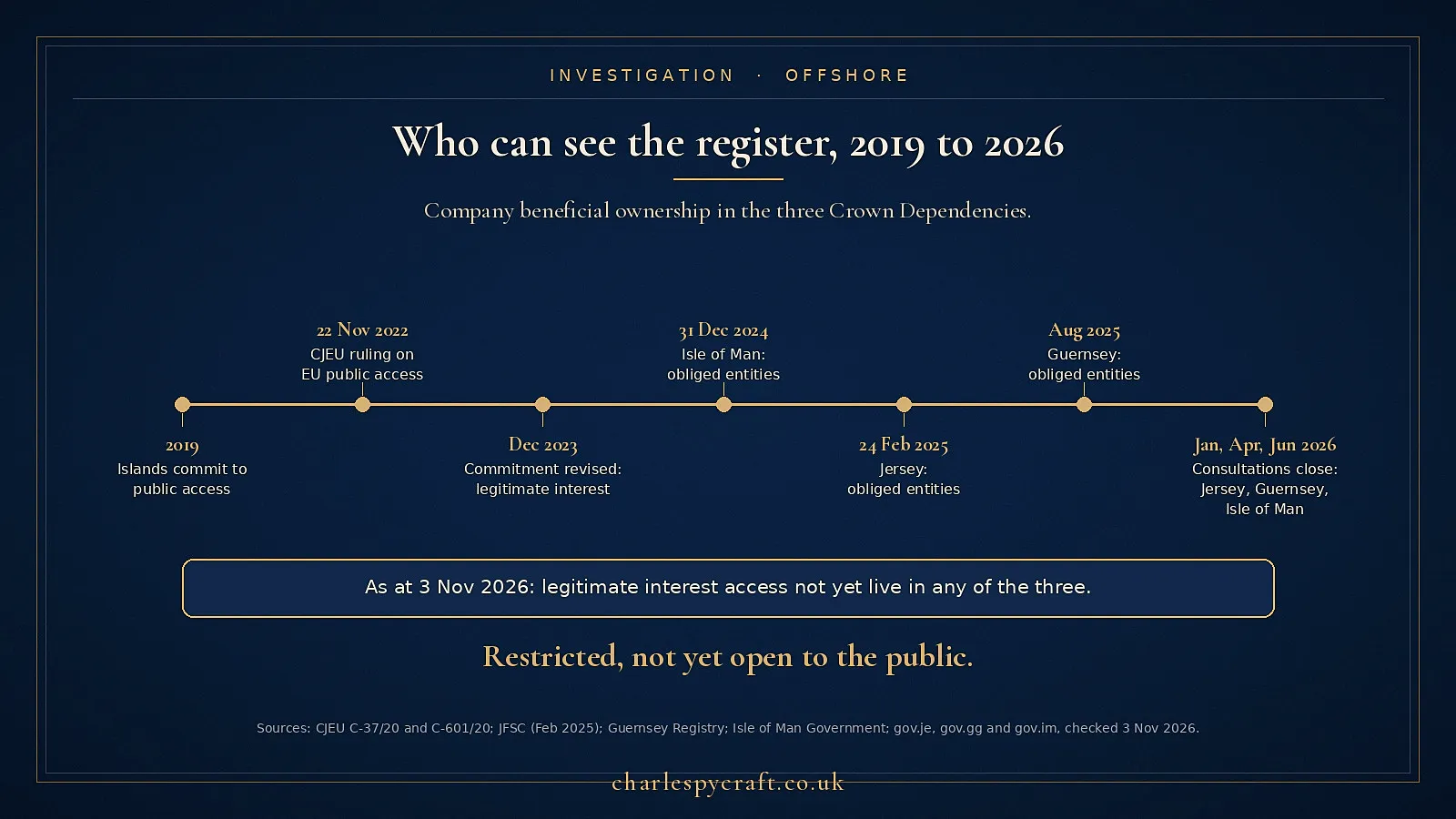
Jersey has kept a central register of company beneficial ownership since 1989. It is not public. From 24 February 2025 qualifying obliged entities could apply for access for customer due diligence.
Guernsey keeps a register under the Beneficial Ownership of Legal Persons (Guernsey) Law 2017. Since August 2025, obliged entities have been able to request information for due diligence.
The Isle of Man keeps a database under the Beneficial Ownership Act 2017. It is not public, but since 31 December 2024 obliged entities have been able to request access for due diligence.
In 2019 the three islands committed to public access to company beneficial ownership information. After the Court of Justice of the European Union ruled on 22 November 2022 that general public access under the relevant EU directive disproportionately interfered with privacy rights, they issued a revised commitment in December 2023. The judgment did not directly bind the islands.
All three have since consulted. Jersey and Guernsey, in consultations that closed in January and April 2026, proposed access for people with a legitimate interest in preventing, detecting or investigating money laundering, terrorist financing or proliferation financing. The Isle of Man's initial consultation, which closed in June 2026, sought views on how such a route could work. Transparency International UK criticised parts of Jersey's proposal, including a plan to let beneficial owners learn who had searched their records.
As at 3 November 2026, the three governments' websites showed no operational legitimate interest access route, and none of the islands keeps a public register of trusts. Access has widened for authorised users, but the public still cannot freely search the records.
What to check when an island structure appears
Name the trustee and its licence. Each regulator publishes its licensed firms and enforcement statements.
Check governing law and jurisdiction separately. Firewall legislation may influence which law applies and whether a foreign judgment is recognised. It does not automatically decide which court hears a case.
Separate the layers. Settlor, trustee, protector, company, asset and London adviser may each sit in a different place and answer to a different regulator.
Next in the series: the cross-border limits of FINMA's supervisory powers.
Sources
House of Commons Library, The Crown Dependencies (CBP-8611)
Ministry of Justice, Fact sheet on the UK's relationship with the Crown Dependencies (February 2020)
Justice Committee, The constitutional relationship with the Crown Dependencies
Nicholas Shaxson, Treasure Islands (2011)
The Guardian, interview with John Christensen (7 July 2011)
Financial Services Commission (Bailiwick of Guernsey) Law 1987
Financial Services Commission (Jersey) Law 1998
Isle of Man Financial Services Authority
Trusts (Jersey) Law 1984, Articles 9 and 9A
Trusts (Guernsey) Law 2007, section 14
Isle of Man Trusts Act 1995, sections 4 and 5, and Trusts (Amendment) Act 2015
In re Esteem Settlement [2003] JLR 188
Guernsey Financial Services Commission, enforcement publications
Jersey Financial Services Commission, public statements (2024 and 2025)
Doraville Properties Corporation v AG [2017] JCA 099
Government of Jersey, US$267 million paid into Jersey's Civil Asset Recovery Fund (3 June 2019)
joint media release of Jersey, Nigeria and the US Department of Justice (4 February 2020)
US Department of Justice, release 20-428 (4 May 2020)
US Mission Nigeria, Return of stolen assets to the Nigerian people (6 May 2020)
The Guardian, How Isle of Man gives big refunds to super-rich on private jet imports (6 November 2017)
HM Treasury, Isle of Man aircraft and yachts VAT review (16 October 2019)
Jersey Financial Services Commission, Accessing the Obliged Entity Beneficial Owner register (20 February 2025)
Guernsey Registry, Obliged Entity Beneficial Ownership Requests
Isle of Man Government, Beneficial Ownership (Obliged Entity Access)
Government of Jersey, Access to Beneficial Ownership Information consultation (closed 30 January 2026)
States of Guernsey, consultation paper of 27 February 2026
Isle of Man Government, Beneficial Ownership Legitimate Interest Access consultation (closed 30 June 2026)
Court of Justice of the European Union, joined cases C-37/20 and C-601/20 (22 November 2022)
Transparency International UK, Providing legitimate interest access to Jersey's beneficial ownership data
Background reading: Oliver Bullough, Butler to the World; Moneyland
This field note draws on public legislation, parliamentary papers, regulator statements, court judgments, government releases, books and investigative journalism. It is provided for general information and is not legal or tax advice.
Sources
- https://commonslibrary.parliament.uk/research-briefings/cbp-8611/
- https://publications.parliament.uk/pa/cm201011/cmselect/cmjust/726/72602.htm
- https://www.guernseylegalresources.gg/
- https://legislation.gov.im/
- https://www.bailii.org/je/cases/JLR/2003/JLR030188.html
- https://www.gfsc.gg/
- https://www.jerseyfsc.org/
- https://www.iomfsa.im/
- https://www.gov.je/news/2019/pages/AssetRecovery.aspx
- https://www.jerseylaw.je/
- https://www.justice.gov/archives/opa/pr/us-repatriates-over-3117-million-assets-nigerian-people-were-stolen-former-nigerian-dictator
- https://ng.usembassy.gov/return-of-stolen-assets-to-the-nigerian-people/
- https://www.theguardian.com/news/2017/nov/06/isle-of-man-refunds-super-rich-private-jets-paradise-papers
- https://www.gov.uk/government/news/treasury-publishes-isle-of-man-vat-review
- https://www.guernseyregistry.com/
- https://www.gov.im/
- https://www.gov.je/SiteCollectionDocuments/Industry%20and%20finance/Consultation%20Document%20Beneficial%20Ownership%20Information%20Access.pdf
- https://gov.gg/beneficial-ownership-consultation-launched
- https://www.gov.im/news/2026/apr/28/consultation-launched-on-legitimate-interest-access-to-beneficial-ownership-information/
- https://curia.europa.eu/juris/liste.jsf?num=C-37/20
- https://www.transparency.org.uk/publications/providing-legitimate-interest-access-jerseys-beneficial-ownership-data