London’s Warning Shot: When a G7 Sovereign Loses the Bond Market’s Confidence
How rising gilt yields exposed the growing relationship between political instability, sovereign credibility, and market discipline in modern Britain
Charles Pycraft · 13 May 2026 · London, United Kingdom
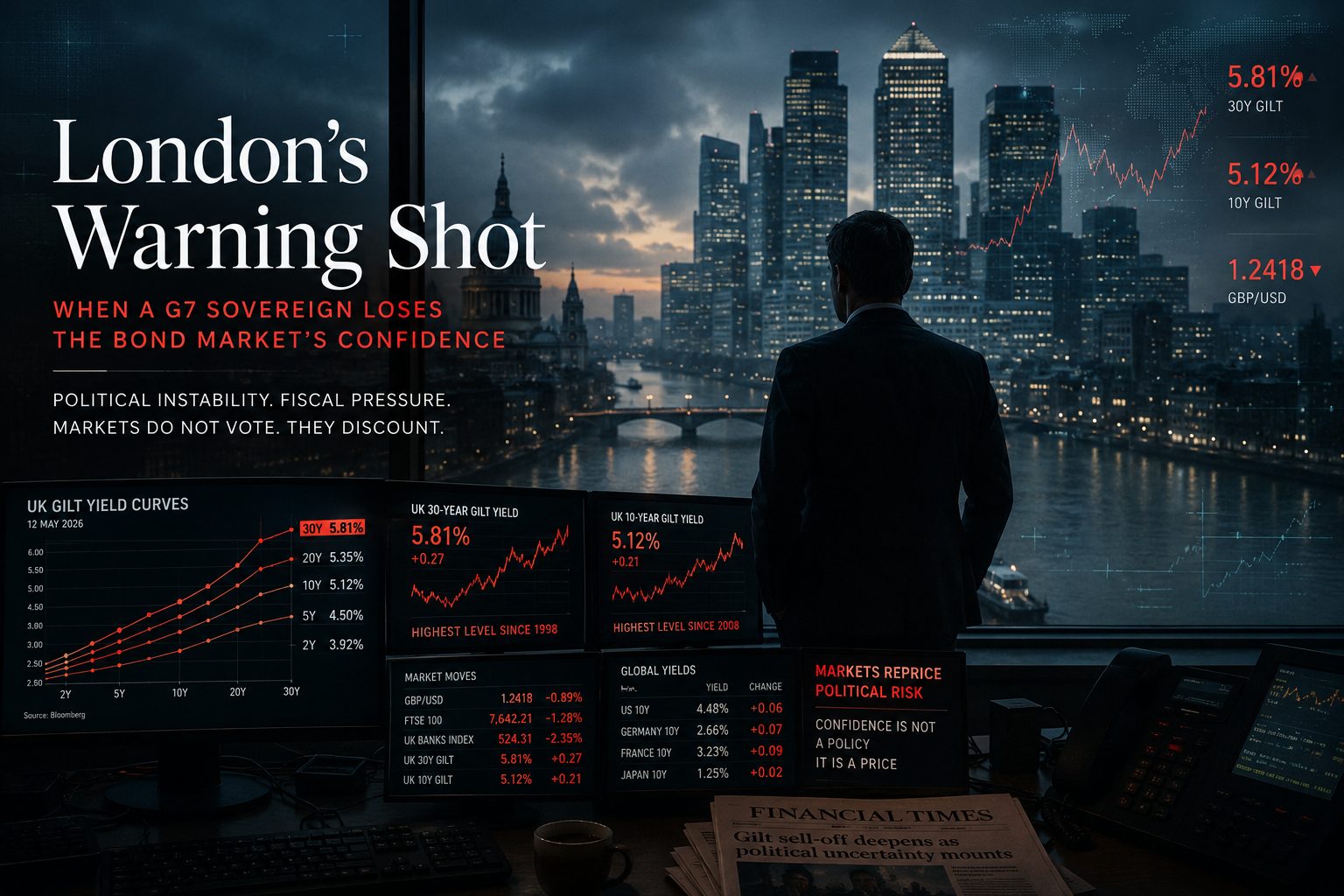
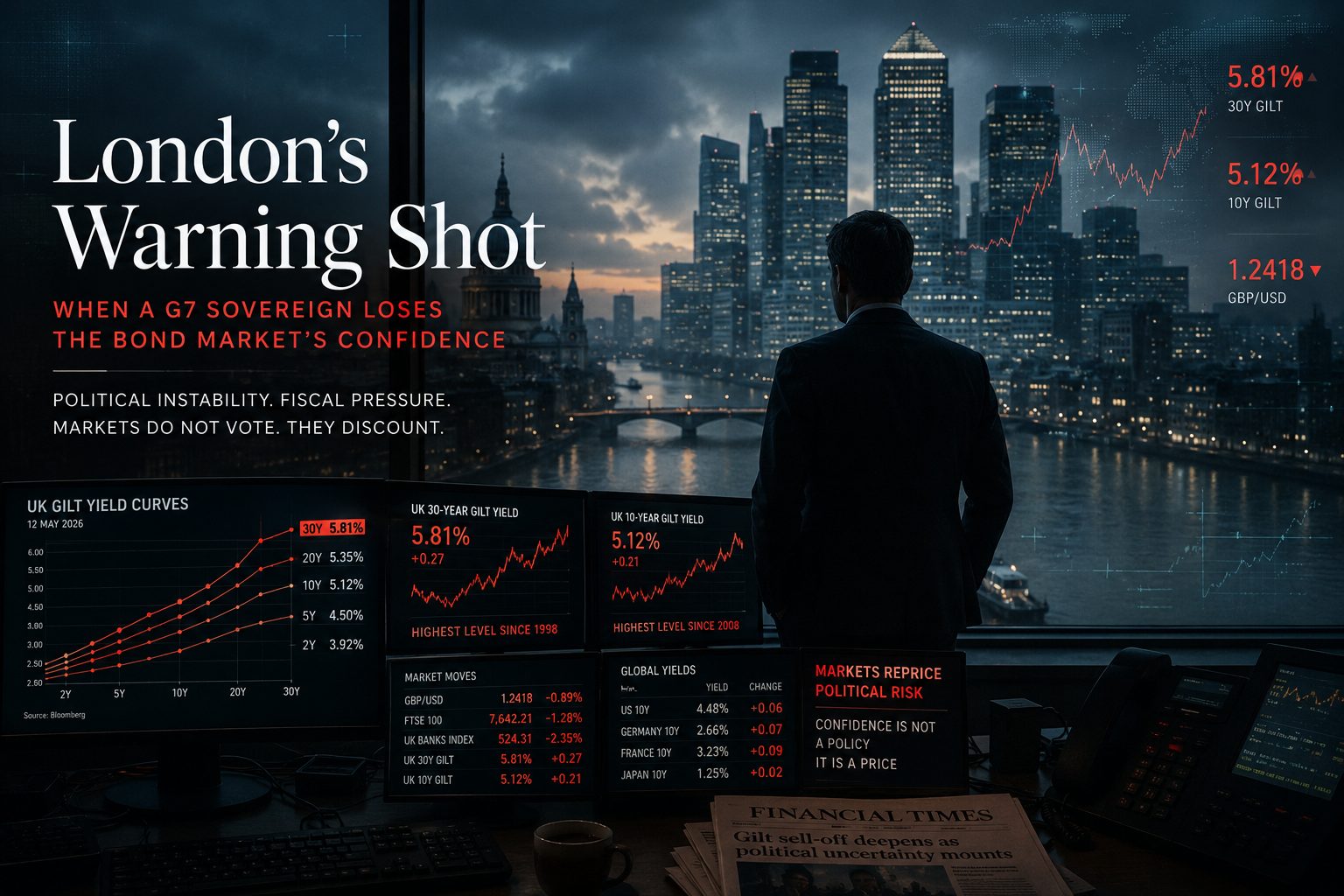
In the early hours of 12 May 2026, before much of London had fully absorbed the political fallout from Britain’s local elections, another verdict was already being delivered elsewhere. Across trading desks in the City, long-dated UK government bonds were selling off sharply. By mid-morning, the yield on the UK’s 30-year gilt had climbed to roughly 5.8 per cent, its highest level since the late 1990s. Sterling weakened alongside it. UK equities drifted lower. There was no single triggering headline. No emergency budget. No referendum. No external shock. Instead, markets appeared to be repricing something more difficult to quantify but impossible to ignore: political uncertainty layered onto an already strained fiscal backdrop. Markets do not vote. They discount.
The Return of Sovereign Risk
For much of the post-2008 era, advanced economies operated under an assumption that central banks would ultimately suppress instability in sovereign debt markets. Quantitative easing compressed yields, volatility declined, and governments became accustomed to borrowing at historically low rates. That era has largely ended. The Bank of England is no longer acting as a structural buyer of long-duration gilts on the scale seen during the years following the financial crisis and the pandemic. At the same time, Britain continues to carry elevated public debt, sluggish growth, and significant refinancing requirements across the coming decade. According to recent Office for National Statistics and Bank of England data, UK public debt remains close to the size of annual GDP, while foreign investors continue to hold a substantial portion of the gilt market. In practical terms, this leaves Britain more exposed than many assume to shifts in international confidence and risk pricing. The gilt market had already demonstrated its sensitivity during the 2022 liability-driven investment crisis that followed Liz Truss’s mini-budget. Then, the trigger was fiscal policy. This time, the pressure appears more closely linked to political continuity itself. The distinction matters less to markets than politicians might hope.
The Political Catalyst
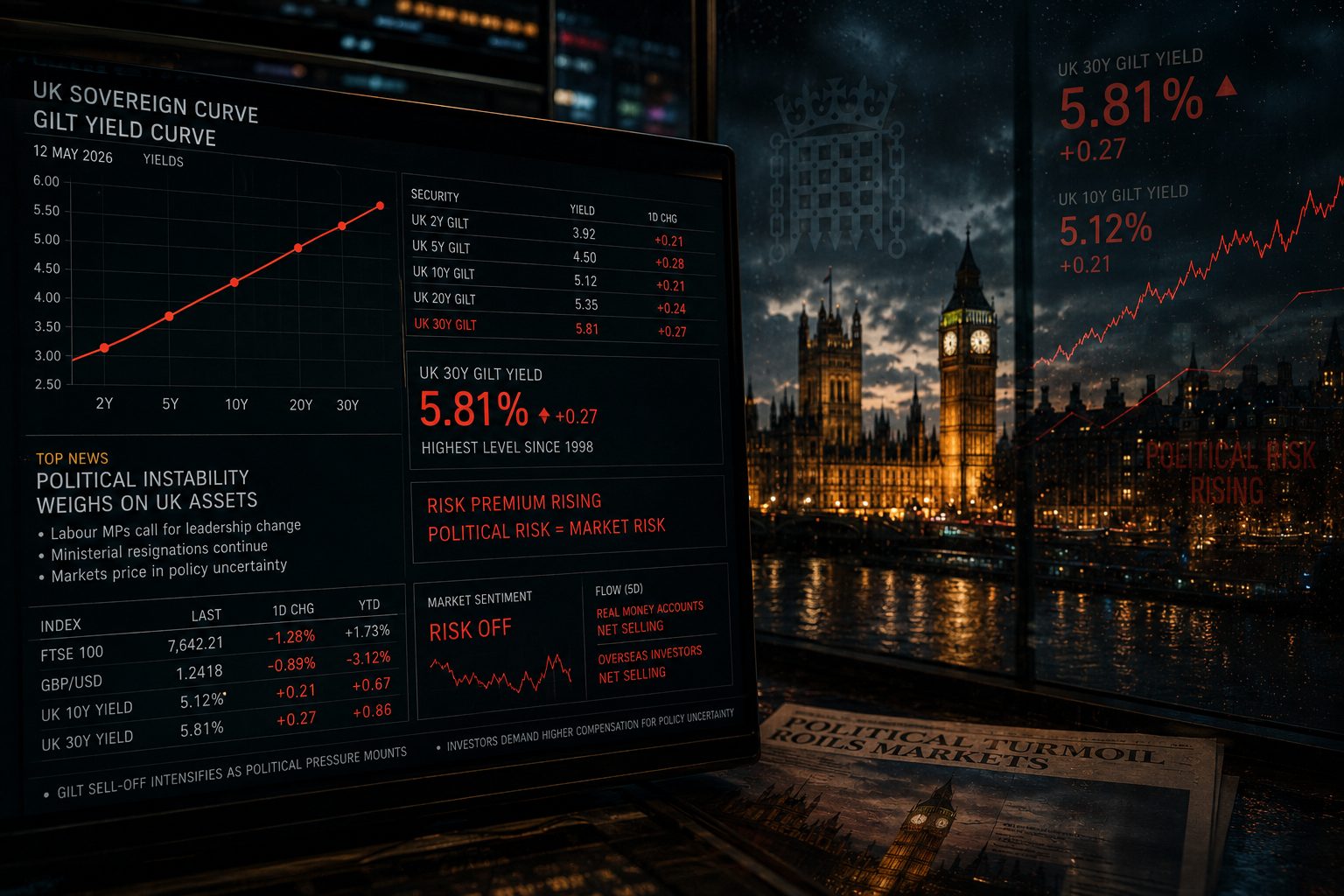
The immediate backdrop was a bruising set of local and regional election results for Keir Starmer’s Labour government in early May. Labour reportedly lost more than a thousand council seats, while Reform UK continued to consolidate support across several regions. Within days, public speculation over leadership stability intensified. Multiple reports suggested growing unease within Labour’s parliamentary ranks. A number of MPs publicly called for a transition timetable. Several junior resignations added to the perception of internal instability, although Starmer himself insisted he would remain in office. The bond market reacted before Westminster found clarity. Between 5 and 12 May, yields on long-dated gilts rose sharply. The 30-year gilt briefly moved above 5.8 per cent before easing modestly. The 10-year benchmark pushed above levels not seen since the aftermath of the global financial crisis. Sterling weakened in parallel. Importantly, the moves remained orderly. There were no signs of systemic dysfunction comparable to 2022. But orderly repricing can still carry a powerful message. What markets appeared to be reassessing was not simply one administration, but the broader question of whether Britain’s political system could maintain credible long-term fiscal continuity in an increasingly fragmented electoral environment.
Why Long-Term Yields Matter
Long-duration government bonds occupy a unique role in the financial system. They are not merely borrowing instruments. They are reference points for pension liabilities, mortgage pricing, insurance portfolios, infrastructure financing and institutional risk models. When investors demand materially higher yields to hold those bonds, the consequences spread quietly through the wider economy. A sustained rise in long-term borrowing costs increases future debt-servicing pressure for governments already operating with limited fiscal flexibility. Mortgage markets eventually absorb part of that repricing. Pension funds must adjust liability assumptions. Corporate borrowing costs become less forgiving. The process rarely arrives dramatically at first. It accumulates incrementally. That is partly why the recent gilt move attracted attention inside financial institutions even if much of the wider public remained focused on political headlines alone. One senior market participant quoted in dealer commentary described the shift not as panic, but as “a reassessment of political risk premium in a structurally indebted economy.” That language may sound technical. Its implications are not.

A Broader Global Shift
Britain is not alone. Across advanced economies, investors are beginning to confront a world in which higher interest rates may persist alongside historically elevated sovereign debt loads. The assumption that central banks can indefinitely suppress volatility without consequence has weakened considerably since the inflation shocks of the early 2020s. The United States continues to run substantial deficits while issuing record quantities of Treasury debt. France faces recurring fiscal tensions and political fragmentation. Japan, long insulated by domestic ownership structures and ultra-loose monetary policy, is now navigating the complexities of normalising rates after decades of intervention. In that context, Britain may represent less an isolated anomaly than an early warning signal. The key issue is credibility. Debt sustainability in advanced economies increasingly depends not only on economic output, but on whether markets believe political systems retain the capacity to make difficult long-term decisions consistently and coherently. When that confidence weakens, capital reprices risk accordingly.
The Quiet Discipline of Markets
Bond markets do not express outrage. They do not issue manifestos. They simply alter the price at which governments can borrow. That mechanism can appear abstract until its secondary effects begin to spread into daily life. A household refinancing a mortgage at a higher fixed rate. A government department facing tighter spending constraints as debt interest consumes a larger share of public expenditure. A pension scheme recalibrating long-term liabilities under changing discount assumptions. The consequences are gradual, but cumulative. Britain is not facing a sterling crisis on the scale of the 1970s. There has been no IMF intervention, no collapse in market functioning, and no immediate suggestion of systemic failure. What has occurred is more subtle and, in some respects, more consequential. A G7 sovereign has been reminded, publicly and in real time, that financial credibility remains conditional. Political mandates alone do not determine borrowing costs. Markets continuously evaluate whether governments appear capable of maintaining institutional coherence, fiscal discipline and policy continuity over time. That process is neither ideological nor emotional. It is structural.

Final Observation
Whether Keir Starmer survives the immediate political pressure remains uncertain. Markets are unlikely to wait for Westminster to settle the question before continuing to assess Britain’s trajectory. The deeper issue extends beyond one government or one week of volatility. The post-crisis financial era conditioned many political systems to assume that liquidity would remain abundant and sovereign borrowing costs manageable indefinitely. The re-emergence of bond-market discipline suggests that assumption may no longer hold. London’s warning shot may ultimately matter less for what it says about Britain alone, and more for what it signals about the next phase of the global financial order.
Sources
- https://www.ft.com/content/755ebf5e-566a-4209-811e-f277a456fa6f
- https://finance.yahoo.com/economy/policy/articles/uk-30-bonds-reached-highest-131508563.html
- https://tradingeconomics.com/united-kingdom/30-year-bond-yield
- https://www.marketwatch.com/investing/bond/tmbmkgb-30y
- https://www.theguardian.com/politics/2026/may/08/keir-starmer-under-pressure-to-agree-exit-plan-after-election-mauling
- https://www.npr.org/2026/05/10/nx-s1-5817491/uk-elections-keir-starmer-resign-reform-green
- https://www.nytimes.com/live/2026/05/12/world/uk-starmer/labours-deep-losses-in-local-elections-reflect-a-shift-in-the-public-mood
- https://www.reuters.com/world/uk/could-uk-pm-starmer-be-forced-out-after-local-election-losses-2026-05-08/
- https://www.bbc.com/news/live/ce8p2d6nrm9t
- https://www.bloomberg.com/news/videos/2026-05-11/uk-gilts-under-pressure-video
- https://www.bloomberg.com/news/articles/2026-05-05/gilts-selloff-pushes-30-year-yield-to-the-highest-since-1998