The Spider's Web: London as the hub
In 1955 Midland Bank took US dollar deposits in London, an early stage of the Eurodollar market. How London came to sit at the centre of the offshore map, as the film and book argue, how a chain is built, and what UK registers now show.
Charles Pycraft · November 2026 · London
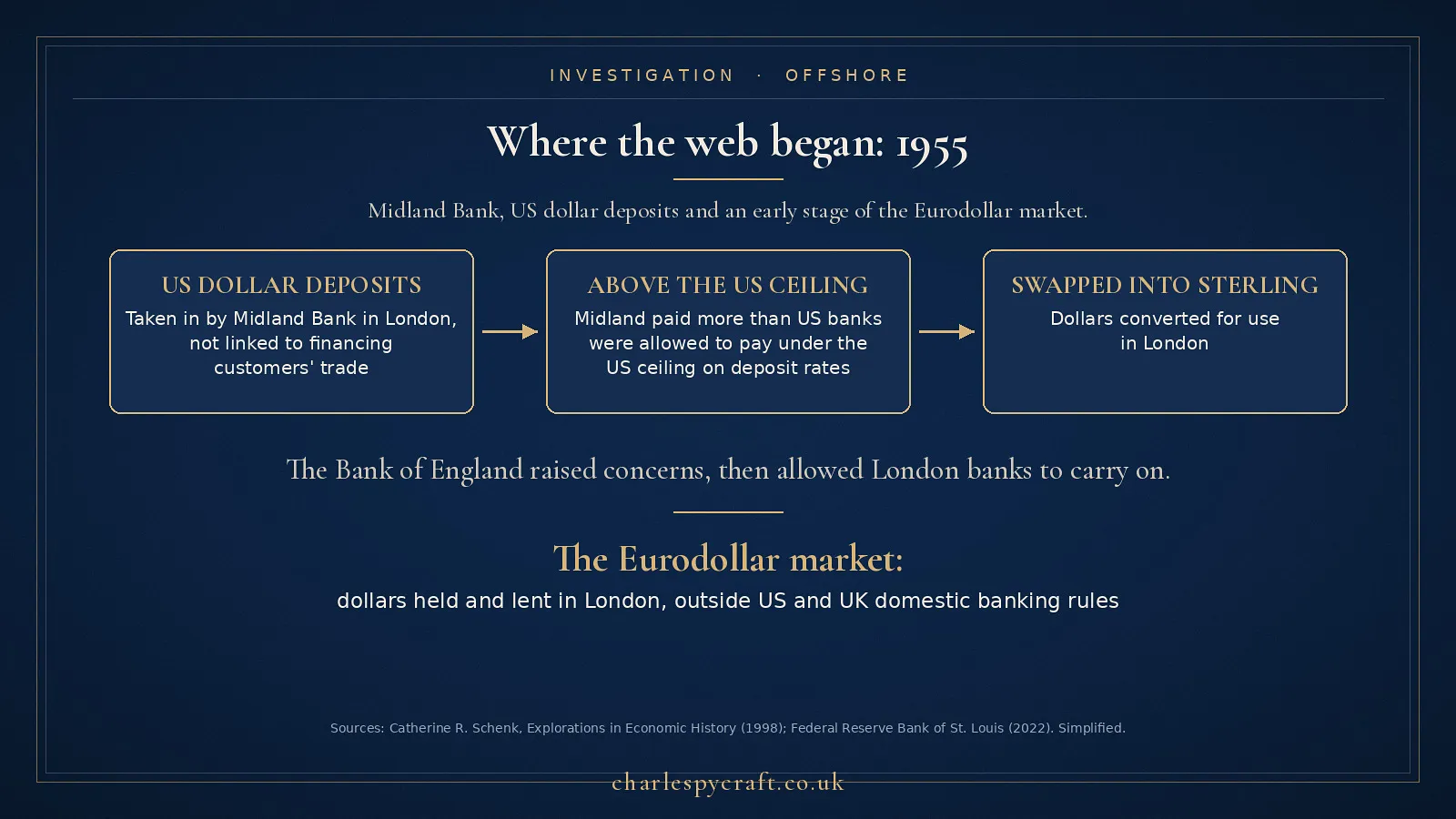
In June 1955 the Bank of England became aware of an important development at Midland Bank. Midland was taking in US dollar deposits that were not linked to financing its customers' trade, paying more than American banks were allowed to pay under the US ceiling on deposit rates, known as Regulation Q, and swapping the dollars into sterling. The Bank of England raised concerns, but in the end it allowed London banks to carry on taking such deposits. Foreign currency deposits were not new to London; what changed was how banks used dollar funding. The economic historian Catherine Schenk, writing from the Bank's own archive in 1998, identifies this as the first stage of what became the Eurodollar market: dollars held and lent in London under a regulatory framework different from domestic banking arrangements in the United States or Britain. Earlier accounts dated the market from Britain's 1957 sterling controls; Schenk places its first stage two years earlier. London became the centre of that market.
The Spider's Web: Britain's Second Empire, a 2017 documentary written and directed by Michael Oswald and co-produced with John Christensen of the Tax Justice Network, argues that this mix of strict rules at home and relative freedom for international money became a lasting pattern. Oswald has said the film was inspired by Nicholas Shaxson's book Treasure Islands. This field note turns to London, which the film and the book both place at the centre of the map.
The argument in plain terms
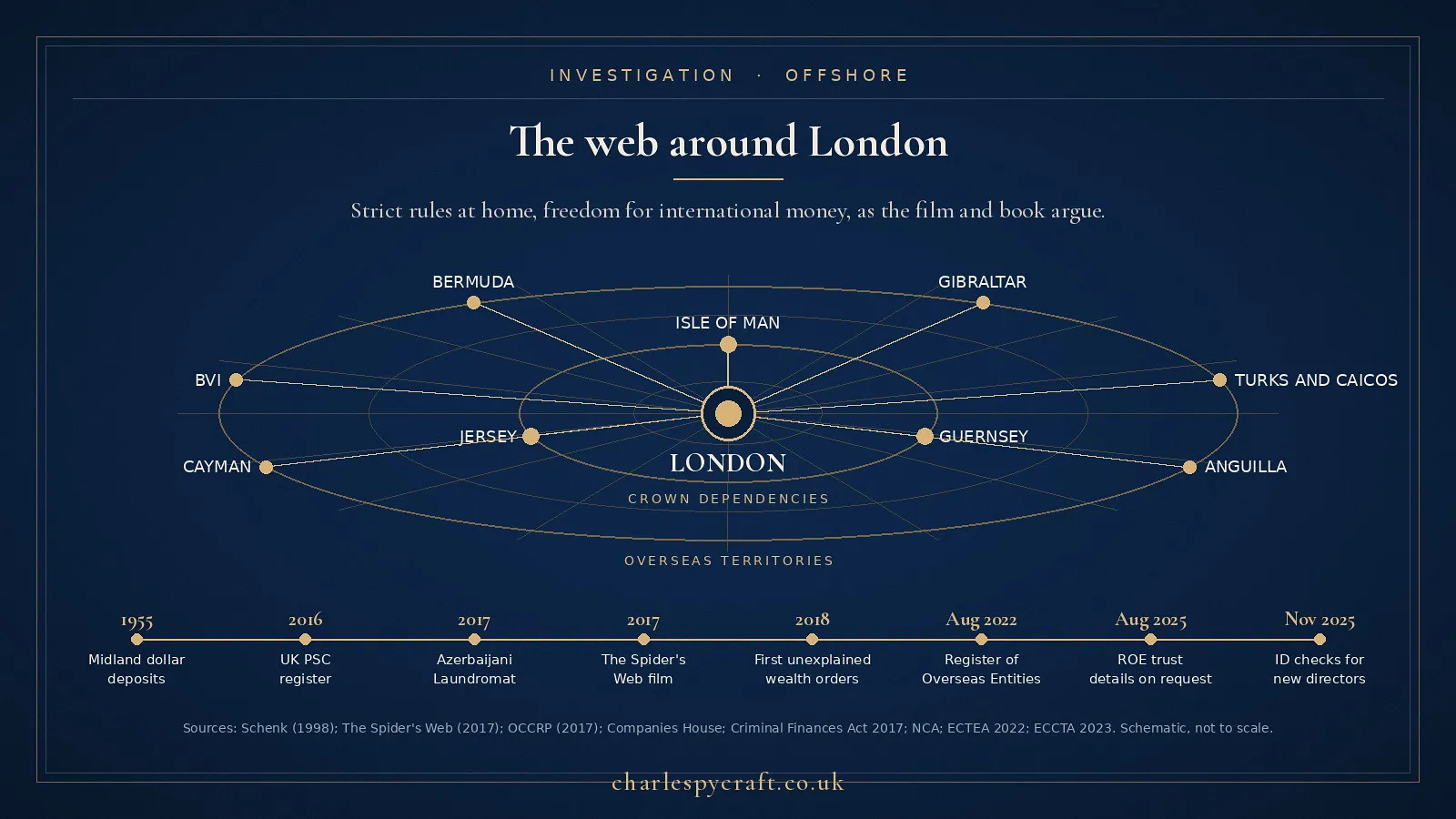
The case made by Shaxson and the film runs like this. As the British Empire wound down after the Second World War, the City of London kept and grew its role as a financial centre by serving money from elsewhere. A ring of places with constitutional links to Britain, the Crown Dependencies close in and the Overseas Territories further out, developed company, trust and banking laws that attracted that money. Each has its own legislature, courts and regulators. In the model described by the film, business booked in those places was often arranged, advised on or managed through London.
The film's own synopsis says that up to half of global offshore wealth may be hidden in British offshore jurisdictions. That is the film-makers' estimate, not an official figure, and it should be read as such. The film and the book argue that the point does not depend on the exact number: in their account, London supplies the lawyers, banks, accountants, trust companies and courts, and the islands supply the legal vehicles.
Oliver Bullough's Butler to the World (2022) makes a related argument about Britain itself: that the country made a business of serving wealthy people from abroad, with discretion as part of the service.
How a London-centred chain is built
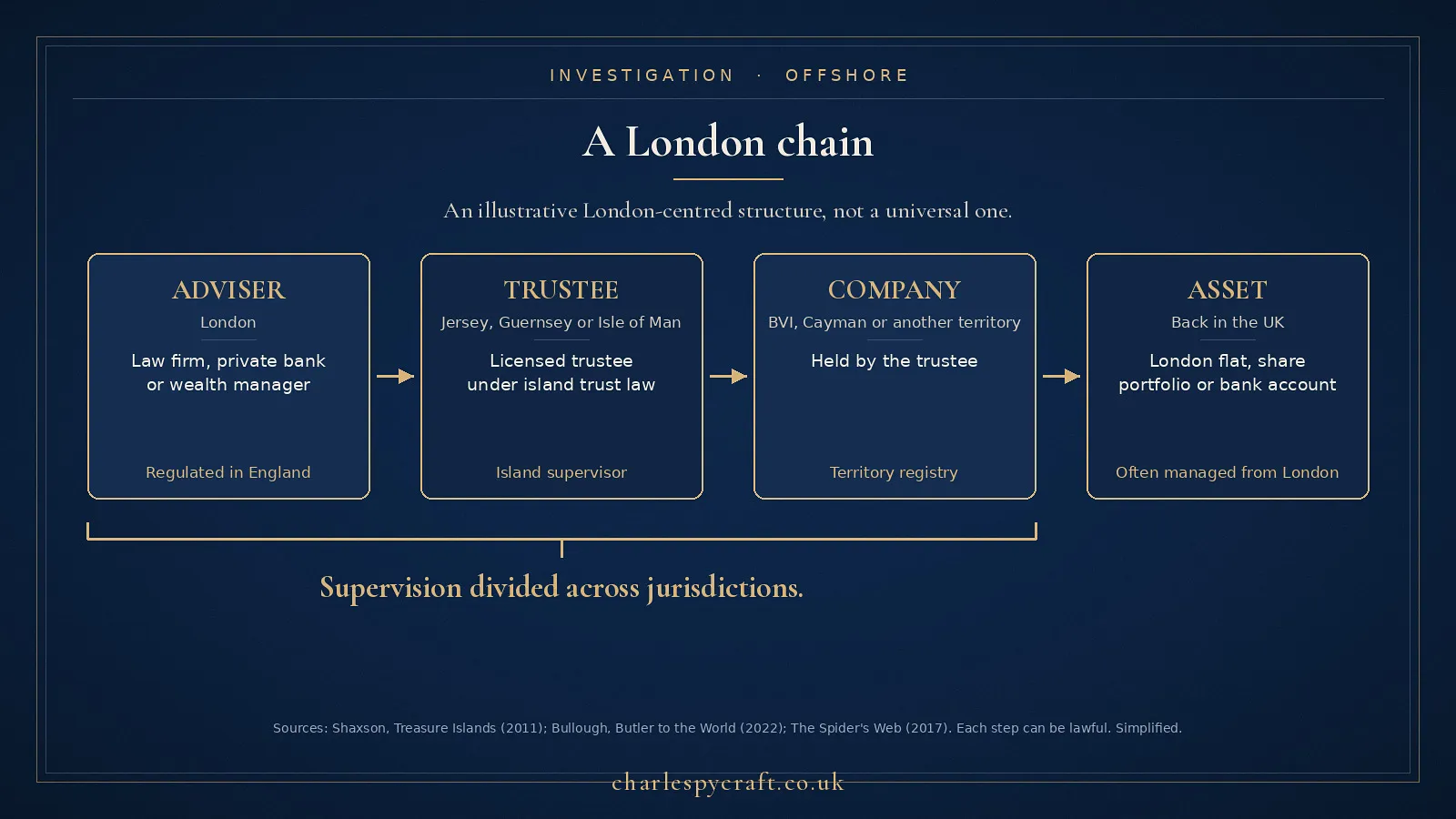
An illustrative chain is simple to draw and can be hard to see from outside.
Adviser in London. A law firm, private bank or wealth manager in London designs the structure and often manages the relationship.
Trust in the inner web. A trust is set up with a licensed trustee in Jersey, Guernsey or the Isle of Man, often under that island's trust law.
Company further out. The trustee holds a company in the British Virgin Islands, Cayman or another territory.
Asset back in the UK. The company owns a London flat, a share portfolio or a bank account, sometimes managed from London again.
Each step can be lawful, and many such structures are used for ordinary family and tax planning reasons. Legal ownership, economic benefit and control may each sit with a different party. Critics argue that cross-border structures like this can complicate oversight, because the adviser is regulated in England, the trustee in an island and the company in a territory, so effective supervision depends on cooperation and information sharing between them.
The trust layer
The most private part of the chain is often the trust. A settlor transfers assets to a trustee, who holds them for beneficiaries under the terms of a trust deed. In a discretionary trust the trustee decides which members of a defined class of beneficiaries receive income or capital, and when.
Many offshore trusts also have a protector, a person or firm whose powers depend on the trust instrument and can include consenting to distributions or replacing the trustee, and a letter of wishes, a private note from the settlor that guides the trustee but is not usually binding. Neither is automatically evidence that the settlor still controls the trust, but each is a place where influence can sit without appearing on a public register. UK anti-money laundering rules take a wide view: the Money Laundering Regulations 2017 treat the settlor, the trustees, the beneficiaries and any individual with control over a trust as its beneficial owners, and trusts within scope must record them on HMRC's Trust Registration Service, which is not public.
The public record shows why the professionals in these roles matter. The Panama Papers, Paradise Papers and Pandora Papers were drawn largely from the records of law firms and corporate or trust service providers. In England and Wales the Solicitors Regulation Authority publishes its disciplinary decisions, including fines against firms for anti-money laundering failures such as not checking where client money came from. Trustees and trust professionals act under fiduciary duties, regulation and the oversight of the courts, which is why their supervision is a recurring subject of public reports and disciplinary decisions.
When the web was used
The Azerbaijani Laundromat, published in September 2017 by the Organized Crime and Corruption Reporting Project, Berlingske, The Guardian and other partners, reported how ordinary British vehicles sat at the centre of what the consortium described as a money laundering and lobbying scheme. According to the reporting, leaked bank records showed that about US$2.9 billion passed between 2012 and 2014 through four UK-registered limited partnerships and limited liability partnerships, with accounts at the Estonian branch of Danske Bank. Two were Scottish limited partnerships registered at addresses in Glasgow. The reporting said their partners were anonymous entities in the British Virgin Islands, Seychelles and Belize, and that the owners and directors named in their filings were not the real people in charge. On that account, a UK registration gave the companies a respectable address but did not tell anyone who controlled them. Scottish limited partnerships were brought into the people with significant control regime from 26 June 2017, after the period the reporting covered.
Watched, then exposed
London is also where much of the web has become visible, the through-line of this series.
Company owners. Since 2016 most UK companies have had to name their people with significant control on a free public register at Companies House.
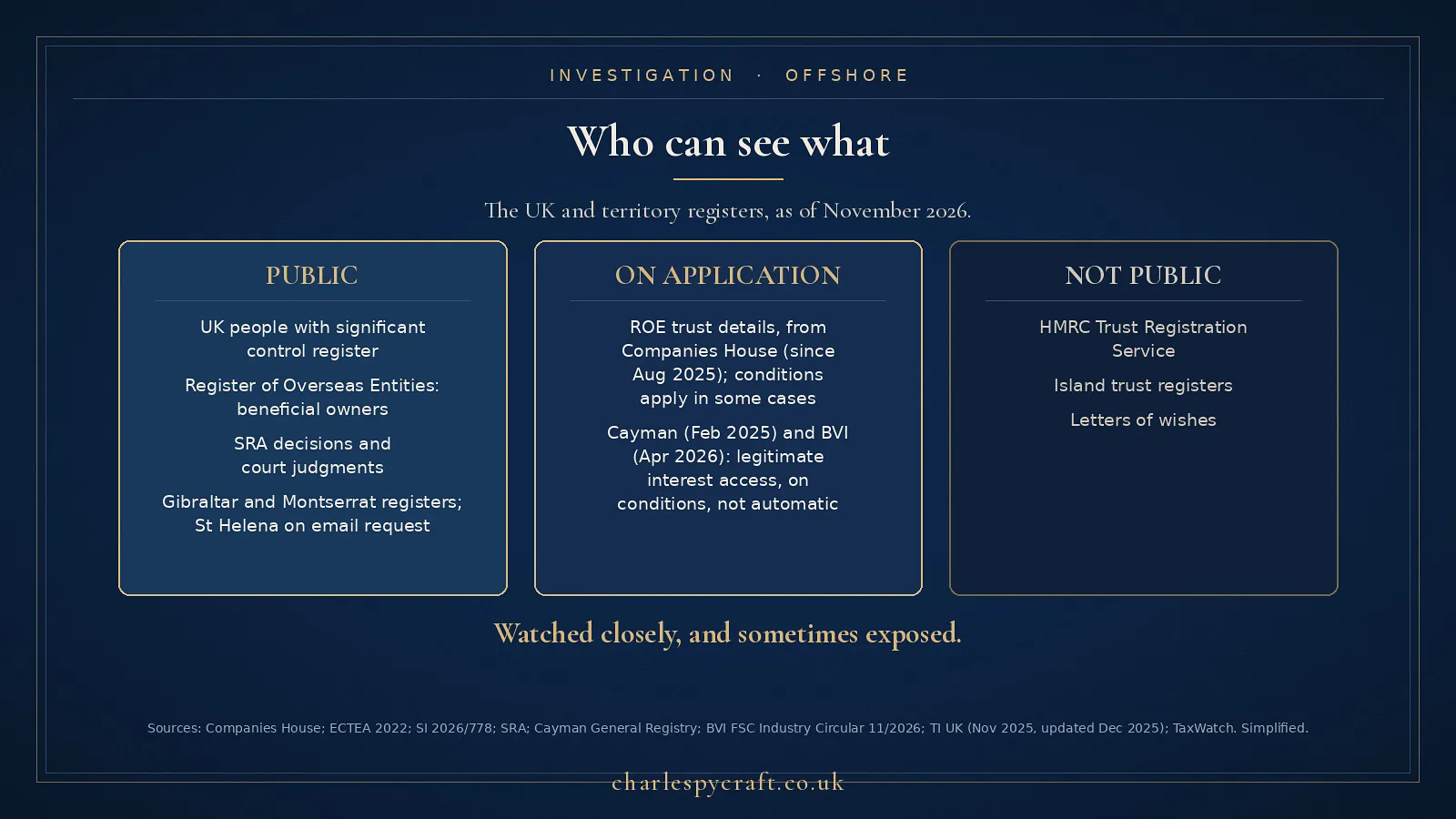
Overseas owners of UK property. The Register of Overseas Entities, created by the Economic Crime (Transparency and Enforcement) Act 2022, went live on 1 August 2022. Foreign companies holding UK land must name their registrable beneficial owners or, if they have none, say so and give details of their managing officers. Trust details are not published, but since 31 August 2025 anyone can apply to Companies House for them, with a legitimate interest required only in some cases, such as requests covering several entities or a person under 18. Changes in force from 9 July 2026 removed the need to identify the trust by name first. Access on application is not the same as a public register: there is a fee, and disclosure can be refused or made subject to conditions.
Identity checks. Under the Economic Crime and Corporate Transparency Act 2023, identity checks became compulsory for new directors and people with significant control from 18 November 2025, with existing ones brought in over a twelve-month transition.
Unexplained wealth. The Criminal Finances Act 2017 created unexplained wealth orders, available from January 2018. The National Crime Agency obtained two in 2018 concerning a Knightsbridge property and a golf club in Berkshire. In February 2020 the Court of Appeal dismissed a challenge to the order relating to the Knightsbridge property. An unexplained wealth order is an investigative measure, not itself a finding of criminal wrongdoing. The 2022 Act extended the orders to the officers of companies and other entities that hold property, and limited the costs the authorities can be ordered to pay.
The territories. The Sanctions and Anti-Money Laundering Act 2018 pushed the Overseas Territories towards public registers of company owners. Progress has been uneven. Transparency International UK counts Gibraltar, Montserrat and St Helena as having fully public registers, although it reports that St Helena's is accessible on email request rather than through an online search. Cayman and the British Virgin Islands instead give access to people who can show a legitimate interest, such as those investigating money laundering: Cayman from 28 February 2025 and the BVI from 1 April 2026. Access is not automatic merely because someone is a journalist or researcher.
These developments improve access to information, but they do not remove every limitation associated with cross-border ownership structures. HMRC's Trust Registration Service is not public, island trust registers are not open, and a register is only as reliable as what is filed on it. But the map the film and the book drew can now be checked against registers, judgments and published leaks.
What to check if a London chain is in front of you
Follow every layer. Note the adviser, trustee, protector, company and asset, and which jurisdiction each sits in.
Use the free UK registers. The people with significant control register and the Register of Overseas Entities are searchable at Companies House. Where an overseas entity reports no registrable beneficial owner, note the managing officers it names.
Ask who supervises whom. The London adviser, the island trustee and the territory company may each answer to a different regulator.
Compare the records. Check register entries against your own file and against filings in other jurisdictions. Record discrepancies without assuming they establish wrongdoing.
Read the published record. SRA decisions, court judgments and the methods notes of investigative consortia are public.
Next in the series: Jersey, Guernsey and the Isle of Man, London's inner web.
Sources
Catherine R. Schenk, "The Origins of the Eurodollar Market in London: 1955-1963", Explorations in Economic History (1998)
Federal Reserve Bank of St. Louis, Bretton Woods and the growth of the Eurodollar market (January 2022)
The Spider's Web: Britain's Second Empire (Michael Oswald, 2017), film website and Tax Justice Network release notes (May and August 2017)
Nicholas Shaxson, Treasure Islands (2011)
Oliver Bullough, Butler to the World (2022)
OCCRP, The Azerbaijani Laundromat and The Core Companies (4 September 2017)
The Guardian, UK at centre of secret $3bn Azerbaijani money laundering and lobbying scheme (4 September 2017)
UK government, Scottish limited partnerships brought into the people with significant control regime (June 2017)
Money Laundering, Terrorist Financing and Transfer of Funds (Information on the Payer) Regulations 2017, regulation 6
Economic Crime (Transparency and Enforcement) Act 2022
Companies House, Ask Companies House for information about a trust (Trust Disclosure Service, from 31 August 2025, guidance updated 9 July 2026)
Register of Overseas Entities (Protection and Trusts) and Limited Liability Partnerships (Application of Company Law) (Amendment) Regulations 2026 (SI 2026/778) and explanatory memorandum
Companies House, identity checks for directors and people with significant control from 18 November 2025
Criminal Finances Act 2017
National Crime Agency, court dismisses UWO appeal (5 February 2020)
Sanctions and Anti-Money Laundering Act 2018
Cayman Islands, Beneficial Ownership Transparency (Legitimate Interest Access) Regulations 2024 and General Registry guidance
BVI Financial Services Commission, Industry Circular 11 of 2026
Transparency International UK, Opening Up Offshore Secrecy (November 2025, updated December 2025)
TaxWatch, The transparency registers that weren't (7 August 2025)
Background reading: Oliver Bullough, Moneyland
This field note draws on public legislation, government guidance, court materials, academic history, books, documentary film and investigative journalism. It is provided for general information and is not legal or tax advice.
Sources
- https://www.sfu.ca/~poitras/EEH_Eurodollar_98.pdf
- https://doi.org/10.1006/exeh.1998.0693
- https://www.stlouisfed.org/on-the-economy/2022/january/bretton-woods-growth-eurodollar-market
- https://spiderswebfilm.com/
- https://www.occrp.org/en/azerbaijanilaundromat/
- https://www.theguardian.com/world/2017/sep/04/uk-at-centre-of-secret-3bn-azerbaijani-money-laundering-and-lobbying-scheme
- https://www.legislation.gov.uk/ukpga/2022/10/contents
- https://www.gov.uk/guidance/ask-companies-house-for-information-about-a-trust
- https://www.legislation.gov.uk/uksi/2026/778/contents
- https://www.legislation.gov.uk/ukpga/2023/56/contents
- https://www.gov.uk/government/news/companies-house-confirms-identity-verification-rollout-from-18-november-2025
- https://www.gov.uk/guidance/people-with-significant-control-pscs
- https://www.legislation.gov.uk/ukpga/2017/22/contents
- https://www.legislation.gov.uk/ukpga/2018/13/section/51
- https://www.ciregistry.ky/beneficial-ownership-legitimate-interest-access/
- https://www.bvifsc.vg/news/industry-updates/industry-circular-11-2026-launch-legitimate-interest-transactions-and-request
- https://www.legislation.gov.uk/uksi/2026/778/made
- https://www.legislation.gov.uk/uksi/2017/694/contents
- https://www.legislation.gov.uk/uksi/2017/692/regulation/6
- https://www.legislation.gov.uk/ukpga/2022/10/section/45
- https://www.transparency.org.uk/publications/opening-offshore-secrecy
- https://www.taxwatchuk.org/the-transparency-registers-that-werent/