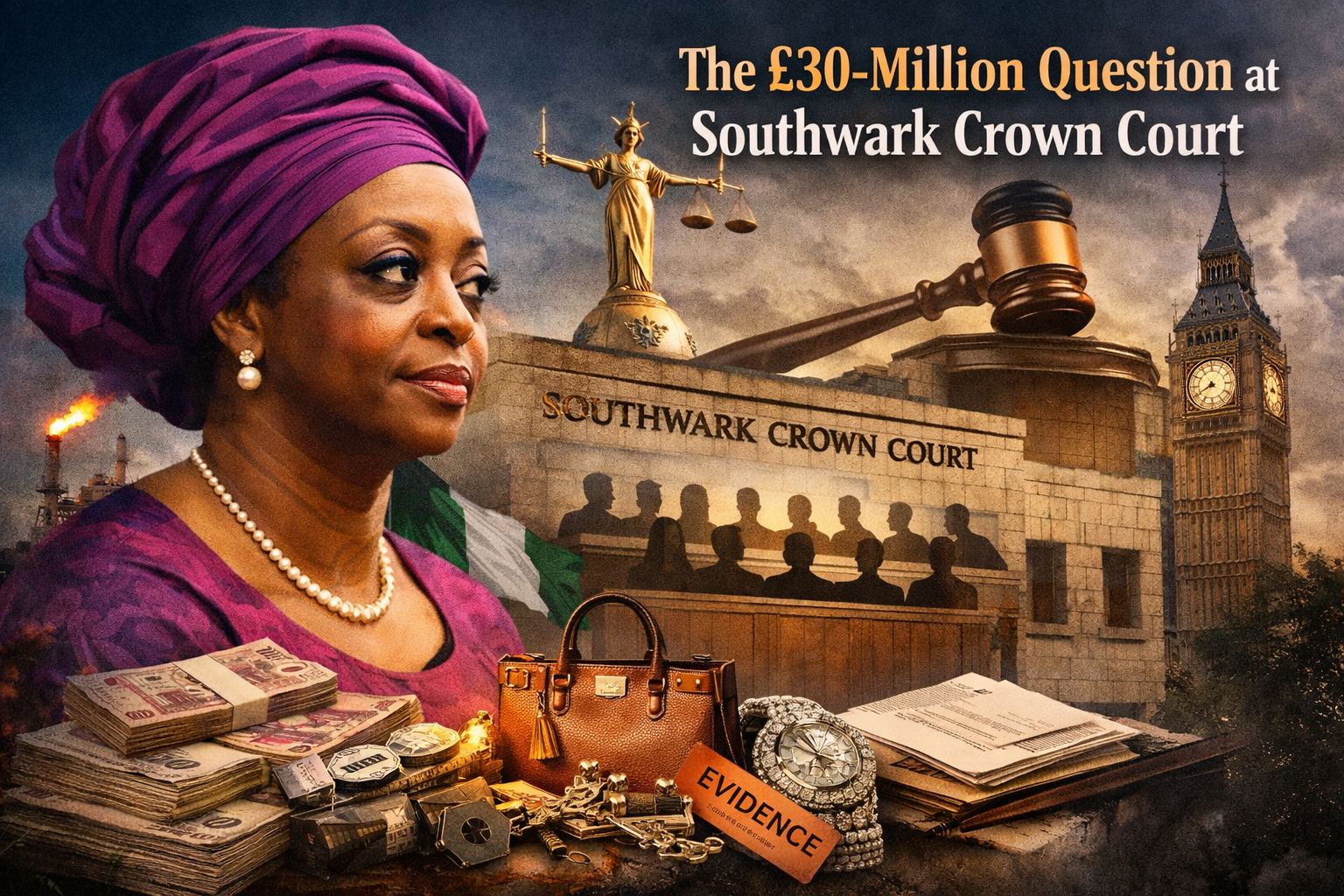
The £30-Million Question at Southwark Crown Court
Diezani Alison-Madueke, power, reform and the trial a decade in the making
Charles Pycraft · January 2026 · London, United Kingdom
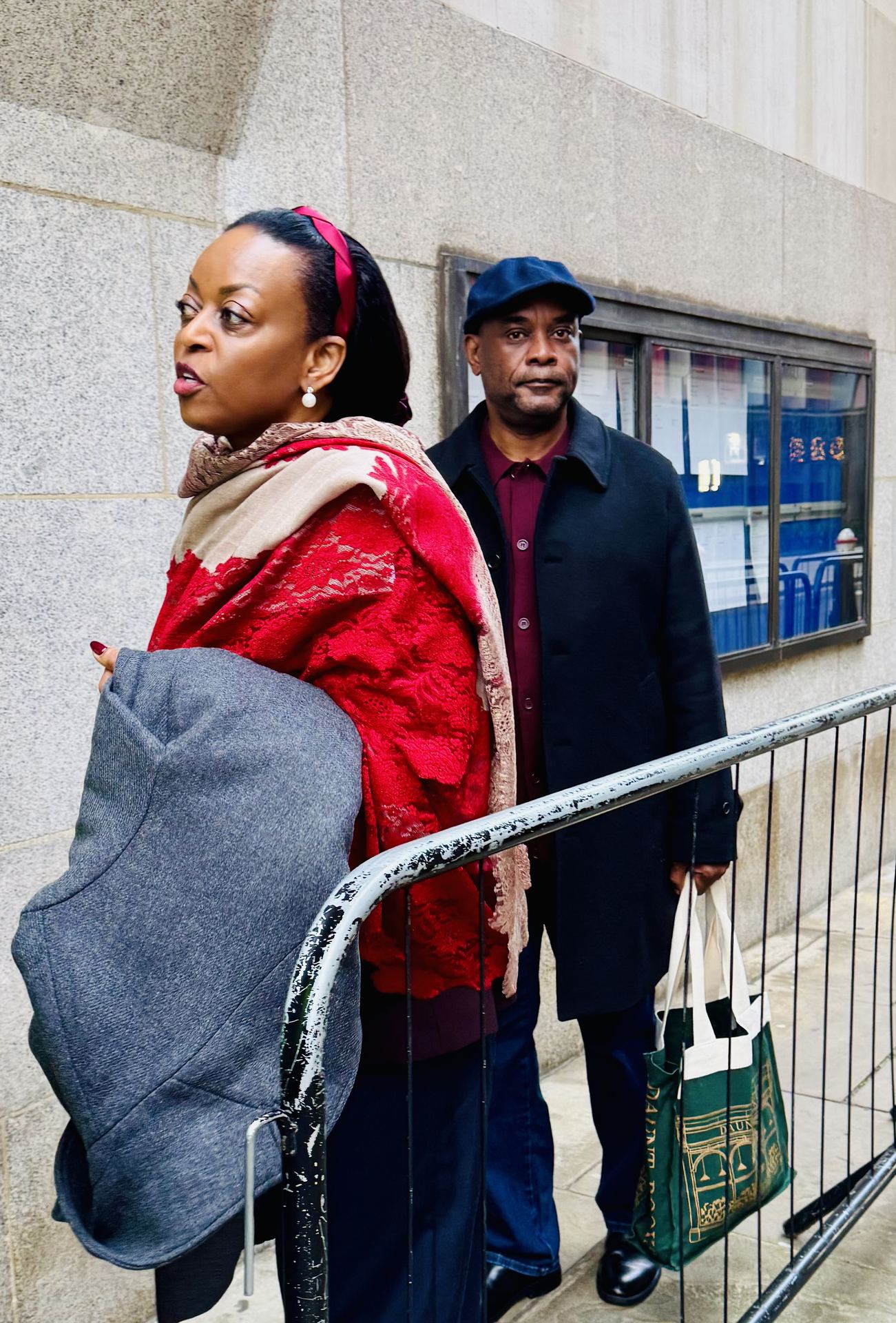
Update, 17 June 2026: Diezani Alison-Madueke was acquitted on all counts. This piece was written during the trial and reflects public reporting at that time; it is not a comment on the evidence before the jury. On a cold January morning in London, a woman who once sat at the centre of the global energy system walked quietly into a British courtroom.
There were no motorcades, no diplomatic entourages, no summit halls waiting beyond the doors. Instead, there was the measured choreography of a Crown Court listing: jurors assembling, counsel conferring, reporting restrictions in force.
At Southwark Crown Court, preliminary proceedings have begun in Regina v Diezani Alison-Madueke, ahead of a full jury trial scheduled to commence on 26 January 2026 and expected to last between ten and twelve weeks.
The estimated cost to the British taxpayer already exceeds £30 million, making this one of the longest-running and most resource-intensive foreign corruption prosecutions ever pursued by UK authorities.
Diezani Alison-Madueke denies all charges.
A case ten years in the making
Alison-Madueke has been on bail in the United Kingdom since her arrest in October 2015. Despite extensive investigation across jurisdictions, formal criminal charges were not brought until 2023, when the UK’s National Crime Agency alleged that she accepted bribes between 2011 and 2015, during her tenure as Nigeria’s Minister of Petroleum Resources.
She denies all six counts.
Two co-defendants, Doye Agama and Olatimbo Ayinde, face related bribery charges. Their cases are procedurally linked but will be assessed individually by the court.
Jury selection commenced on Monday, 19 January 2026. The prosecution’s case is expected to open the following week, subject to reporting restrictions that apply during parts of the proceedings.
That distinction matters.
For years, Alison-Madueke’s name has circulated globally amid allegations of corruption in the oil sector. Yet allegations, however widely repeated, are not evidence. Southwark Crown Court is where repetition finally gives way to proof.
Who is Diezani Alison-Madueke?
Any serious assessment must begin with scale.
Between 2010 and 2015, Diezani Alison-Madueke was: • Nigeria’s Minister of Petroleum Resources • Chair of the Nigerian National Petroleum Corporation (NNPC) • The first woman to serve as President of OPEC • One of the most influential energy policymakers on the African continent.
Her professional background includes engineering, international consultancy, and senior public service in both Nigeria and the United Kingdom, long before she entered frontline politics.
In an industry defined by male dominance and geopolitical competition, her rise was unprecedented.
So, inevitably, was the resistance she encountered.
Reform is never neutral
During Alison-Madueke’s tenure, Nigeria’s oil and gas sector underwent one of its most ambitious and politically destabilising reform periods since nationalisation.
Under President Goodluck Jonathan, her ministry oversaw: • Expansion of deep-water offshore production • Enforcement of the Nigerian Oil & Gas Industry Content Development Act • A strategic shift toward gas-to-power infrastructure • Increased penalties for gas flaring • Attempts to professionalise accounting and monitoring within NNPC.
Major projects, including Egina FPSO, Bonga North West, and Bonga Phase 3, came online. Egina, in particular, marked the first time FPSO topside integration was executed domestically in Nigeria, a milestone with economic and symbolic significance.
Nigeria’s liquids production peaked at approximately 2.7 million barrels per day during this period.
These were not cosmetic reforms. They materially altered who benefited from oil revenues.
Local content: the reform that reshaped power
The most consequential and controversial reform was the enforcement of local content rules.
Between 2005 and 2015: • Indigenous oil operators increased from 29 to around 70 • Nigerian firms acquired or took control of nearly half of the producing oil mining leases • International oil companies divested more than 20 blocks to local entities • Billions of dollars previously exiting Nigeria through foreign service contracts were retained domestically.
Estimates suggest Nigeria’s effective share of oil-sector value rose from approximately 5% to closer to 30% under this regime.
In energy politics, that is not incremental reform.
It is redistribution.
Redistribution creates winners and losers.
The “missing billions” narrative and the problem of arithmetic
The allegations that would later dominate Alison-Madueke’s public reputation first crystallised around claims by then-Central Bank Governor Sanusi Lamido Sanusi, who asserted that tens of billions of dollars in oil revenue were unaccounted for.
The figures shifted repeatedly from $49.8 billion to $20 billion before collapsing under scrutiny.
Independent audits, including a PwC forensic review commissioned by the Nigerian government, found no evidence of missing funds once subsidy mechanisms, timing differentials, debt financing, and operational flows were properly accounted for.
Crucially, no audit concluded that Diezani Alison-Madueke personally embezzled Nigerian state oil revenues.
What remained was largely narrative.
Narratives travel well. Accounting does not.
From reformer to defendant
By the time Alison-Madueke left office in 2015, Nigeria’s oil sector was politically fractured.
Many of the institutional mechanisms she helped establish were weakened, politicised, or abandoned. Investment confidence deteriorated. Output later fell to between 1.2 and 1.6 million barrels per day, far below demonstrated capacity.
Yet the legal focus narrowed relentlessly onto one individual.
In the United Kingdom, the National Crime Agency pursued a case not centred on oil-revenue flows, but on alleged personal benefits, including cash, property use, travel, and luxury goods, allegations she denies and which the prosecution must now prove beyond reasonable doubt.
Gender, faith, and Nigerian power politics
Context is not evidence but legal cases do not arise in a vacuum.
Alison-Madueke was Nigeria’s first female Minister of Petroleum Resources and first female President of OPEC, operating within an overwhelmingly male political and commercial ecosystem.
She is also a publicly declared born-again Christian, in a national context marked by long-running religious tension and sustained violence against Christian communities, particularly in northern and central Nigeria.
International organisations, including Open Doors, USCIRF, Human Rights Watch, and the International Crisis Group, have documented the scale of religious persecution and state failure to protect minority communities.
None of this determines guilt or innocence.
But it does shape the environment in which accusations emerge, reputations calcify, and certain figures become lightning rods for institutional frustration.
The British state steps in
The UK’s role in this case is itself unusual.
After nearly a decade of investigation, asset restraint, and international cooperation, the Crown is committing to a lengthy jury trial to test allegations that have circulated globally for years.
This is not a civil forfeiture action.
It is not an administrative sanction.
It is a criminal prosecution, with the highest burden of proof known to law.
And it raises an unavoidable question:
What does a decade of investigation ultimately produce evidence, or expectation?
Southwark Crown Court is where that distinction finally matters.
What this trial will and will not decide
The jury will not be asked whether Diezani Alison-Madueke was powerful, controversial, or resented.
They will not adjudicate Nigeria’s oil policy, the politics of post-Jonathan Nigeria, or the success or failure of reform.
They will be asked something narrower and more demanding:
Have specific criminal offences been proved beyond reasonable doubt, on admissible evidence?
After ten years of allegation and investigation, that question remains open.
Waiting for evidence
This article is not an acquittal in advance.
It is an argument for proportion.
In an era where allegation often becomes verdict long before a courtroom is entered, there is something quietly radical about letting evidence speak and waiting for it to do so.
On 26 January 2026, the prosecution says it is ready.
The jury has since given its verdict.
Sources
- https://www.france24.com/en/live-news/20260119-ex-opec-president-in-uk-court-ahead-of-corruption-trial