Venezuela and the Dollar: The Real Price of Disobedience
Why this crisis was never about drugs, democracy, or terrorism but about currency power.
Charles Pycraft · January 2026 · London / Caracas / Washington
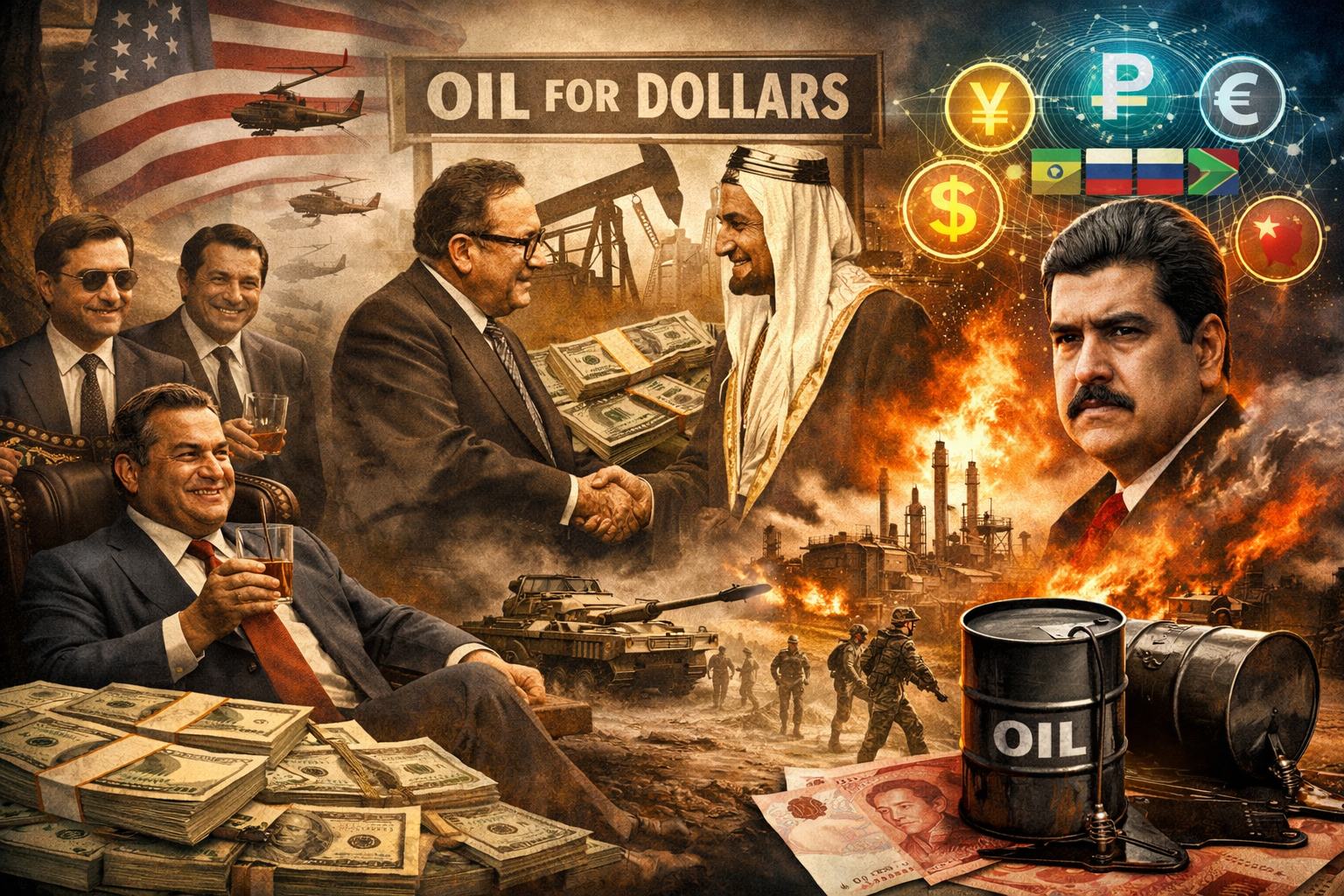
For decades, the United States has framed its foreign interventions in moral language, such as democracy promotion, counter-narcotics, or national security. Venezuela does not fit that script. What unfolded here was not ideological. It was monetary. This investigation examines how Venezuela’s decision to sell oil outside the US dollar system placed it on a collision course with a 50-year-old financial architecture known as the petrodollar and why history shows that defiance of this system is rarely tolerated.
Venezuela’s Oil Is the Real Story
The World’s Largest Oil Prize
Venezuela holds over 300 billion barrels of proven oil reserves, more than Saudi Arabia, and roughly one-fifth of global reserves. Control of that supply is not symbolic; it is structural power in the global energy system. For decades, this oil was sold almost exclusively in US dollars. That changed after sanctions, when Venezuela openly announced it would accept yuan, euros, rubles, and other currencies instead. That decision mattered more than any election or speech.
How the Petrodollar Was Built
The Deal That Propped Up the Dollar
In 1974, following the collapse of the gold standard, the US struck a strategic agreement with Saudi Arabia: oil would be priced exclusively in US dollars, and the US would provide military protection in return. This arrangement created permanent global demand for dollars. Every nation needed them to buy energy. The petrodollar, not manufacturing strength, became the backbone of American financial dominance.
What Happens When Countries Break Ranks
The Pattern No One Talks About
History shows a consistent response to countries that challenge dollar-denominated oil trade. • Iraq announced euro-priced oil in 2000, and was invaded in 2003. • Libya proposed a gold-backed oil currency destroyed in 2011. In each case, the official justifications collapsed. The currency challenge did not. Venezuela’s move placed it squarely in this lineage.
De-Dollarisation Is No Longer Fringe
Why This Time Is Different
Unlike Iraq or Libya, Venezuela is not acting alone. Russia, China, and Iran already conduct large portions of energy trade outside the dollar. China has built its own SWIFT alternative. BRICS nations now represent over 40% of global GDP in purchasing power terms. Venezuela’s oil reserves make it a force multiplier in this transition which is precisely why the response was so aggressive.
The Official Narrative vs the Record
Why the Justifications Don’t Hold
Claims about drugs, terrorism, or democracy collapse under scrutiny. Venezuela accounts for a negligible fraction of US drug inflows. No credible evidence supports state-run terror operations. And the US continues to support unelected regimes elsewhere. What has been stated openly is that some US officials view Venezuelan oil as an American entitlement, a claim rooted in corporate history, not international law.
The Message Being Sent
Currency Enforced by Force
To the Global South, the signal is unmistakable: trade outside the dollar, and consequences follow. But coercion reveals weakness. A currency that must be defended by intervention has already lost trust. Rather than halting de-dollarisation, this approach may accelerate it.
The Question No One Wants to Ask
What Happens When Bombing Stops Working?
What happens when military pressure no longer compels compliance? When economic retaliation becomes symmetrical? When alternative payment systems reach escape velocity? Venezuela may not mark the beginning of the end of the petrodollar. But it may be the moment the architecture became impossible to ignore.
Sources
- https://www.eia.gov/international/analysis/country/VEN
- https://www.opec.org/opec_web/en/data_graphs/330.htm
- https://www.reuters.com/article/us-venezuela-economy-currency-idUSKCN1BM2D3
- https://www.reuters.com/article/us-venezuela-oil-idUSKCN1MJ1X3
- https://history.state.gov/milestones/1969-1976/oil-embargo
- https://wikileaks.org/clinton-emails/emailid/12659
- https://www.imf.org/en/Publications/WEO
- https://www.bis.org/about/bisih/topics/cbdc/mcbdc_bridge.htm