Moneyland: not a country
Oliver Bullough's name for a borderless space where wealth can hide. How the machinery works, what public registers and leaks have shown since, and what still sits out of sight.
Charles Pycraft · November 2026 · London
Oliver Bullough gave the place a name. In Moneyland: Why Thieves And Crooks Now Rule The World And How To Take It Back, published by Profile Books on 6 September 2018, he described a country that does not appear on any map.[1] In a Guardian extract adapted from the book, he called it "the virtual country of the rich". It includes offshore finance, he wrote, but is designed to protect a rich person's life from scrutiny, not only their money. If you are rich enough, he argued, the laws do not apply to you in the same way. Profile Books describes it as a Sunday Times bestseller, shortlisted for the 2019 Orwell Prize for Political Writing.[1][17]
This note takes that idea as its peg, not as a finding that every cross-border structure is a crime. Many such structures serve ordinary family and commercial purposes. The question is how a system that is not a country can have its own routes, and how much of that map is now public.
Not one island, a set of rules
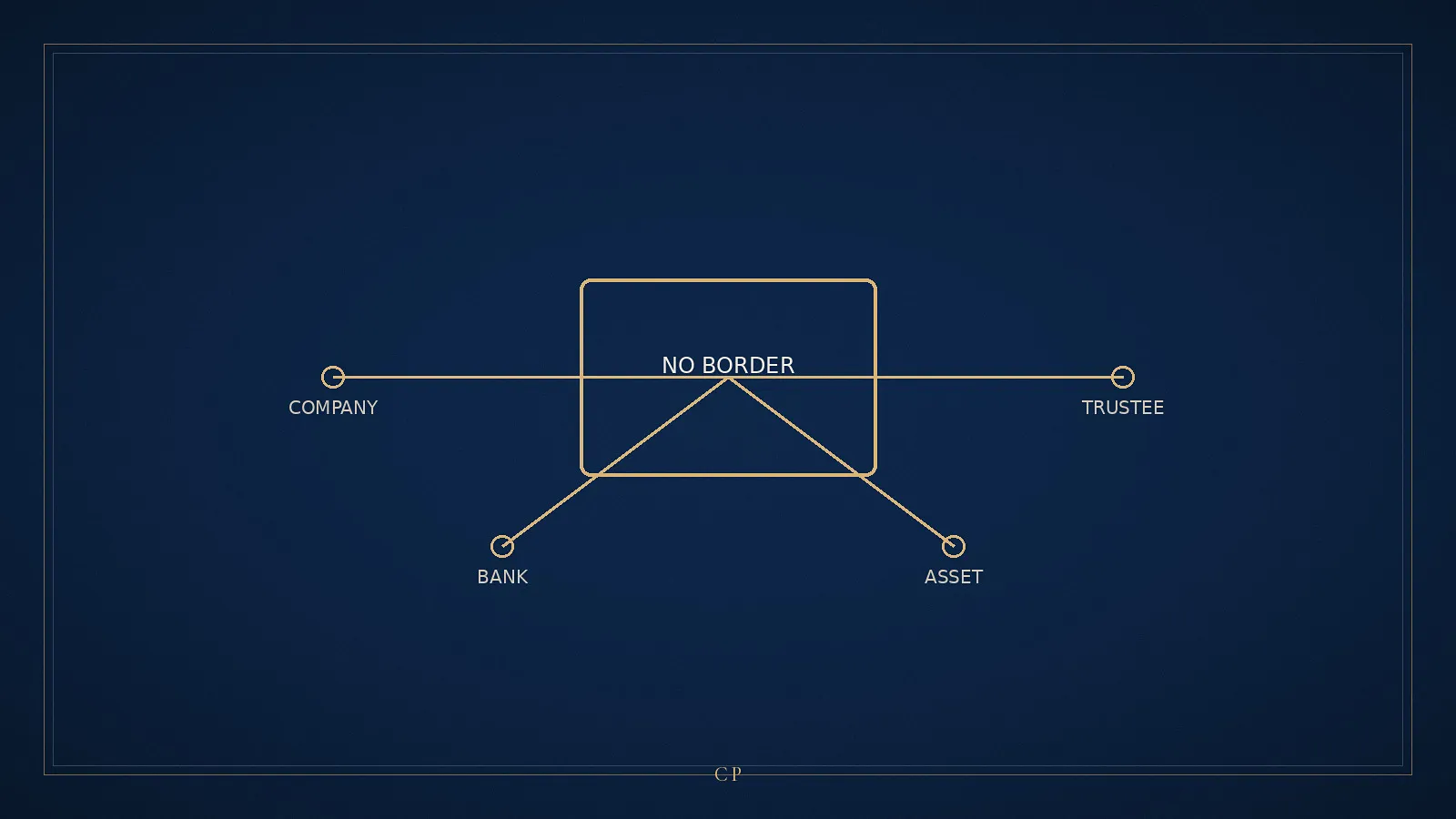
A tax haven is usually a place. Moneyland, as Bullough describes it, is a method. Wealth can sit in a company in one jurisdiction, held by a trustee in a second, banked in a third and spent on a flat in a fourth. Legal ownership, economic benefit and control may sit with different parties. Each step can be lawful. Critics argue that oversight then depends on supervisors who each see only part of the chain.
In the same extract, Bullough argues that wealthy people have used differences between national rules to reduce their exposure to immigration restrictions, journalistic scrutiny and legal claims.[2] Tim Adams, reviewing the book in the Guardian, set out Bullough's list of its parts: Maltese passports, English libel, American privacy, Panamanian shell companies, Jersey trusts and Liechtenstein foundations.[3]
He names the Moneyland ratchet: once one jurisdiction offers a looser rule, business can move there and others come under pressure to match it. Money can cross a border easily, he writes. The law that would restrain it often cannot.[2]
Where it began, as Bullough tells it
Bullough traces a decisive step to London in 1962-63. The International Capital Market Association says the eurobond market is generally accepted to have begun with an issue for Autostrade in July 1963, led by S. G. Warburg.[4]
Drawing on Ian Fraser, one of the bankers involved, Bullough describes how parts of the deal sat under different national rules. The bonds were issued outside Britain, interest was paid in Luxembourg, a London listing was obtained, and the named borrower was Autostrade rather than the state holding company behind it, so tax was not deducted at source. He describes them as bearer bonds, owned by whoever held them rather than by a public register, and argues that idle offshore wealth could then earn a return and move. That is an account of market structuring, not a finding of crime.[2]
An earlier field note, The Spider's Web, examined offshore US dollar deposits in London in the 1950s. In a 1998 article, Catherine Schenk identifies 1955 as the first stage of the Eurodollar market.[5] Those offshore dollars came first. The eurobond, as Bullough tells it, then gave that money a portable form.
What the public record now shows
On 1 August 2022 the United Kingdom opened the Register of Overseas Entities under the Economic Crime (Transparency and Enforcement) Act 2022. Overseas entities within scope, including those that own relevant UK land or want to deal in it, must register and name their registrable beneficial owners, or say they have none and name their managing officers.[6] Companies House reported 33,100 registered overseas entities at 31 March 2026, compared with 32,054 a year earlier. That counts registered entities, not every property they hold, and a filing is only as reliable as what is submitted.[7]
The Home Office closed the Tier 1 (Investor) visa route to new applicants on 17 February 2022. It cited security concerns, including people who had acquired wealth illegitimately or been associated with wider corruption, and said the economic benefit did not outweigh those longstanding concerns.[8]
Cyprus took a different product off the shelf. On 13 October 2020 the Council of Ministers abolished the citizenship through investment programme from 1 November 2020, citing longstanding weaknesses and abusive exploitation of its provisions. The official registry records the same termination date.[9] The announcement followed an Al Jazeera undercover investigation that raised allegations about how the programme was operated. Those allegations should be distinguished from a court finding. In February 2026 a Nicosia criminal court acquitted the two former politicians prosecuted in connection with the case. The Legal Service said it intended to appeal.[18]
The Panama Papers, published in 2016 by the International Consortium of Investigative Journalists and its partners, showed from the files of one Panamanian law firm how lawyers and corporate service providers can sit at the centre of such chains. Those structures may be lawful, and appearing in leaked files is not itself evidence of wrongdoing.[10]
Gabriel Zucman has tried to measure household financial wealth held offshore. In a 2014 Journal of Economic Perspectives paper he estimated that, at the end of 2013, about 8 per cent of the world's household financial wealth sat offshore, including about 4 per cent for the United States, 50 per cent for Russia and 57 per cent for Gulf countries.[11] Those are estimates of financial assets, not houses or art, and they are more than a decade old. They do not show that such holdings were all unlawful or undeclared.
Watched, then exposed
Since 2016 most UK companies have had to name their people with significant control on a free public register at Companies House.[12] Under the Economic Crime and Corporate Transparency Act 2023, identity checks began on 18 November 2025 for new directors and people with significant control. Existing ones were given a 12 month transition through November 2026, with deadlines linked to company filings.[13] The Register of Overseas Entities lets anyone look up who is named behind many overseas owners of UK land. Trust information is not generally published in the same way. Applications have been permitted since 31 August 2025. A legitimate interest is required where a request covers more than one overseas entity or a person aged 17 or under. Protected details are withheld, pension scheme trusts are excluded, and information may be withheld or disclosed only in part.[6][14]
None of that dissolves Moneyland as Bullough described it. HMRC's Trust Registration Service is not generally open to public searching, although restricted disclosure procedures exist for certain requests.[15] A register cannot show a private letter of wishes, and it cannot invent a beneficial owner who was never filed. Automatic exchange lets participating tax authorities receive specified account information under international agreements. It does not tell a journalist or a neighbour who stands behind a company.[16]
What readers can do, and what should change
Bullough's close, in the Guardian extract, was an argument for shining a light on hidden wealth before more of it is stacked against ordinary politics.[2] The steps below are general information, not personal advice.
1. Treat Moneyland as a chain, not a country. Note the adviser, company, trustee, bank and asset, and which law each sits under. Distinguish legal title, economic benefit and control. Public records may identify some of these roles without establishing all of them.
2. Use the public UK registers. Search the people with significant control register and the Register of Overseas Entities at Companies House. Where an overseas entity reports no registrable beneficial owner, look at any managing officers named. That absence does not, by itself, establish concealment or wrongdoing. Compare the entries with other records and distinguish confirmed inconsistencies from unanswered questions.[6][12]
3. Ask who can see the rest. Trust information may sit on registers that are not generally public. Certain information connected with overseas entities can be requested from Companies House, subject to statutory conditions. Automatic exchange between tax authorities is not a public list.[14][15][16]
4. Distinguish immigration status from ownership transparency and reporting obligations. The UK investor route and the Cypriot investment citizenship programme were both withdrawn after official concerns about their operation.[8][9] Immigration status, tax residence and reporting obligations are separate questions under the applicable laws. A change of address or immigration status does not automatically resolve them.
5. Close the gap between filing and checking. For policymakers, unfinished work includes extending identity checks to people who file on behalf of companies, improving scrutiny of ownership filings, providing access to trust information under safeguards, and supervising the intermediaries who design the chain.[13]
Next in the series: Treasure Islands and ownership gaps.
This field note draws on public books, journalism, official statistics, legislation and government announcements. It is general information, not legal or tax advice.
Sources
Sources and reference materials are listed below. Numbers above identify supporting sources. Book arguments, reviews, media investigations and official records are distinguished in the text.
- Profile Books, Moneyland, ebook publication 6 September 2018; paperback 1 May 2019: https://profilebooks.com/work/moneyland/
- Oliver Bullough, The real Goldfinger: the London banker who broke the world, The Guardian, 7 September 2018, adapted from Moneyland: https://www.theguardian.com/news/2018/sep/07/the-real-goldfinger-the-london-banker-who-broke-the-world
- Tim Adams, Moneyland review, The Guardian, 9 September 2018: https://www.theguardian.com/books/2018/sep/09/moneyland-oliver-bullough-review-wealth-corruption-oligarchs
- International Capital Market Association, The History of the Eurobond Market: https://www.icmagroup.org/about-icma/history/history-of-the-eurobond-market/
- Catherine R. Schenk, The Origins of the Eurodollar Market in London: 1955-1963, Explorations in Economic History, 35(2), 1998: https://doi.org/10.1006/exeh.1998.0693 ; author PDF: https://www.sfu.ca/~poitras/EEH_Eurodollar_98.pdf ; earlier field note: https://www.charlespycraft.co.uk/investigations/the-spiders-web-london-as-the-hub
- Economic Crime (Transparency and Enforcement) Act 2022; Companies House guidance on the Register of Overseas Entities: https://www.gov.uk/guidance/register-an-overseas-entity
- Companies House, Annual report and accounts 2025 to 2026, presented 13 July 2026, updated 16 July 2026: https://www.gov.uk/government/publications/companies-house-annual-report-and-accounts-2025-to-2026/companies-house-annual-report-and-accounts-2025-to-2026
- Home Office, Tier 1 Investor Visa route closes over security concerns, 17 February 2022: https://www.gov.uk/government/news/tier-1-investor-visa-route-closes-over-security-concerns
- Cyprus Ministry of Finance, Registry of Service Providers of the Cyprus Investment Programme, recording termination from 1 November 2020 by Council of Ministers decision of 13 October 2020: https://cipregistry.mof.gov.cy/en/ ; Al Jazeera, Cyprus abolishes citizenship through investment programme, 13 October 2020: https://www.aljazeera.com/news/2020/10/13/cyprus-abolishes-citizenship-through-investment-programme
- Earlier field note: Panama Papers without the myth: https://www.charlespycraft.co.uk/investigations/panama-papers-without-the-myth ; ICIJ Panama Papers: https://www.icij.org/investigations/panama-papers/
- Gabriel Zucman, Taxing across Borders: Tracking Personal Wealth and Corporate Profits, Journal of Economic Perspectives, 28(4), 2014, Table 1 and accompanying text (household financial wealth held offshore at the end of 2013): https://gabriel-zucman.eu/files/Zucman2014JEP.pdf
- Companies House, People with significant control (PSC) guidance: https://www.gov.uk/guidance/people-with-significant-control-pscs
- Companies House, When you need to verify your identity for Companies House: https://www.gov.uk/guidance/when-you-need-to-verify-your-identity-for-companies-house ; Companies House, Annual report and accounts 2025 to 2026, on the 12 month transition through November 2026 and later checks on people who file: https://www.gov.uk/government/publications/companies-house-annual-report-and-accounts-2025-to-2026/companies-house-annual-report-and-accounts-2025-to-2026
- Companies House, Ask Companies House for information about a trust (applications from 31 August 2025): https://www.gov.uk/guidance/ask-companies-house-for-information-about-a-trust
- HMRC, Check if you need to register a trust: https://www.gov.uk/guidance/check-if-you-need-to-register-a-trust ; HMRC, Send a data request to HMRC to get information about a trust: https://www.gov.uk/guidance/ask-hmrc-for-information-about-a-trust
- HMRC, automatic exchange of information agreements: https://www.gov.uk/government/collections/automatic-exchange-of-information-agreements
- The Orwell Foundation, The Orwell Prizes 2019: Shortlists announced, 10 June 2019: https://www.orwellfoundation.com/the-orwell-foundation/news-events/news-events/news/orwell-prizes-2019-shortlists-announced/
- OCCRP, Cyprus Court Acquits Ex-Parliament President, MP in Golden Passport Case, 17 February 2026: https://www.occrp.org/en/news/cyprus-court-acquits-ex-parliament-president-mp-in-golden-passport-case ; Cyprus Mail, Legal service to appeal Syllouris-Giovanis acquittal, 18 February 2026: https://cyprus-mail.com/2026/02/18/legal-service-to-appeal-syllouris-giovanis-acquittal
Sources
- https://profilebooks.com/work/moneyland/
- https://www.theguardian.com/news/2018/sep/07/the-real-goldfinger-the-london-banker-who-broke-the-world
- https://www.theguardian.com/books/2018/sep/09/moneyland-oliver-bullough-review-wealth-corruption-oligarchs
- https://www.icmagroup.org/about-icma/history/history-of-the-eurobond-market/
- https://doi.org/10.1006/exeh.1998.0693
- https://www.sfu.ca/~poitras/EEH_Eurodollar_98.pdf
- https://www.charlespycraft.co.uk/investigations/the-spiders-web-london-as-the-hub
- https://www.gov.uk/guidance/register-an-overseas-entity
- https://www.gov.uk/government/publications/companies-house-annual-report-and-accounts-2025-to-2026/companies-house-annual-report-and-accounts-2025-to-2026
- https://www.gov.uk/government/news/tier-1-investor-visa-route-closes-over-security-concerns
- https://cipregistry.mof.gov.cy/en/
- https://www.aljazeera.com/news/2020/10/13/cyprus-abolishes-citizenship-through-investment-programme
- https://www.charlespycraft.co.uk/investigations/panama-papers-without-the-myth
- https://www.icij.org/investigations/panama-papers/
- https://gabriel-zucman.eu/files/Zucman2014JEP.pdf
- https://www.gov.uk/guidance/people-with-significant-control-pscs
- https://www.gov.uk/guidance/when-you-need-to-verify-your-identity-for-companies-house
- https://www.gov.uk/government/publications/companies-house-annual-report-and-accounts-2025-to-2026/companies-house-annual-report-and-accounts-2025-to-2026
- https://www.gov.uk/guidance/ask-companies-house-for-information-about-a-trust
- https://www.gov.uk/guidance/check-if-you-need-to-register-a-trust
- https://www.gov.uk/guidance/ask-hmrc-for-information-about-a-trust
- https://www.gov.uk/government/collections/automatic-exchange-of-information-agreements
- https://www.orwellfoundation.com/the-orwell-foundation/news-events/news-events/news/orwell-prizes-2019-shortlists-announced/
- https://www.occrp.org/en/news/cyprus-court-acquits-ex-parliament-president-mp-in-golden-passport-case
- https://cyprus-mail.com/2026/02/18/legal-service-to-appeal-syllouris-giovanis-acquittal