Back to Offshore & Investigations
The transparency machine works. But has offshore money moved beyond its reach?
Opinion and analysis: on the broad BIS measure the UAE overtook the UK as a counterparty for banks in Switzerland in 2026, though the UK still leads on loans and deposits. What the data show, what they cannot, and five forecasts.
Listen to this article
Charles Pycraft · November 2026 · London
How this series is written · Corrections and a right of reply

Part of Offshore: the enabler chain, a data analysis published after The circuit.
Opinion and analysis. Published on 21 November 2026.
On the broad measure of banking liabilities reported to the Bank for International Settlements, the UAE overtook the UK as a counterparty for banks in Switzerland in both quarters of the first half of 2026, although a reporting break complicates the comparison and the UK remains ahead on loans and deposits alone. The global exchange of financial account information has sharply reduced offshore tax evasion. Because it is built around tax residence, it raises a further question: whether the next gap in transparency lies in where account holders live rather than where they bank. Here is what the data show, what they cannot show, and five dated forecasts.
The figures are official statistics, as downloaded on 21 November 2026; the reading of them, and every forecast, is the author's.
The crossover in the Swiss banking data
The Bank for International Settlements (BIS) in Basel publishes quarterly locational banking statistics: the cross-border positions of banks in around 50 reporting jurisdictions, by where the bank sits and where the counterparty lives. Economists, including the EU Tax Observatory, Gabriel Zucman and BIS researchers, have long used them to estimate offshore wealth. My analysis examines the latest changes in the geographical distribution of these reported banking liabilities. The BIS series keys and the method are set out in the note at the end.
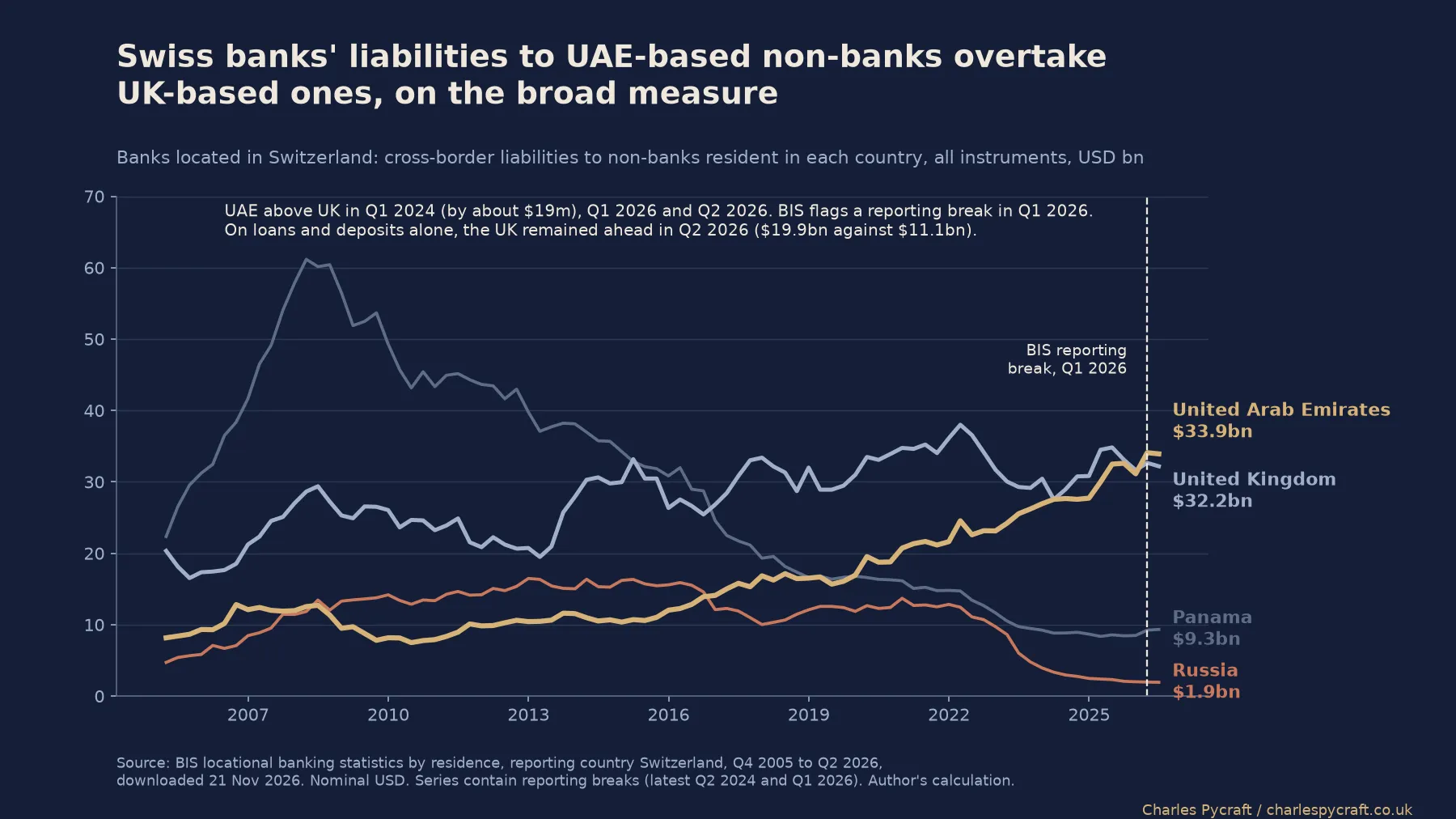
First, the UAE has edged past the UK in Swiss books. At the end of June 2026, banks located in Switzerland reported $33.9bn of cross-border liabilities to non-banks resident in the UAE and $32.2bn to those resident in the UK. The UAE drew fractionally ahead in early 2024, by about $19m, fell back, then led in the first two quarters of 2026: the first time it has led two quarters running since its series began in 1983. Since 2007 the UAE line has nearly trebled, from $12.0bn, while Panama's fell from $57.9bn to $9.3bn; since the end of 2021, Russia's has fallen from $12.8bn to $1.9bn. In this series, only Germany now ranks higher as an individual country counterparty.
Three qualifications belong here, not at the bottom. First, the BIS flags a reporting break in both series in the first quarter of 2026, the quarter the UAE moved ahead. Its figures adjusted for reporting breaks and exchange rate movements show changes that quarter of approximately $150m for UAE-resident non-banks and $320m for UK-resident non-banks. These suggest that most of the increase in outstanding liabilities reflected factors other than underlying transactions. The BIS describes such adjusted changes as approximations of underlying flows, not precise measures of transactions. Second, on loans and deposits alone, UK-resident non-banks remain well ahead, at $19.9bn against $11.1bn at the end of June 2026. The UAE's lead therefore arises outside that narrower measure, in liabilities whose precise composition cannot be established from the bilateral series used here. Third, the longer trend persists after adjustment for reported breaks and exchange rate movements: cumulative adjusted changes since the start of 2020 amount to approximately $13.7bn for UAE-resident non-banks and minus $1.8bn for UK-resident non-banks.
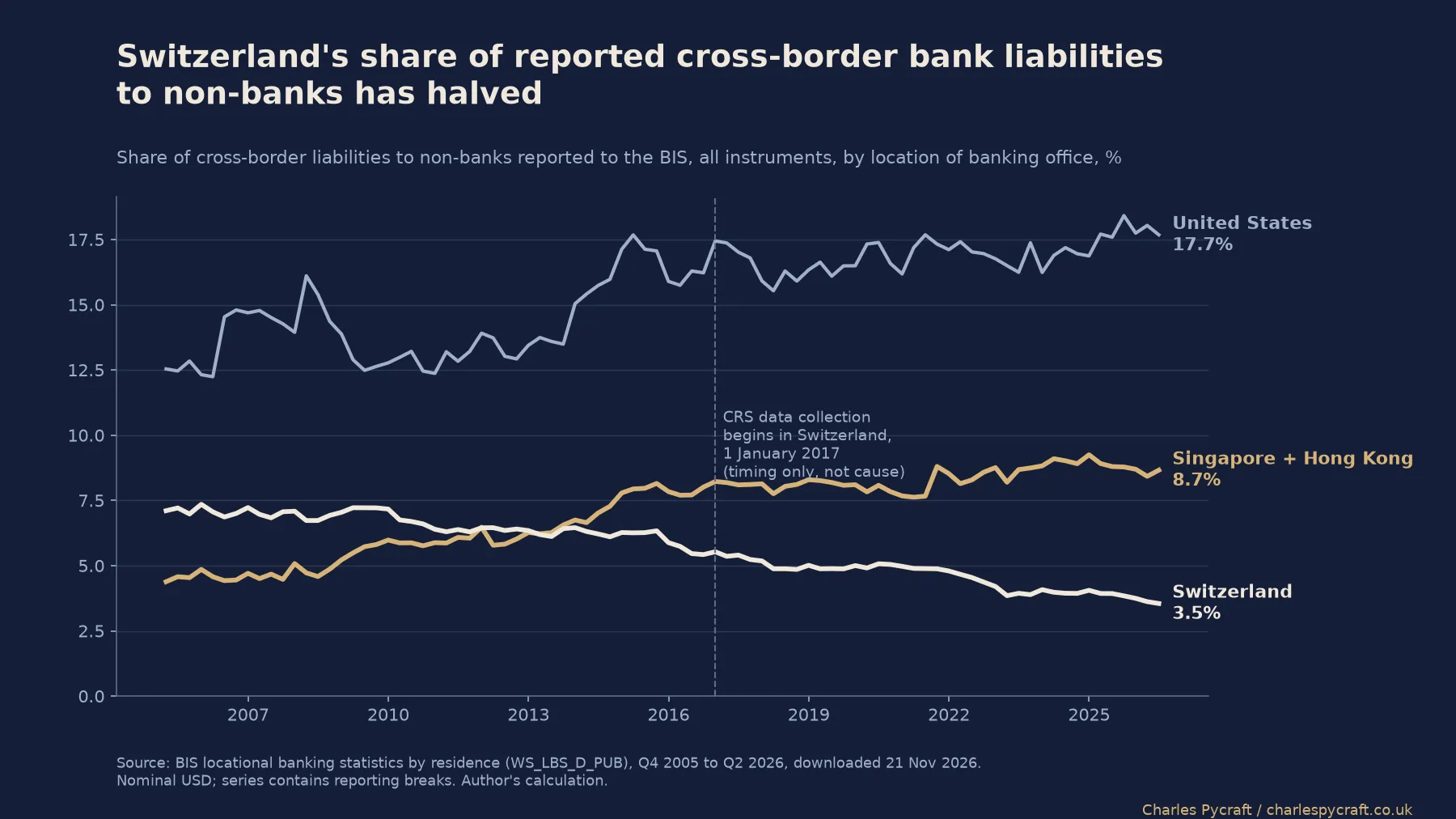
Second, Switzerland's share has halved. At the end of 2007, banks located in Switzerland accounted for 7.1 per cent of the cross-border liabilities to non-banks reported to the BIS. By June 2026 the figure was 3.5 per cent; on loans and deposits alone it fell from 7.5 to 2.1 per cent. The total for all reporting banks nearly doubled, from $7.7tn to $15.3tn, while the Swiss figure changed little in nominal dollars, from $548bn to $542bn. Hong Kong passed Switzerland in 2017 and Singapore in 2023; together they hold 8.7 per cent. The United States, at 17.7 per cent, has been the largest location since 2022. The Swiss series has several reporting breaks, so long comparisons are indicative.
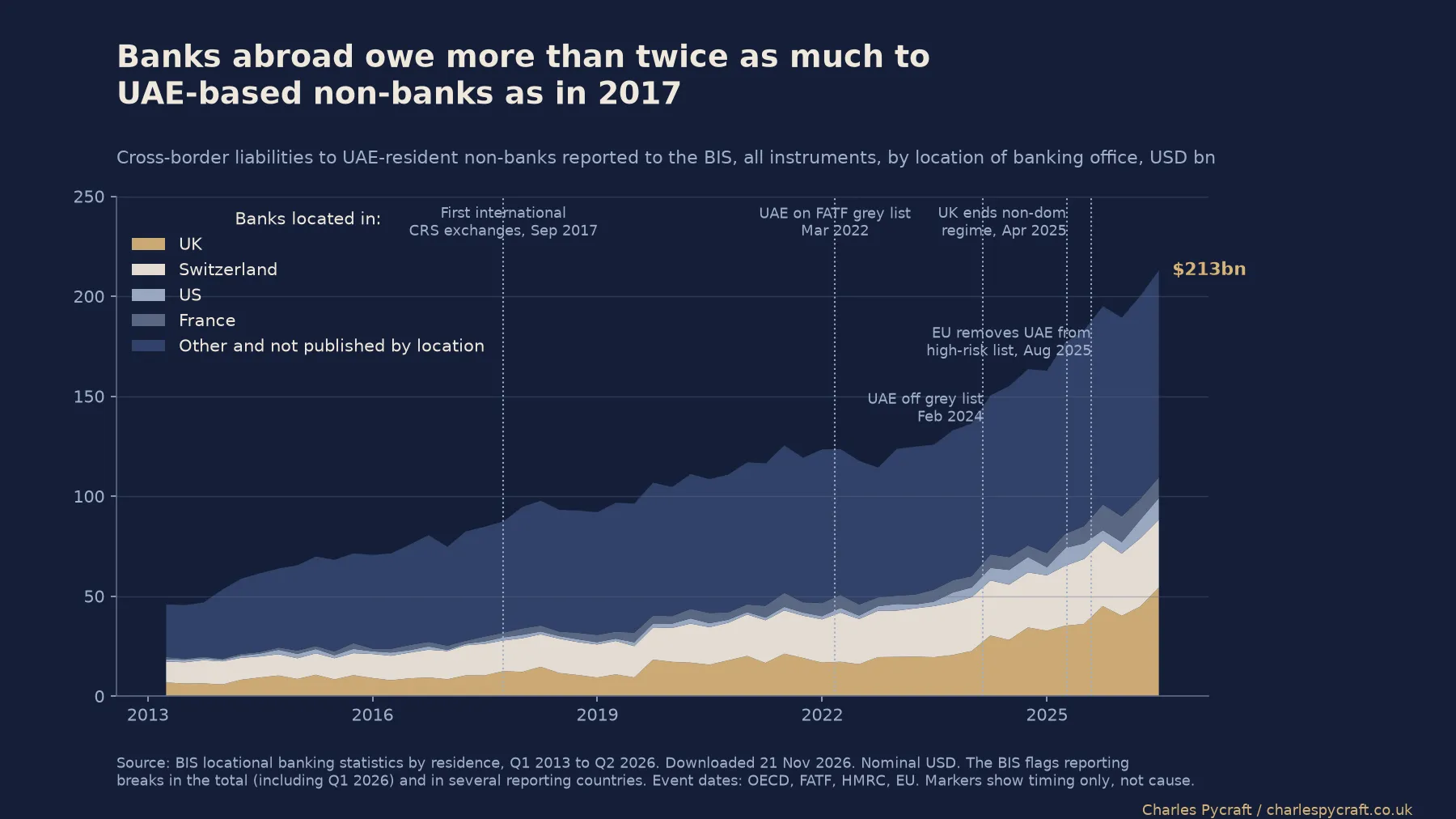
Third, the rise in UAE-resident balances is global. Banks in BIS reporting jurisdictions reported $213bn of liabilities to UAE-resident non-banks in June 2026, against $94.6bn at the end of 2017, the year of the first exchanges under the OECD's Common Reporting Standard (CRS). Cumulative adjusted changes since 2018 amount to approximately $131bn, suggesting that the increase cannot be explained by exchange rate movements and reported breaks alone. Of the jurisdictions that publish this breakdown, banks in the UK are the largest, up from $12.1bn to $54.3bn, including 54 per cent since the end of March 2025; about $80bn of the total is not published by location. Separately, on 6 April 2025 the UK replaced its domicile-based tax regime with residence-based rules; the data cannot show how much of the rise relates to former UK residents.
What the data cannot say
"Non-banks" covers companies, funds, public bodies and households; in the UAE that may include sovereign investment institutions, and the published Swiss figures do not separate them. The series follow residence, not money: a client who moves from London to Dubai and keeps a Zurich account switches lines without a franc moving. Positions are in US dollars, so currency moves change totals; the BIS revises back data and reporting can be reclassified. These are bank balance-sheet liabilities, not the client assets that make up most Swiss wealth management.
Other explanations include the UAE's economic and population growth, business activity and geopolitical uncertainty. In March 2026 Reuters reported that Swiss wealth managers expected more Gulf money after the outbreak of war with Iran, and that cash positions booked in Switzerland by private individuals and non-banks from the UAE had risen around 40 per cent over three years. Aggregate data cannot isolate any single factor. Nothing here suggests that any bank, client or government has acted unlawfully. Moving money across borders and changing one's country of residence can be entirely lawful.
What the transparency machine may be changing
The CRS has substantially improved transparency. The OECD's Global Forum says information on more than 171 million accounts, worth nearly 13 trillion euros, was exchanged in 2024. The EU Tax Observatory's Global Tax Evasion Report 2024, published in October 2023, estimated that automatic exchange had cut offshore tax evasion by a factor of about three over the previous decade; that households held about $12tn offshore at the end of 2022, 12 per cent of world GDP; and that Switzerland's share had fallen from almost half before 2008 to about 20 per cent as Asian centres rose.
Under the CRS, banks establish where account holders are tax resident through prescribed checks, including a self-certification, and report to their own tax authority for exchange. Residence rights alone do not establish tax residence or end obligations elsewhere. One feature of that design is particularly relevant here. Switzerland's official list of exchange partners shows the UAE as one of 13 "permanently non-reciprocal" jurisdictions: they send account information to their partners but do not receive it. That arrangement is permitted under the standard. It means that information about an account held directly by an individual whose sole tax residence is the UAE is not automatically transmitted by Switzerland to the UAE under the current bilateral CRS arrangement. Other applicable tax obligations and information exchange mechanisms remain unaffected. Applying the October 2026 list of permanently non-reciprocal jurisdictions retrospectively to the BIS data, their combined share of Swiss cross-border liabilities to non-banks rose from 13.6 per cent at the end of 2017 to 14.5 per cent in June 2026 (the list and method are in the note at the end). The UAE accounts for the whole of the net increase; the lines for the Bahamas and the Cayman Islands fell.
The UAE has also committed to implementing the amended Common Reporting Standard from 1 January 2027, with its first exchanges under the amended framework expected in 2028. The UAE Ministry of Finance confirmed this on 8 November 2025. The announcement does not itself establish that the UAE will become reciprocal.
The residence risk is not new. In October 2018 the OECD identified certain residence and citizenship by investment schemes, in jurisdictions including the UAE, as potentially high risk for CRS checks, because they combined low taxation of foreign financial income with limited physical presence; people use such schemes for many legitimate reasons. The OECD advises banks with doubts to ask how residence rights were obtained, whether the client holds residence elsewhere and where they last filed income tax returns. The Tax Justice Network flagged the gap in 2018, and a 2023 study in the Journal of Public Economics by Dominika Langenmayr and Lennard Zyska, also using BIS data, found that tax-haven deposits from countries that introduced citizenship by investment rose markedly afterwards. The figures here raise a related question; they do not show that the same mechanism explains the UAE's growth.
Property is a separate gap, outside the CRS. Using 2020 Dubai ownership data, EU Tax Observatory researchers found 227 Norwegian tax residents who owned property there; 66, or 29 per cent, had reported it on their wealth tax returns. Non-declaration is not by itself evidence of evasion, and the study names no one, but the report's phrase was "think of Dubai properties as the new Swiss bank accounts". In December 2025 the UK and others said they intend to join a new OECD framework for exchanging property information by 2029 or 2030.
In my view, automatic exchange has largely addressed the old problem of accounts hidden from foreign tax authorities. The next challenge sits where tax residence, non-reciprocal exchange and assets outside the reporting net meet. On that test, a transparency system built around the bank account is no longer enough on its own.
Switzerland's position
Switzerland's recent reforms deserve recognition. It has exchanged account data under the CRS since 2018, and on 1 October 2026 it opened a central, non-public register of the beneficial owners of companies and other legal entities, alongside revised anti-money laundering rules; existing entities have transition periods to report. The Tax Justice Network, a campaign group, ranks Switzerland second on its Financial Secrecy Index as at its 23 June 2026 update, behind the United States, with Singapore third, Hong Kong fourth and the UAE fifth, up from thirteenth in 2025. The ranking weights secrecy by the scale of services to non-residents, so Switzerland's place reflects size as well as secrecy, and it predates the Swiss register.
The OECD's Crypto-Asset Reporting Framework extends automatic exchange to reportable crypto-asset transactions. UK firms began collecting reportable data on 1 January 2026, with their first reports due by 31 May 2027. EU tax authorities must make their first exchanges by 30 September 2027. The UAE plans to implement the framework in 2027, with its first exchanges expected in 2028. Switzerland approved the legal foundations in 2025, and responsibility for selecting partner states now rests with the Federal Council. On 28 September 2026 the National Council declined to consider a separate partner-state decree. The State Secretariat for International Finance expects the Federal Council to approve partner jurisdictions by the end of November. Implementation cannot begin before 1 January 2027, meaning that Switzerland could begin collecting information a year after the UK and EU, on a timetable similar to that announced by the UAE.
England and Wales: trust law and the cost of recourse
In September 2025 the Law Commission's Fourteenth Programme carried forward a scoping study on modernising trust law, first agreed under its Thirteenth. It calls English trust law "an important global export", names Scotland, Jersey, New Zealand and Singapore among jurisdictions that have updated theirs, and excludes the law of mistake, which it notes has significant tax consequences. The Commission's website says the project has not yet started. That is a reasonable remit for a law reform body, but in my view the Government should explain how the competitiveness aim fits with tax enforcement and transparency policy.
Then there is who can afford to enforce trust law. Beneficiaries alleging a breach of trust may have limited access to affordable redress. The Financial Ombudsman Service has jurisdiction over specified financial activities, while legislation excludes certain activities undertaken by trustees from financial services regulation. The Legal Ombudsman can consider eligible complaints about authorised legal service providers, including complaints from beneficiaries, with compensation generally subject to a £50,000 limit. Trust law is ordinarily excluded from civil legal aid, subject to limited exceptions and exceptional case funding. Where litigation is necessary, the general rule is that the unsuccessful party pays the successful party's costs, although the court retains discretion. In my view, the cost and financial risk of enforcing trust rights can make those rights difficult to exercise in practice.
Five forecasts
These are scenario-based forecasts made on 21 November 2026, rather than model outputs. Each separately numbered or lettered prediction will be assessed individually. The financial ones use nominal US dollar positions, judged against the same BIS series as first published for the end of December 2027, with revisions, currency effects and reporting breaks disclosed; dollar thresholds are vulnerable to all three.
- Swiss books. (a) At the end of December 2027, on the all-instruments measure, banks in Switzerland will report larger liabilities to UAE-resident than to UK-resident non-banks. (b) Over the four quarters of 2027, cumulative BIS adjusted changes in the liabilities of banks located in Switzerland to UAE-resident non-banks will exceed the equivalent changes for UK-resident non-banks.
- The UAE total. At the end of December 2027, BIS reporting banks' liabilities to UAE-resident non-banks will exceed $250bn (June 2026: $213bn).
- London. On the same date, UK-located banks' liabilities to UAE-resident non-banks will exceed $60bn (June 2026: $54.3bn).
- The Swiss share. On the same date, banks in Switzerland will account for no more than 3.3 per cent of reported cross-border liabilities to non-banks, before rounding (June 2026: 3.5 per cent).
- What the rules will miss. (a) By 31 December 2027 the OECD will not have adopted a CRS amendment requiring continued reporting to a former country of tax residence after a move to a jurisdiction without general personal income tax. (b) On that date Switzerland will still list the UAE as permanently non-reciprocal.
I will assess the rule forecasts against decisions adopted by 31 December 2027 and publish all the results, including any forecasts that turn out to be wrong.
What would help
First, the OECD should examine a time-limited reporting tail after specified changes of tax residence, with clear legal authority and confidentiality safeguards. Second, governments should speed up and widen the property information framework. Third, before the trust law study begins, the UK Government should say who coordinates trust law reform, tax enforcement and transparency, and whether people harmed by a fiduciary's failure need a route to redress short of the High Court.
Methodology note
Data: BIS locational banking statistics by residence (dataflow WS_LBS_D_PUB), downloaded 21 November 2026, positions to the end of June 2026, nominal US dollars, amounts outstanding unless stated. Series keys: banks in Switzerland, cross-border liabilities to non-banks, all instruments, Q.S.L.A.TO1.A.5J.A.CH.N.{counterparty}.N; loans and deposits, Q.S.L.G.TO1.A.5J.A.CH.N.{counterparty}.N; adjusted changes (break and exchange rate adjusted), Q.F.L.A.TO1.A.5J.A.CH.N.{counterparty}.N; all reporting banks to UAE-resident non-banks, Q.S.L.A.TO1.A.5J.A.{reporter}.N.AE.N; reporting-country totals, Q.S.L.A.TO1.A.5J.A.{reporter}.N.5J.N. The BIS flags reporting breaks in the Swiss bilateral series in 2013, 2015, 2018, the second quarter of 2024 and the first quarter of 2026; long comparisons are indicative.
Non-reciprocal group: the 13 jurisdictions that Switzerland's partner list (State Secretariat for International Finance, as at 8 October 2026) marks as permanently non-reciprocal are Anguilla, the Bahamas, Bahrain, Bermuda, the British Virgin Islands, the Cayman Islands, Kuwait, the Marshall Islands, Nauru, New Caledonia, Qatar, the Turks and Caicos Islands and the UAE. The same list is applied to every quarter, retrospectively; it is not the group's historical membership. Anguilla and the British Virgin Islands are not published separately in the Swiss bilateral data, so the share is calculated over the other 11, held constant. Nauru has no published value for June 2026 (its December 2017 value was under $0.1m) and is counted as zero. The share is the group's sum divided by Swiss cross-border liabilities to non-banks in all countries.
Calculations are the author's. Data files and the calculation script are available on request.
Previous: The circuit: a game of snakes and ladders from Nassau to Zurich, Hong Kong and Dubai
Related: Dubai, Singapore and the new quiet rooms; Switzerland: how banking secrecy was built
Series overview: Offshore: the enabler chain
Sources
- Bank for International Settlements, locational banking statistics (WS_LBS_D_PUB), downloaded 21 November 2026: data.bis.org/topics/LBS
- State Secretariat for International Finance, automatic exchange of information, partner list as at 8 October 2026: www.sif.admin.ch/de/automatischer-informationsaustausch-aia
- State Secretariat for International Finance, automatic exchange of information on crypto-assets, 2 November 2026: www.sif.admin.ch/en/framework-for-the-automatic-exchange-of-informatio
- Swiss Parliament, business 25.052: www.parlament.ch/de/ratsbetrieb/suche-curia-vista/geschaeft?AffairId=2
- Swiss Federal Act on the Transparency of Legal Persons (SR 955.3): www.fedlex.admin.ch/eli/cc/2026/323/en
- UAE Ministry of Finance, commitment to implement the updated Common Reporting Standard, 8 November 2025: mof.gov.ae/en/news/ministry-of-finance-announces-the-uaes-commitment-t
- UAE Ministry of Finance, Crypto-Asset Reporting Framework guidance: mof.gov.ae/wp-content/uploads/2025/09/The-Crypto-Asset-Reporting-Frame
- EU Tax Observatory, Global Tax Evasion Report 2024: www.taxobservatory.eu/www-site/uploads/2023/10/global_tax_evasion_repo
- OECD Global Forum, Annual Report 2025: www.oecd.org/content/dam/oecd/en/networks/global-forum-tax-transparenc
- OECD, residence and citizenship by investment schemes: www.oecd.org/en/topics/sub-issues/international-standards-on-tax-trans
- Langenmayr and Zyska (2023), Journal of Public Economics: doi.org/10.1016/j.jpubeco.2023.104865
- Tax Justice Network, Financial Secrecy Index, updated 23 June 2026: fsi.taxjustice.net/full-list/
- Reuters, "Swiss money managers expect Iran war to increase inflows from Gulf", 13 March 2026: www.reuters.com/business/finance/swiss-money-managers-expect-iran-war-
- Joint statement on automatic exchange of information on immovable property, December 2025: www.gov.uk/government/publications/joint-statement-for-the-automatic-e
- HMRC, reporting cryptoasset user and transaction data: www.gov.uk/guidance/reporting-cryptoasset-user-and-transaction-data
- European Commission, DAC8: taxation-customs.ec.europa.eu/taxation/tax-transparency-cooperation/ad
- HM Treasury and HMRC, changes to the taxation of non-UK domiciled individuals: www.gov.uk/government/publications/changes-to-the-taxation-of-non-uk-d
- Law Commission, Fourteenth Programme of Law Reform, paras 3.49 to 3.51: assets.publishing.service.gov.uk/media/68b95657b0a373a01819fdec/14th_p
- Law Commission, upcoming projects: lawcom.gov.uk/upcoming-projects/
- FCA Handbook, DISP 2: handbook.fca.org.uk/handbook/disp2
- Financial Services and Markets Act 2000 (Regulated Activities) Order 2001, article 66: www.legislation.gov.uk/uksi/2001/544/article/66
- Legal Services Act 2007, section 138: www.legislation.gov.uk/ukpga/2007/29/section/138
- LASPO 2012, Schedule 1 Part 2: www.legislation.gov.uk/ukpga/2012/10/schedule/1/part/2/enacted
- LASPO 2012, section 10 (exceptional cases): www.legislation.gov.uk/ukpga/2012/10/section/10
- Civil Procedure Rules, Part 44: www.justice.gov.uk/courts/procedure-rules/civil/rules/part44
- FATF, jurisdictions under increased monitoring, February 2024: www.fatf-gafi.org/en/publications/High-risk-and-other-monitored-jurisd
- EU Delegated Regulation 2025/1184: eur-lex.europa.eu/eli/reg_del/2025/1184/oj/eng
Sources
- https://data.bis.org/topics/LBS
- https://www.sif.admin.ch/de/automatischer-informationsaustausch-aia
- https://www.sif.admin.ch/en/framework-for-the-automatic-exchange-of-information-aeoi-on-crypto-assets
- https://www.parlament.ch/de/ratsbetrieb/suche-curia-vista/geschaeft?AffairId=20250052
- https://www.fedlex.admin.ch/eli/cc/2026/323/en
- https://mof.gov.ae/en/news/ministry-of-finance-announces-the-uaes-commitment-to-implement-the-updated-common-reporting-standard-crs-2-0/
- https://mof.gov.ae/wp-content/uploads/2025/09/The-Crypto-Asset-Reporting-Framework-Guidance-document-EN.pdf
- https://www.taxobservatory.eu/www-site/uploads/2023/10/global_tax_evasion_report_24.pdf
- https://www.oecd.org/content/dam/oecd/en/networks/global-forum-tax-transparency/global-forum-annual-report-2025.pdf
- https://www.oecd.org/en/topics/sub-issues/international-standards-on-tax-transparency/residence-citizenship-by-investment.html
- https://doi.org/10.1016/j.jpubeco.2023.104865
- https://fsi.taxjustice.net/full-list/
- https://www.reuters.com/business/finance/swiss-money-managers-expect-iran-war-increase-inflows-gulf-2026-03-13/
- https://www.gov.uk/government/publications/joint-statement-for-the-automatic-exchange-of-information-on-immovable-property
- https://www.gov.uk/guidance/reporting-cryptoasset-user-and-transaction-data
- https://taxation-customs.ec.europa.eu/taxation/tax-transparency-cooperation/administrative-co-operation-and-mutual-assistance/directive-administrative-cooperation-dac/dac8_en
- https://www.gov.uk/government/publications/changes-to-the-taxation-of-non-uk-domiciled-individuals
- https://assets.publishing.service.gov.uk/media/68b95657b0a373a01819fdec/14th_programme_-_with_covers_for_web_and_digital_laying.pdf
- https://lawcom.gov.uk/upcoming-projects/
- https://handbook.fca.org.uk/handbook/disp2
- https://www.legislation.gov.uk/uksi/2001/544/article/66
- https://www.legislation.gov.uk/ukpga/2007/29/section/138
- https://www.legislation.gov.uk/ukpga/2012/10/schedule/1/part/2/enacted
- https://www.legislation.gov.uk/ukpga/2012/10/section/10
- https://www.justice.gov.uk/courts/procedure-rules/civil/rules/part44
- https://www.fatf-gafi.org/en/publications/High-risk-and-other-monitored-jurisdictions/Increased-monitoring-february-2024.html
- https://eur-lex.europa.eu/eli/reg_del/2025/1184/oj/eng